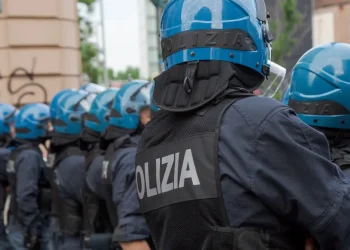
From Friday through Sunday, teenage rioters attacked police officers, looted stores, and wreaked havoc in city centers across several Italian cities. Milan was hit the hardest: Following Saturday’s riots, hundreds of youths—most of them minors—returned to the area around the cathedral on Sunday afternoon and smashed store windows again. According to the ANSA news agency, by evening the police had taken 160 of them to the Questura for identification; about 80 % of them were minors.
The violence erupted during protests against rising prices, high gas prices, and low wages, which had been called for in about a dozen cities. Police and the media describe the perpetrators primarily as very young men from the suburbs who organized through social media and are known in Italy as „Maranza.“ Nationwide, police reported 197 individuals identified, 28 arrests—including 12 minors and 6 foreign nationals—and 43 charges filed on Saturday alone.
The Riots in Italy, by City
| City and Day | Figures according to the authorities |
|---|---|
| Milan Saturday | 72 people taken to the police headquarters, 17 arrests, 22 charges filed, 104 law enforcement officers injured |
| Milan Sunday | 160 people were taken to the Questura by 7 p.m., about 80 of whom were minors; later, the number rose to over 200 |
| Bologna Saturday | 5 arrests, including 4 minors; 7 charges filed; approximately 50 people identified; 75 first responders injured |
| Turin Saturday | 12 people carrying Molotov cocktails and projectiles were stopped, 10 of whom were minors; 4 were arrested, and 5 were charged |
| Verona Saturday | About 200 teenagers in the Old Town; 5 were taken to the police headquarters, 4 of whom were minors |
| Rome Friday | Student protest with over 5,000 participants; explosive devices and firecrackers thrown at police and the Ministry of Education |
As of October 18, 2026, 10:00 p.m. · Information provided by the police headquarters in Milan, Bologna, Turin, and Verona, ANSA, Il Fatto Quotidiano, and Open.
What happened in Milan on Sunday?
Less than 24 hours after Saturday’s riots, the youths arranged to meet again in Piazza del Duomo via social media. According to the local news site MilanoToday, around 2,000 young people gathered in the city center, most of them dressed in black, many wearing hoods and with their faces covered. According to various, consistent reports, they moved in groups of 10 to 20 people.
On Via Torino, youths looted a Carrefour supermarket and threw chairs, tables, and barricades at the storefronts of other shops. Near Piazza Cordusio, the Under Armour and Levi’s stores were ransacked; the perpetrators smashed the window of the Levi’s store with the handlebars of an e-scooter. A Decathlon store and restaurants on Corso Garibaldi were also attacked, and trash containers were set on fire at Piazza Cordusio.
The police used water cannons and tear gas after stones, bottles, and explosive devices were thrown at the officers. In the evening, further clashes broke out on Corso Vittorio Emanuele and in Piazza San Babila. The Galleria Vittorio Emanuele II was cordoned off, and the cathedral closed early to visitors. Milan’s public transit authority, ATM, rerouted numerous lines.
Among those detained on Sunday were several teenagers who had already been identified on Saturday. Interior Minister Matteo Piantedosi met with the police chief and top officials from the Interior Ministry that afternoon; Milan’s Questor Bruno Megale joined the meeting via video conference.
How did a protest against rising prices turn into a street battle?
Milan
On Saturday afternoon, about 5,000 people gathered in Piazza del Duomo for the „Italia in piazza“ rally against rising prices, gas prices, and the tax burden. The police department had been informed and had not classified the event as dangerous in advance, as reported by Sky TG24. Bottles were already being thrown at the police on Via Broletto, and later the clashes shifted to the cathedral square.
The attackers took advantage of the square’s size to launch brief assaults using rocks and barricades, then quickly retreated. They set fire to a portable toilet at a construction site, vandalized a Carabinieri vehicle, and stormed a Foot Locker store on Corso Vittorio Emanuele. The M1 and M3 subway stations were closed. In Milan According to ANSA, police fired 484 tear gas canisters on Saturday.
The Milan Police Headquarters reported a total of 72 people brought in for questioning, 17 arrests, and 22 charges filed. According to MilanoToday, those arrested included 7 Italian adults, 5 foreigners, and 5 minors. 104 police officers and Carabinieri were injured, none critically. In addition, dozens of demonstrators were injured. The trade association Confcommercio Milano estimates that damage and lost revenue in the city center amounted to more than half a million euros.
Bologna
In Bologna, a protest march set off from Piazza Minghetti. According to *Il Resto del Carlino*, around 300 youths broke away from the main march and attacked the central train station starting around 4:15 p.m. For an extended period, travelers were only able to leave the station via Via Carracci. The rioters threw flares, glass bottles, rocks, and barricades; they defaced the side wall of the Basilica of San Petronio and vandalized a fast-food restaurant inside the station.
The riots continued into the night along Via Matteotti, through Montagnola Park, and across Piazza Lucio Dalla. The police headquarters most recently reported 75 injured officers, twelve damaged police vehicles, five arrests—including four 16- and 17-year-olds—seven charges filed, and approximately 50 people identified. According to the broadcaster èTV, officers found a knife with an 18-centimeter blade on a 16-year-old girl who was arrested.
Bologna Mayor Matteo Lepore called the scenes unacceptable and urged the young people to isolate the perpetrators of violence within their own ranks. Whether the march was authorized is a matter of dispute: Lepore stated that, according to his information, it had not been authorized, while the organizers claim it was an authorized rally and distanced themselves from the damage.
Turin
In Turin, the rally had been announced as „apolitical and nonpartisan.“ According to the Questura, individuals other than the organizers took the lead of the march and directed it toward the Porta Nuova train station. There, a group stormed into the Feltrinelli bookstore and threw books and shelves to the ground. In Piazza Castello and on Via Po, police used water cannons and tear gas.
Police detained twelve people—ten of whom were minors—in possession of Molotov cocktails, homemade firecrackers, paving stones, and emergency hammers. According to Torino Cronaca, three teenagers between the ages of 15 and 17 were arrested for manufacturing a weapon of war, as they are alleged to have made Molotov cocktails. The Questura reported that police officers were injured in Turin No.
Verona and Bergamo
In Verona On Saturday afternoon, about 200 young people gathered in Piazza Bra, right in the middle of the weekend strolls of many families. Firecrackers exploded in Piazza Pradaval, trash cans went up in flames, and traffic signs were torn down, according to the local newspaper L’Arena. Around 6:30 p.m., a group of CasaPound activists showed up there, and the police separated the two sides with an operation. The Questura refers to vandalism, but makes no mention of brawls or burning trash containers. Five youths, four of whom were minors, were taken to the Questura. Sky TG24 also reported incidents in Bergamo where stones and firecrackers were thrown at the police.
How did the riots begin on Friday?
The protests began on Friday with student strikes in several cities. In Rome, according to police, more than 5,000 students marched to the Ministry of Education on Viale Trastevere; organizers put the number at 20,000. On Via Marmorata, about 20 masked participants pushed trash containers into the street and threw firecrackers and explosive devices at the police, Il Fatto Quotidiano reported. Bottles, eggs, and firecrackers were thrown in front of the ministry, and powder from a fire extinguisher was sprayed onto the stairs. Participants burned U.S. and Israeli flags. According to ANSA, the march ended in Testaccio without further incidents. In Turin, three minors were arrested on the sidelines of the student strike.
Who are the Maranza?
„Maranza“ is an Italian slang term for young people who hang out in groups wearing tracksuits, brand-name clothing, and fanny packs, and who are associated with petty crime. The word is derogatory and is often used to refer to second-generation immigrants from the suburbs.
The picture painted by the authorities of the weekend is more mixed. According to the police, as reported by Sky TG24 and Business.it, among others, the young people came from the suburbs, the Milan area, and other provinces, organizing themselves into small groups. Many are said to be second- or third-generation immigrants, but just as many are Italian by birth and family background. The surnames of those detained include numerous Italian ones. Il Post reports that there is no evidence of political affiliation or central coordination. The gatherings were arranged via TikTok, Instagram, and messaging apps.
According to police and media reports, in Turin and Bologna, the youths mingled with groups from the left-wing autonomous scene and the Centri sociali. The rally in Milan was organized by the network „Italia in piazza,“ which has only been active on Instagram since October 4. At the same time, riots and looting also broke out in France, and President Emmanuel Macron announced on Sunday that he would ban certain gatherings if necessary.
Names and addresses of suspected rioters are now circulating on social media, accompanied by threats, as reported by Il Giorno. The authorities have not yet commented on the matter.
What is the government planning to do about the violence?
Prime Minister Giorgia Meloni has convened a summit on public order at Palazzo Chigi for Monday, October 19. According to AGI and L’Edicola, Deputy Prime Ministers Matteo Salvini and Antonio Tajani, Interior Minister Piantedosi, Defense Minister Guido Crosetto, and the heads of the intelligence services and police are expected to attend. Meloni had stated that protesting is a right, but setting cities on fire is not. She called on the opposition to condemn the violence unequivocally.
Several proposals are on the table. The League wants to fast-track parts of a security bill currently under debate in the Senate via an emergency decree: preventive detention for minors as well, bans on gatherings for participants in group violence, and a new criminal offense of collective property damage. Salvini is also calling for a security deposit for organizers of high-risk rallies, as well as greater leeway for police officers in the use of water cannons and Tasers. Tajani is demanding an increased military presence as part of the „Strade Sicure“ initiative in Milan. According to L’Edicola, the majority is also considering an expedited procedure modeled after the 2023 Caivano Decree, which had already tightened the rules for juvenile offenders. In Italy, juveniles are criminally liable starting at age 14.
Milan Mayor Giuseppe Sala condemned the violence but accused the Ministry of the Interior of underestimating the situation. On Saturday, he said, only about 200 police officers were on duty—too few to deal with groups that quickly split up. Piantedosi rejected this claim and spoke of a reflexive reaction from a “radical-chic” left that is unable to condemn perpetrators of violence without reservations. Senate President Ignazio La Russa dismissed the alleged shortage of personnel as nonexistent.
PD leader Elly Schlein emphasized that her party had nothing to do with the perpetrators of violence, but that they should not be allowed to drown out the protests of thousands of peaceful people. The leader of the Five Star Movement, Giuseppe Conte, called on the government not to deny the causes of the anger. The +Europa party is demanding that Piantedosi report to Parliament.
What happens next?
Monday's summit is intended to determine whether the government will act by decree or fast-track the security bill through the Senate. In Turin, organizers have already announced additional rallies for October 24 and 30, while in Rome, groups of students are planning a gathering on Friday, October 23, to continue their protests. In Milan, according to ANSA, authorities are expecting further gatherings of young people in the city center.
Travelers in Milan, Bologna, and Turin should expect road closures around the cathedral, the Galleria, and the main train stations, as well as closed metro stations and rerouted bus and tram lines over the coming weekends. The latest updates are being posted by the transit authorities ATM in Milan, TPER in Bologna, and GTT in Turin.