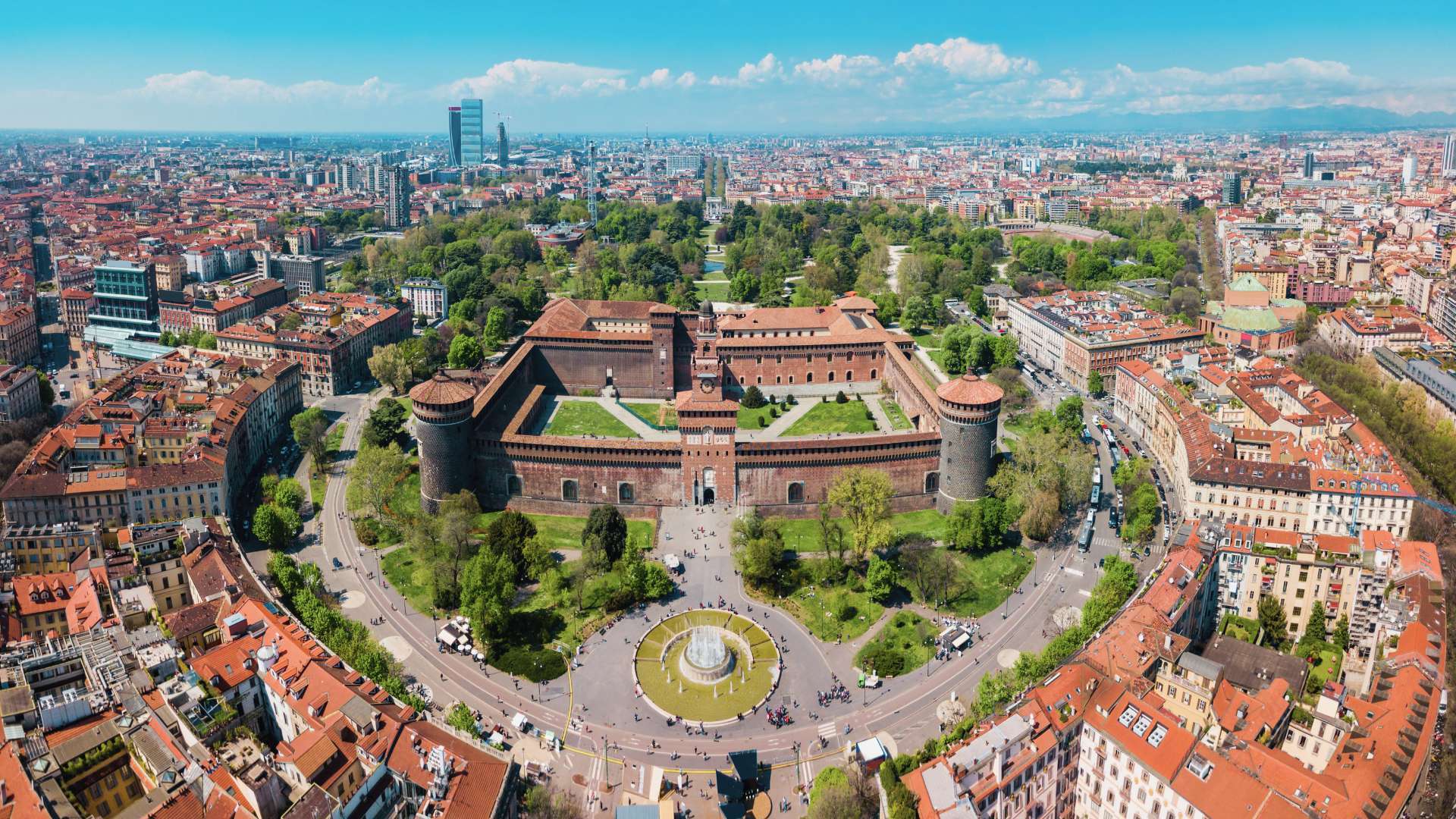

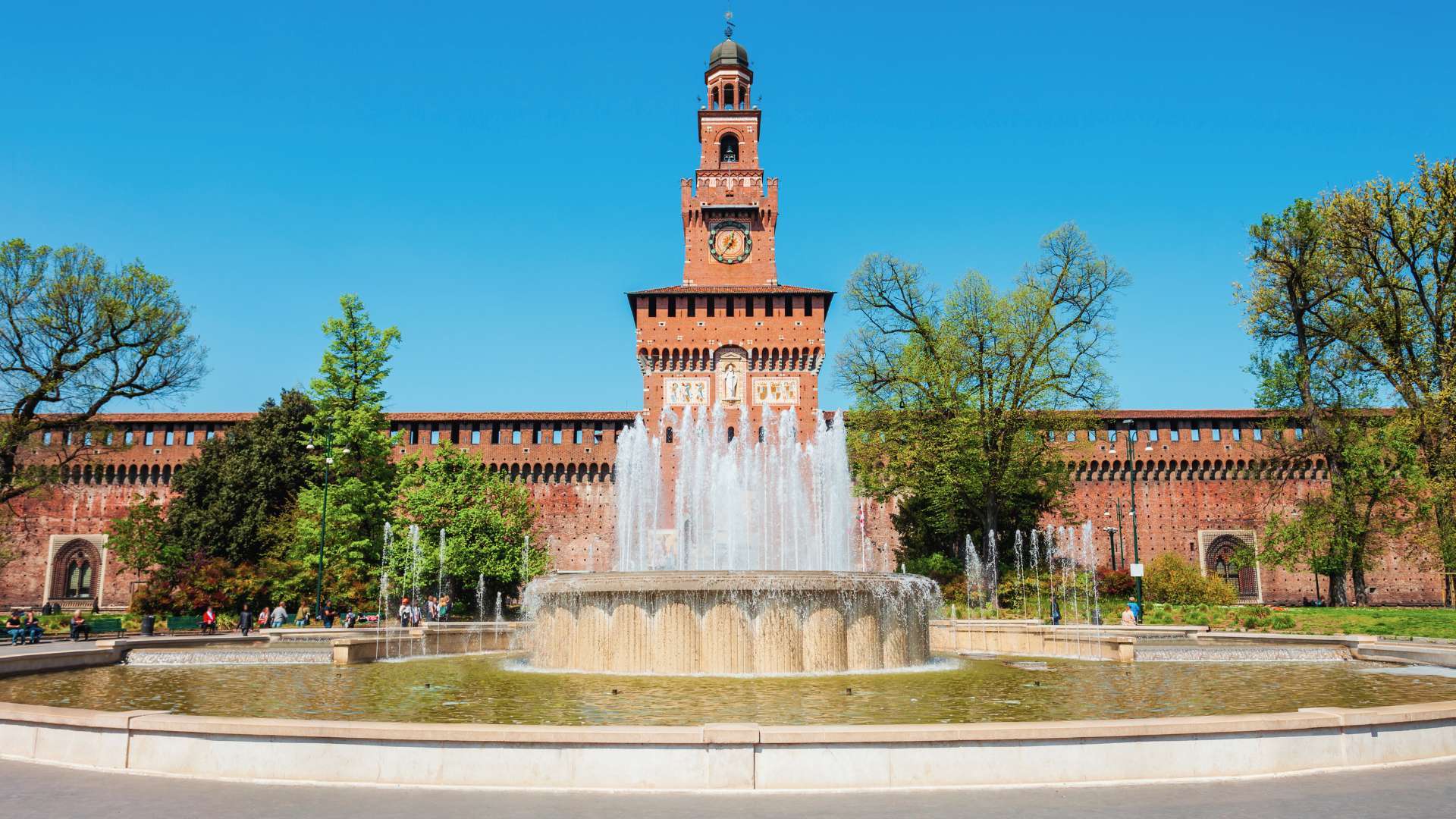
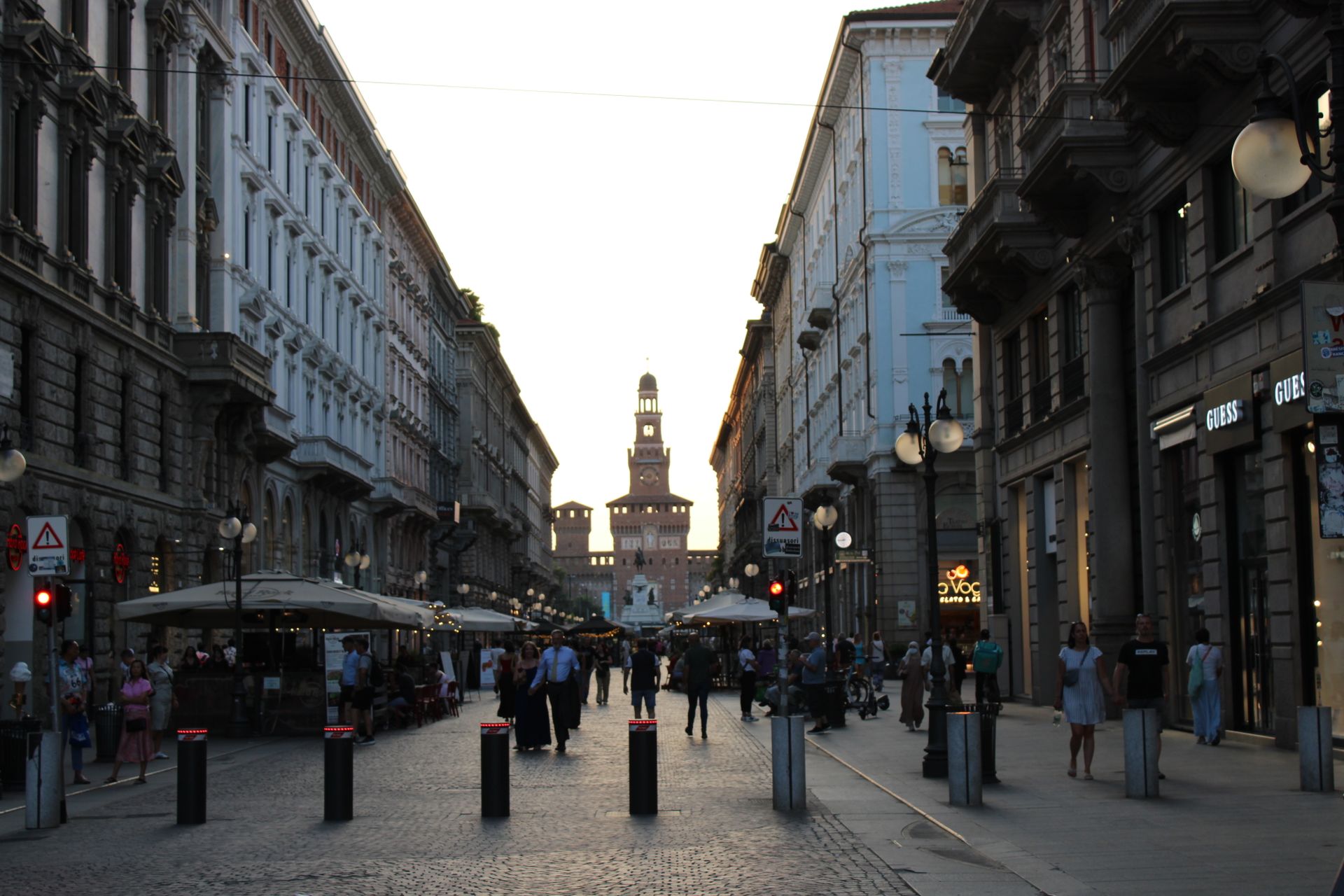
Milan – If you walk northwest from the cathedral through the pedestrian zone, after a quarter of an hour you’ll find yourself in front of a red-brick tower. Behind it lies the Castello Sforzesco, the castle that Galeazzo II Visconti, lord of Milan, began building in 1360 and that military leader Francesco Sforza made the residence of his ducal family beginning in 1450. Today, the city of Milan displays its art collections here, including Michelangelo’s last sculpture, the Pietà Rondanini: A ticket for all museums costs €10.00; they are open Tuesday through Sunday from 10:00 a.m. to 5:30 p.m., and you can enter the castle courtyards every day for free.
Here you'll learn what lies behind the gate tower, what masterpieces await you in the museums, what you'll see along the battlements, and how to get there without any detours. Our guide to the city's other highlights provides an overview of the Sights in Milan, the [name] lists all the attractions in the region Lombardy Travel Guide.
The Castello Sforzesco in Numbers
The Castello Sforzesco is owned by the City of Milan and houses its art collections, which Public Art Collections. One ticket is valid for all museums in the castle, including the Pietà Rondanini, You have to pay extra for the battlements. The courtyards are open to the public.
As of October 2026 · Information provided by Castello Sforzesco (Comune di Milano).
What is the Castello Sforzesco?
The Castello Sforzesco is the castle of the two families that ruled Milan in the late Middle Ages and during the Renaissance—first the Visconti, then the Sforza. It all began with Galeazzo II Visconti, who between 1360 and 1370 had a fortress built atop the medieval city wall, at which Porta Giovia, a small city gate. His successors expanded it into a square castle with sides measuring about 180 meters and four corner towers—the largest the Visconti ever built. When Filippo Maria, the last Visconti, died without a son in 1447, the people of Milan called upon the Repubblica Ambrosiana ...a short-lived city-state, and damaged parts of the hated castle.
On March 25, 1450, the military commander Francesco Sforza, son-in-law of the last Visconti, was celebrated as the city’s new ruler alongside his wife, Bianca Maria Visconti, and immediately began rebuilding the castle. Beginning in 1452, the Florentine architect Antonio Averulino, known as Filarete, designed the facade facing the city, including the tall gate tower. He was soon replaced, and the military architect Bartolomeo Gadio added two round corner towers in front of it, clad in gray, sharply hewn stone blocks. To this day, they dominate the Castle Square, the semicircular square in front of the castle.
Starting in 1468, Galeazzo Maria Sforza, Francesco's eldest son, lived in the Castello with his wife, Bona di Savoia. Within a few years, the Rocchetta, the fortified core of the complex, and the Corte Ducale with the duke's living quarters. His brother Ludovico Sforza, known as il Moro, ...later brought the architects Donato Bramante and Leonardo da Vinci to a court that was among the most magnificent in Europe. In 1499, the French advanced, and Ludovico fled. Afterward, the Castello served as a barracks for foreign troops for over three centuries—from the Spanish in 1535 until the Austrians withdrew in 1859.
The Torre del Filarete is a tower built in 1905
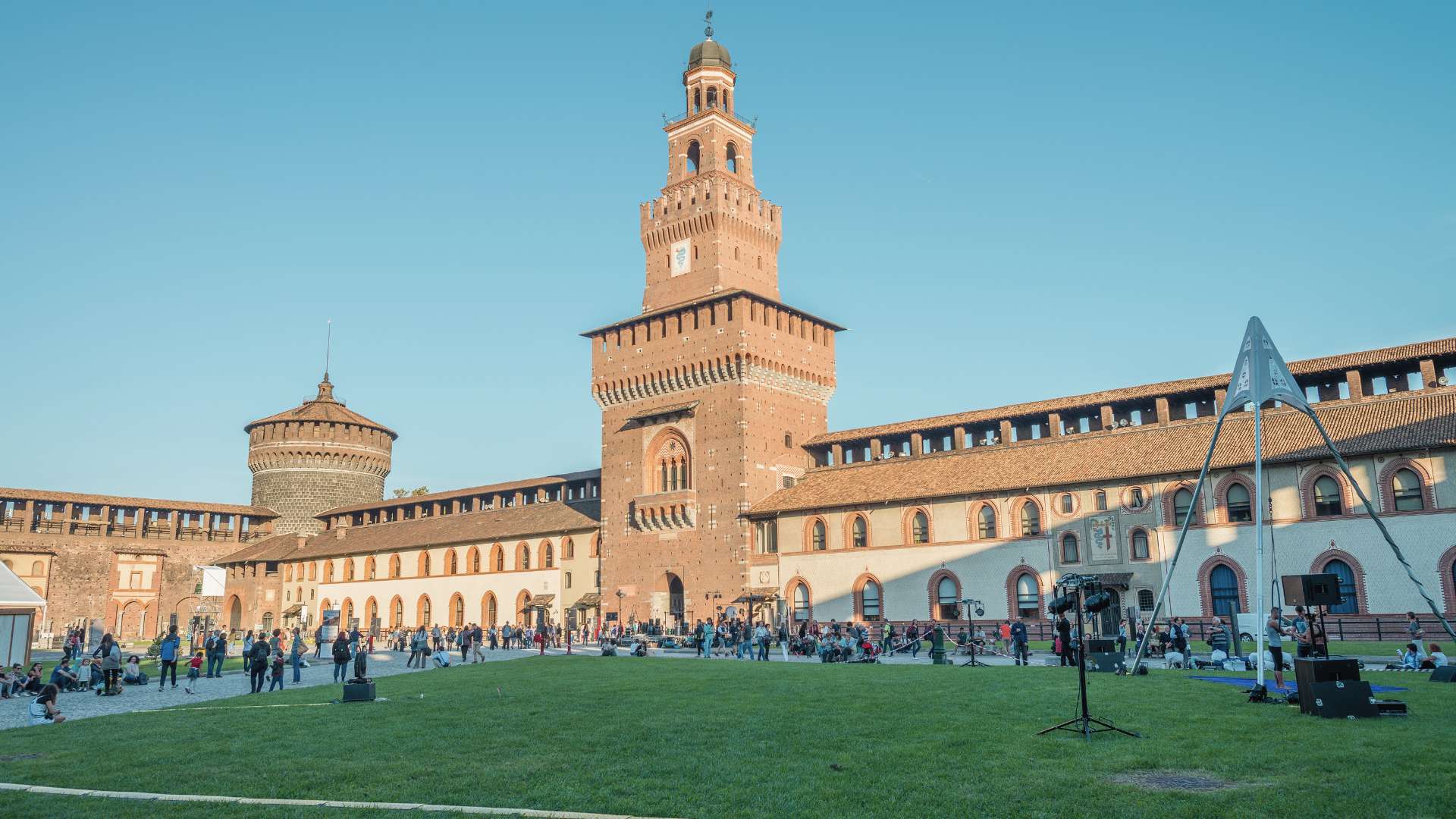
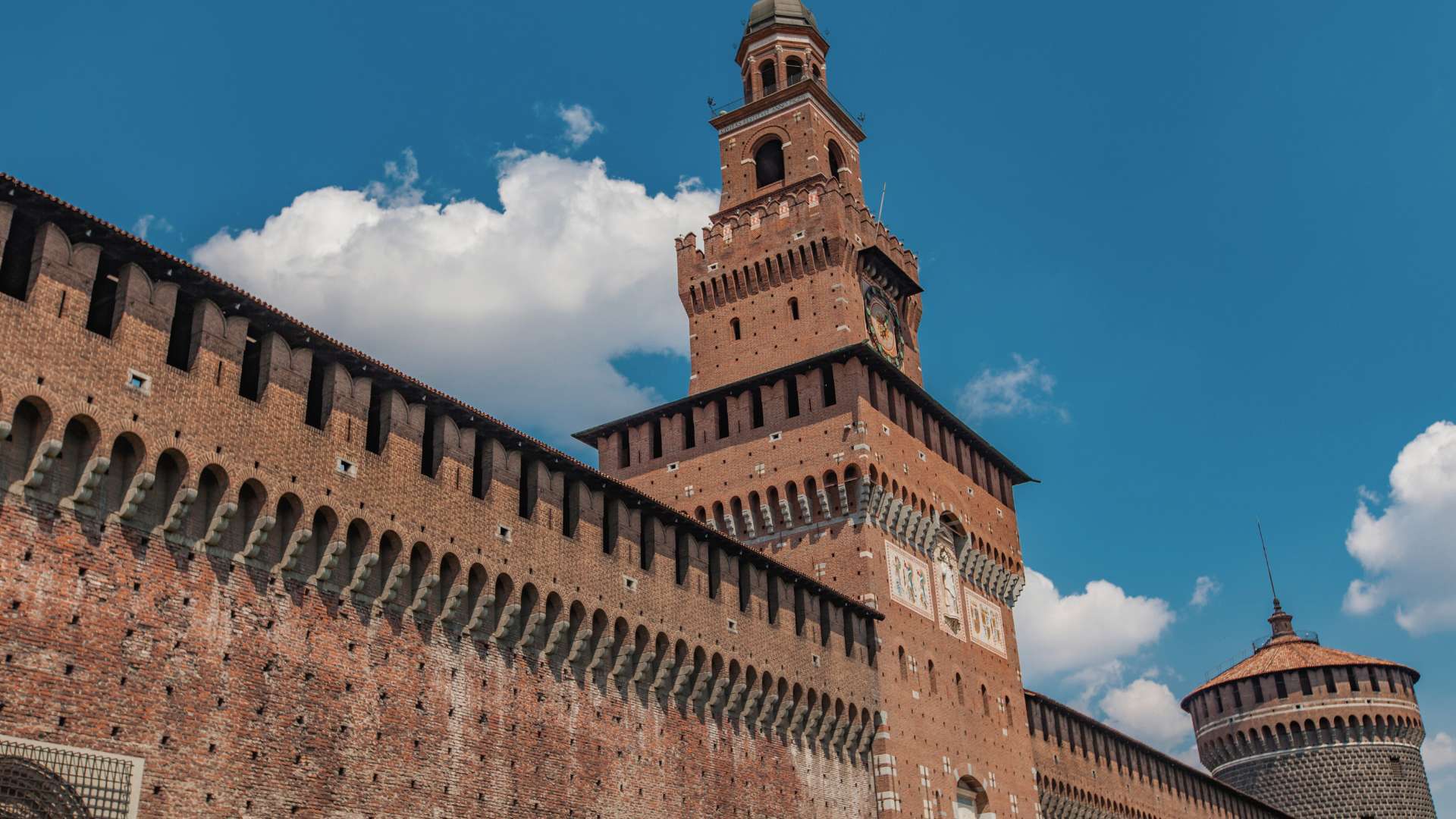
The Filarete Tower, The gate tower, through which you enter the Castello, is newer than it looks. Filarete designed it in 1452, and Lombard master builders constructed it. Under French rule, it served as a powder magazine, and in June 1521, it exploded and collapsed. For nearly four centuries afterward, the castle stood without its gate tower.
The current tower was built by the Milanese architect Luca Beltrami, who began restoring the dilapidated barracks in 1893 and turned it into a museum. He based his design on old documents and a painting from Leonardo’s circle, the Madonna Lia, which now hangs in the castle's art gallery, and a wall carving at a country estate outside the city, which Cascina Pozzobonelli. In 1895, Beltrami had a full-scale wooden model erected; on September 24, 1905, the tower was inaugurated and dedicated to King Umberto I, who had been assassinated in Monza five years earlier.
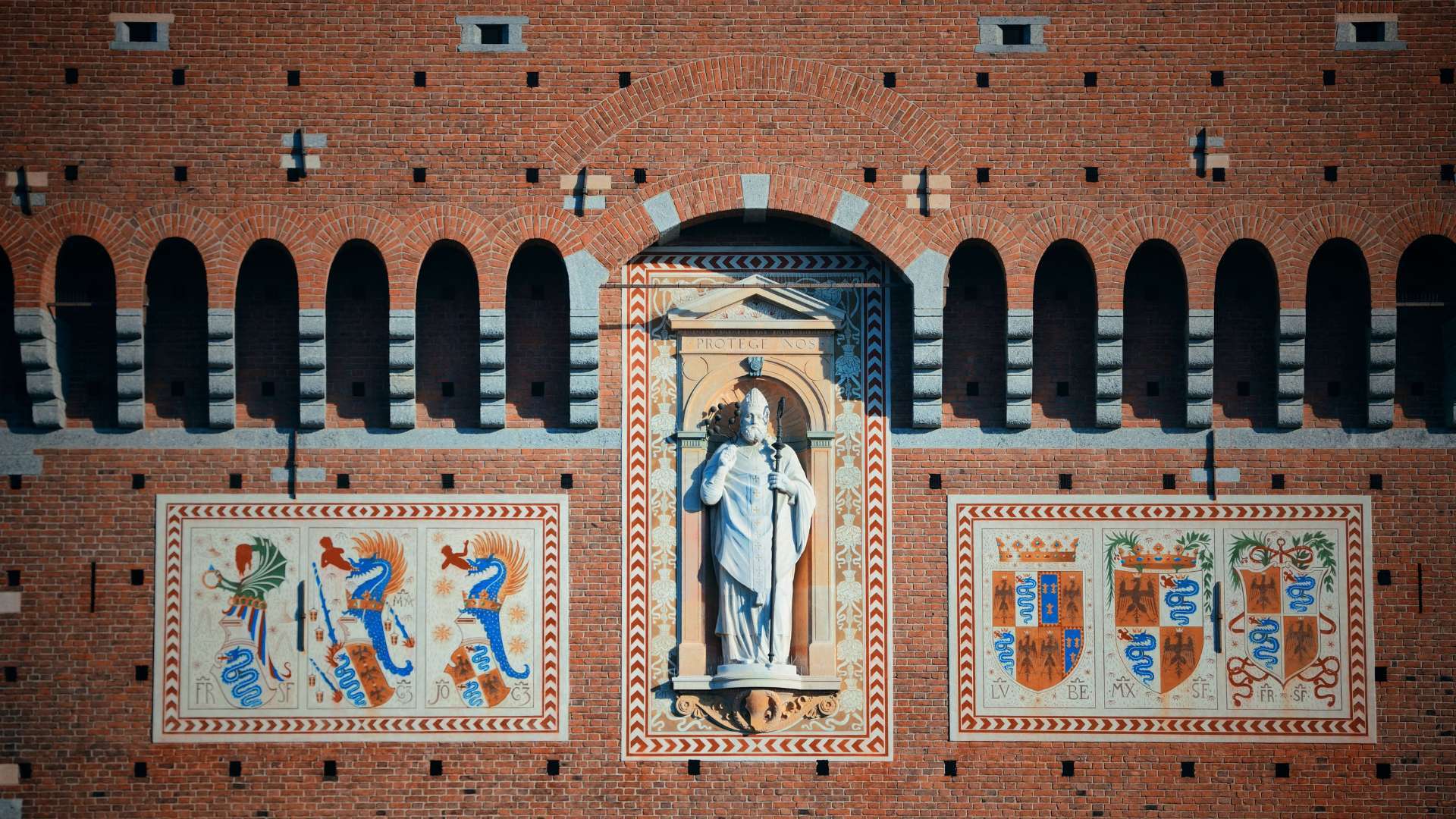
As you walk through, look up. In the niche on the front of the tower stands a statue of Saint Ambrose, the patron saint of Milan, by the sculptor Luigi Secchi; next to it are the painted coats of arms of the Sforza dukes, from Francesco to Francesco II. Further up is a clock featuring a sunburst, a symbol of the Sforza family. During the most recent restoration, the names of the eight winds, carved into the octagonal lantern, were revealed: Beltrami had apparently envisioned the structure as a Tower of the Winds. The gate tower now also houses the Castello’s information center, located on the right as you approach from the Castle Square you'll come.
Three farms you can visit without a ticket
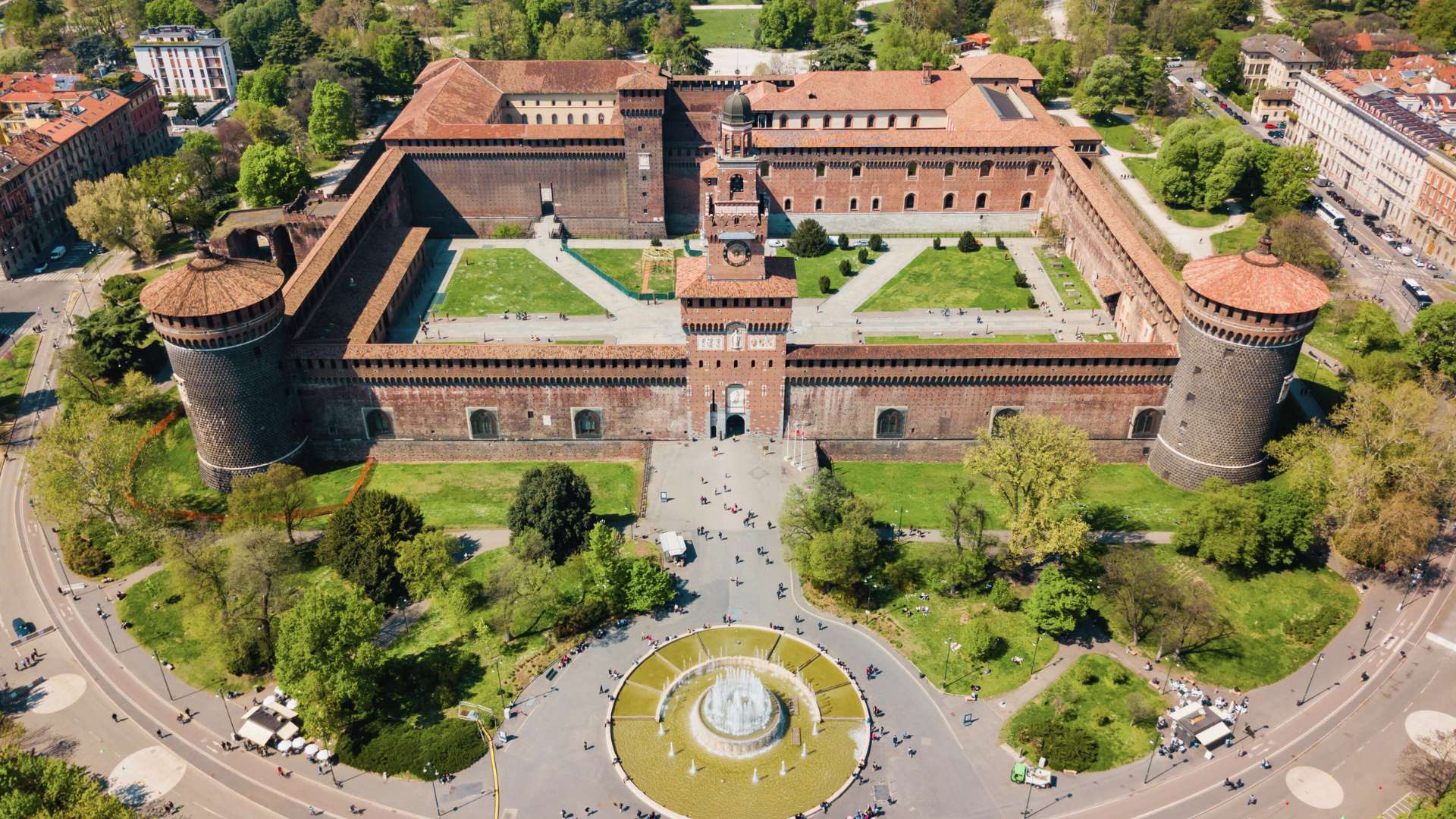
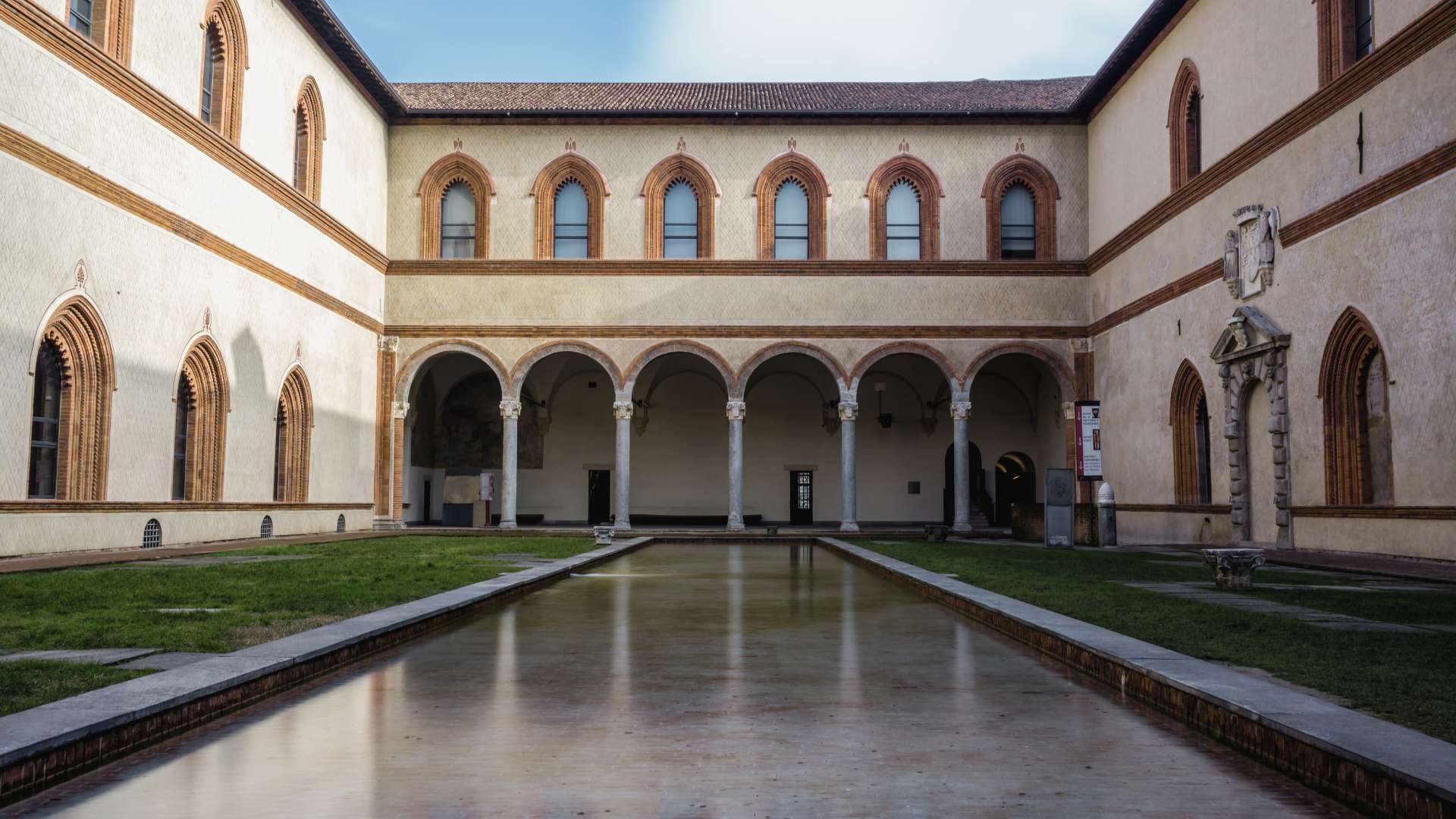
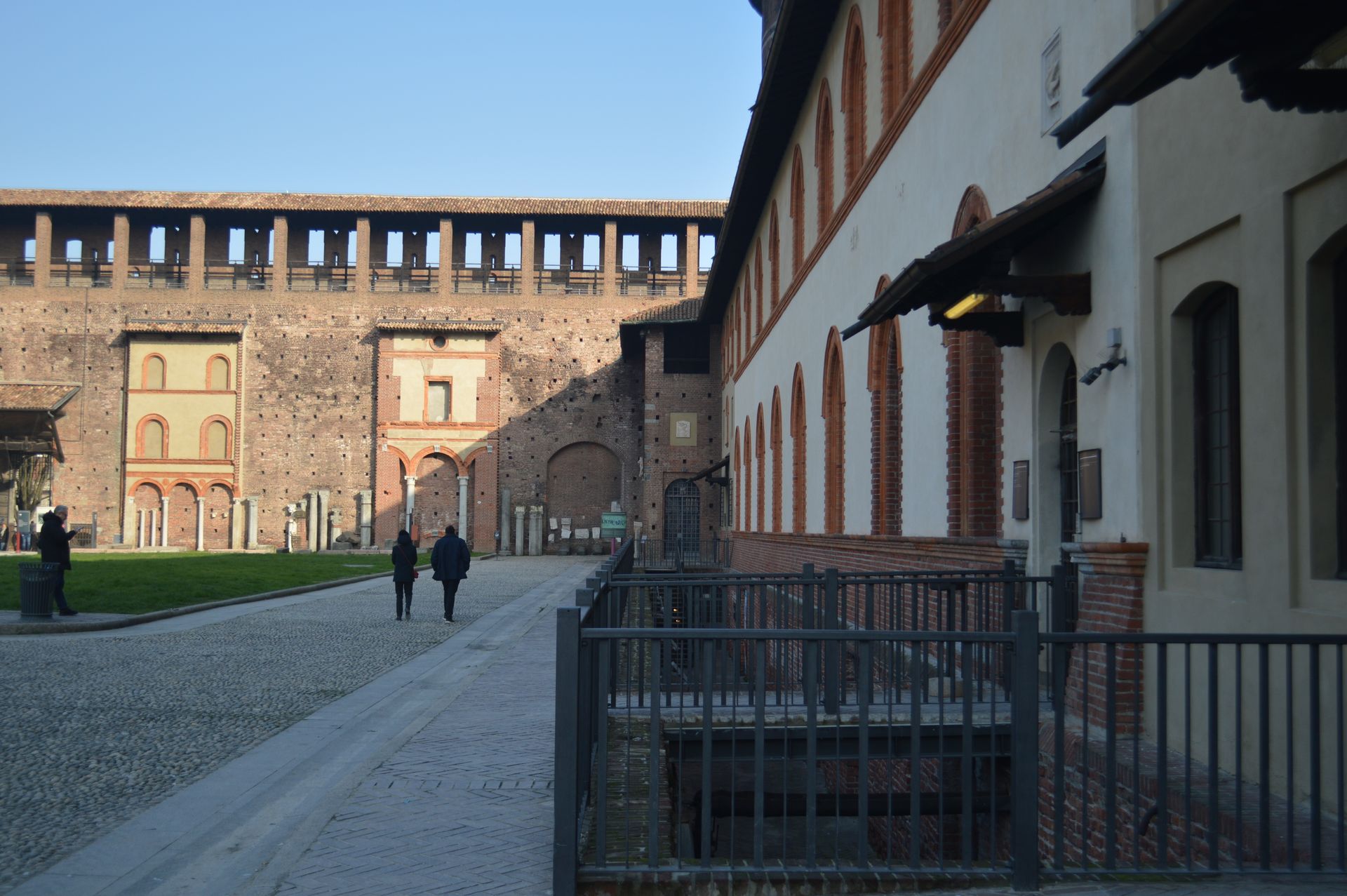
The courtyards are free to visit and are open daily from 7:00 a.m. to 7:30 p.m. Behind the gate tower, the Courtyard of the Arms, the Waffenhof, a vast lawn that Beltrami has extensively restored. Along its edge lie late Roman sarcophagi from the 3rd and 4th centuries and fragments of demolished Milanese buildings—a small open-air museum of the lost city. In the same courtyard stands the Spanish Hospital, the hospital of the Spanish garrison, which today houses the Pietà Rondanini can be seen. In the summer, the city hosts events in the courtyard with Estate al Castello, its outdoor program, June 12 through September 9, 2026, with up to 2,300 seats.
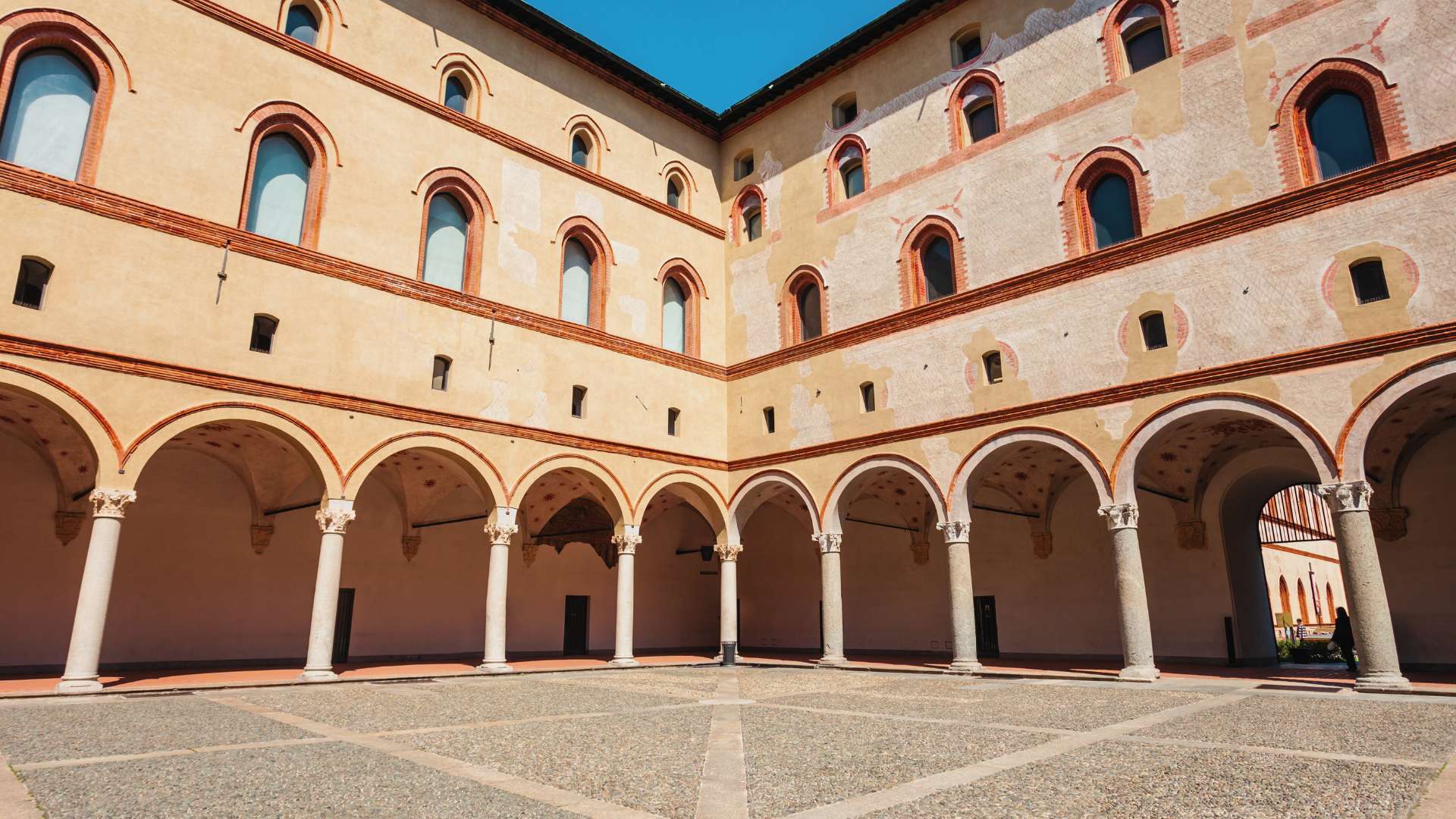
A passageway leads across the old moat of the city wall, the dry ditch, into which Corte Ducale, the Dukes' Courtyard. The portico was built by the architect Benedetto Ferrini in 1473; the Milanese call it Portico of the Elephant next to the faded fresco of an elephant on the wall. A staircase with low steps allowed Galeazzo Maria Sforza to ride his horse up to his rooms on the upper floor. Right next to it is the Rocchetta, the fortress within the fortress. After Galeazzo Maria fell victim to a conspiracy on December 26, 1476, his widow, Bona, retired there and had the tall Torre di Bona built a tower from which she could see the entire castle.
Behind the castle, the Sempione Park, 47 hectares of lawns, trees, and paths, which architect Emilio Alemagna designed as an English landscape garden between 1890 and 1893. It extends all the way to the Arco della Pace, the 19th-century Peace Arch. You can read more about the green space behind the Castello in our article about the Sempione Park.
What do the museums at Castello Sforzesco have on display?
The following are located in the Castello: Public Art Collections, the art collections of the City of Milan, spread across eight museums that you can visit with a single ticket. The tour begins on the ground floor of the Corte Ducale in the Museum of Ancient Art, the Museum of Ancient Art. Some 400 sculptures and architectural elements from monasteries, city gates, and palaces tell the story of more than a thousand years of Milan’s history, from the 5th to the 16th century. The most impressive piece is the tomb of the city lord Bernabò Visconti, created by the sculptor Bonino da Campione and his workshop between 1360 and 1385: The equestrian statue is carved from a single block of marble and still bears traces of its gilding. In the Armeria, in the armory, there are weapons dating from the late 14th century through the 19th century.
The Pinacoteca: From Filippo Lippi to Canaletto
Also in the Corte Ducale is the Pinacoteca, the painting gallery featuring Milanese and Lombard paintings from the 15th to the 18th century, supplemented by works from Veneto and Flanders. Among the earliest works is the Madonna dell’Umiltà by the Florentine painter Filippo Lippi, painted between 1429 and 1432 and originally located in the church Santa Maria del Carmine in Florence. Andrea Mantegna, the great Renaissance painter from Padua, signed his altarpiece depicting the Madonna in Glory on August 15, 1497, for the church Santa Maria in Organo in Verona; it has belonged to the Castello since 1935. A Madonna and Child by the Venetian artist Giovanni Bellini dates from before 1470, while a view of the San Marco pier with the Column of St. Mark, painted around 1735, is by Canaletto, the painter of Venetian cityscapes.
To the Corte Ducale These also include the Museum of Furniture and Wooden Sculptures, the Museum of Furniture and Wooden Sculptures, which Stipo Passalacqua, a cabinet from 1613 featuring ivory figures representing the five senses, and in the basement, the Antique Egypt Gallery, the Egyptian collection, which includes a fragment of a Book of the Dead from the New Kingdom. In the Rocchetta The tour continues upstairs. On the way through the Museum of Musical Instruments, there are Sala della Balla, a large hall on the first floor, the twelve monthly tapestries of the Trivulzio noble family of Milan, designed by the Lombard painter Bramantino and completed in 1509. Right next to it stands the Phonology Studio of the Italian broadcaster RAI, where composers Luciano Berio and Bruno Maderna began Italy's first experiments with electronic music in 1955. This is followed by the Museum of Decorative Arts, the Museum of Applied Arts.
Milan Attractions: 7 Highlights and Tips
The Duomo, The Last Supper, La Scala, Castello, Galleria, Brera, and Navigli: how much these seven highlights in Milan cost, when they’re closed, and how to fit them all into two days.
Pietà Rondanini: Michelangelo's Last Sculpture
The Pietà Rondanini is the last work by the sculptor Michelangelo Buonarroti. He likely began working on the marble block between 1553 and 1555 and continued to refine it intermittently during the last ten years of his life: he made Christ’s body more slender, lowered the head, and altered the arms. According to letters from his student Daniele da Volterra, he was still chiseling away at the figure just a few days before his death in February 1564, at the age of 89. The group is 1.96 meters tall and depicts Mary holding her dead son while standing, rather than cradling him in her lap as in Michelangelo’s earlier Pietà in St. Peter’s Basilica.
After Michelangelo’s death, all trace of the sculpture was lost. The first confirmed record of it dates back to 1807, in the inventory of art treasures belonging to the Roman noble family Rondinini, who gave it its name. Because an appraiser mistakenly identified it as a modern work, it went largely unnoticed for a long time. In 1952, the City of Milan purchased the Pietà. Until 2015, it stood in a stone niche in the Museum of Ancient Art, and since May 2, 2015, it has had its own museum in the Spanish Hospital. In this hall, whose vaulted ceiling is inscribed with verses from the Creed, the Spaniards cared for sick and plague-stricken soldiers in the 16th century.
Admission to the Pietà is included in the museum ticket. The museum has its own ticket office: You can buy your ticket there or at the main ticket office and use the same ticket to visit both areas.
Sala delle Asse: Leonardo's Painted Arbor
Leonardo da Vinci lived in Milan from 1482 to 1499, in the service of Ludovico il Moro. At the Castello, he left behind the Hall of the Axes, the hall on the ground floor of the Torre Falconiera, a square tower of the Corte Ducale. It is documented that Leonardo painted rooms in the castle in April 1498. He transformed the enclosed hall into an arbor: mulberry trees grow up the walls, their branches intertwining beneath the vault to form a dense canopy through which only patches of sky shine, held together by a continuous cord.
What you see today is only partly the work of Leonardo himself. The painting was rediscovered in 1893 and 1894; shortly thereafter, a restorer painted over the entire ceiling, and it wasn’t until 1954 that this layer was largely removed. The monochromatic drawings on the wall—roots bursting through rocks and a landscape—are generally considered to be his own work. The hall is currently undergoing restoration and is closed to visitors. Four digital exhibitions on the museum’s website offer a glimpse of the space.
Leonardo's traces in the Castello extend even further: The Trivulziana Library, the city's historic library located in the castle, houses the Trivulziano Code, a notebook in which he wrote about 8,000 words to expand his vocabulary. His most famous work in Milan is not far away: How you The Last Supper in the church Santa Maria delle Grazie You can read about it in our own post.
Merlate and Sotterranei: Battlements and Hidden Passages
Away from the museums, you can climb the walls. The Panoramic Views of Merlate, a section of the battlements behind the crenellations, can be explored without a guided tour: Tuesday through Sunday starting at 10 a.m., last admission at 5 p.m. The ticket costs €10.00, €5.00 for reduced-rate admission, and is not included in the museum admission fee. Visitors are admitted in groups of no more than 25 people, accompanied by staff. A dedicated elevator also takes wheelchair users and families with strollers up to the top. From up there, you’ll understand how the fortress was defended and enjoy a view over the city’s rooftops. Beltrami reconstructed the battlements themselves starting in 1893 based on old drawings.
Two tours led by Ad Artem, the city’s official tour guide service in the Castello, take visitors deeper into the defenses. The Tour of the Merlate takes visitors on a 90-minute tour of the battlements and towers. The Tour of the Cellars goes through the Ghirlanda Covered Street, a passageway with a 2.80-meter-high brick vault in the outer moat wall, through which soldiers could leave the castle unseen. Both tours cost €18.00 (reduced rate: €15.00), are conducted in Italian, and are suitable for children ages eight and up and ten and up, respectively. In October and November 2026, they will take place on Saturdays and Sundays.
How much is admission to the Castello Sforzesco?
You only need one ticket for the museums. It costs €10.00 and is valid all day for all collections, including the Pietà Rondanini and the Egyptian section, with one admission ticket per section. Students, visitors age 65 and older, and EU citizens ages 18 to 25 pay €5.00; admission is free for those under 18. On the first Sunday of the month, everyone gets in for free; on the second Tuesday, admission is free for everyone under 25. Even with free admission, you still need a ticket: to get one, select the category online free admission, the free ticket.
Entrance to the Castello Sforzesco
All prices are per person. Groups of ten or more receive a 20 % discount on the museum ticket.
| Offer | Price |
|---|---|
| Museums with the Rondanini Pietà | 10,00 € |
| Reduced rate: Students, seniors 65 and older, EU citizens aged 18 to 25 | 5,00 € |
| Children and adolescents under the age of 18 | free |
| Panoramic Views of Merlate, Walkway (no guided tour) | 10.00 € · reduced price 5.00 € |
| Tour delle Merlate or Tour nei Sotterranei, 90 minutes | €18.00 · reduced price €15.00 |
| Weekend museum tour, with ticket | 20,00 € |
| Audio Guide | 5,00 € |
| Tourist Museum Card: Three days of access to all city museums | 20,00 € |
If you want to visit Milan’s municipal museums for a year, get the Milano Museo Card for €15.00. With the Abbonamento Musei Lombardia—the annual pass for museums in Lombardy—admission is free, but you can only get the free ticket at the ticket counter.
As of October 2026 · Information provided by Castello Sforzesco (Comune di Milano) and Ad Artem.
The museums are open Tuesday through Sunday from 10 a.m. to 5:30 p.m. Last admission to each area is at 4:30 p.m., at which time the ticket office also closes. The museums are closed on Mondays, as well as on December 25, January 1, and May 1. The courtyards, on the other hand, are open every day from 7 a.m. to 7:30 p.m., and the information desk at the Filarete Tower is available to assist you Tuesday through Sunday from 9:30 a.m. to 5:30 p.m.
When is the Castello Sforzesco open?
Individual galleries may close on short notice; please check the museum's website for the latest information.
| Area | Times |
|---|---|
| Museums | Tue–Sun, 10 a.m.–5:30 p.m. |
| Ticket Office and Last Admission | 4:30 p.m. |
| Farms | Daily from 7 a.m. to 7:30 p.m. |
| Panoramic Views of Merlate | Tue–Sun, 10 a.m.–5 p.m., last admission |
| Information Desk in the Torre del Filarete | Tue–Sun, 9:30 a.m.–5:30 p.m. |
| Museums Closed | Mondays, December 25, January 1, May 1 |
| Free admission | First Sunday of the month, second Tuesday—up to age 25 |
As of October 2026 · Information provided by Castello Sforzesco (Comune di Milano).
How do you get to the Castello Sforzesco?
The Castello is located on the Castle Square on the northwestern edge of the Old Town and within the Area C, the toll-based environmental zone in the city center. The fastest way to get there is by taking the ATM metro: The red M1 line stops at Cairoli, 200 meters from the ticket booth, the green M2 at Lanza, 240 meters away. Both lines also stop at Cadorna, where the train station is Milan Cadorna is located. From there, the airport train departs Malpensa Express It takes 37 minutes to get to Terminal 1 at Malpensa Airport. Trams 1, 2, 4, 12, and 14, as well as buses 50, 57, 58, and 85, also stop nearby.
From the cathedral, walk about one kilometer—about a quarter of an hour—along the pedestrian street Via Dante. A single-ride ATM ticket costs €2.20 and is valid for 90 minutes; a day pass costs €7.60. If you're driving, you'll pay Area C Monday through Friday from 7:30 a.m. to 7:30 p.m., €7.50 per day; on weekends and holidays, parking in this zone is free.
Here's how to get to the Castello Sforzesco
The main ticket office is located at the entrance to the Museum of Ancient Art in the Corte Ducale, the cash register at the Pietà Rondanini in the Spanish Hospital.
| Connection | Route, Duration, or Price |
|---|---|
| Take the M1 subway to Cairoli | about 200 m to the cash register |
| Take the M2 subway to Lanza | about 240 m to the register |
| From Milano Centrale Main Station: Take the M2 to Lanza | without changing trains |
| From Linate Airport: Take the M4 to San Babila, then the M1 to Cairoli | change trains once |
| Malpensa Express to Milano Cadorna | €15.00, 37 minutes from Terminal 1 |
| ATM Single-Ride Ticket and Day Pass | €2.20 for 90 minutes · €7.60 |
| On foot from the cathedral | about 1 km, about 15 minutes |
| Area C by Car | €7.50, Mon–Fri 7:30 a.m.–7:30 p.m. |
As of October 2026 · Information provided by Castello Sforzesco, ATM, Malpensa Express, and the City of Milan.
Accessibility, Dogs, and Audio Guides
A ramp with a 6 % gradient leads to the main ticket window; another ramp connects it to the Museum of Ancient Art. The ticket office will lend you two wheelchairs if you show some form of ID. Elevators take you down to the Egyptian section and to the Rocchetta on to musical instruments, the applied arts, and the Panoramic Views, the observation rooms on the third floor. People with disabilities and one accompanying person are admitted free of charge. In the Museum of Ancient Art There is a tactile path for blind and visually impaired visitors, as well as videos in Italian Sign Language.
Dogs are allowed only in the outdoor areas; only service dogs are permitted in the museums and on the battlements. You can rent an audio guide for €5.00 at the bookshop near the museum entrance; it is available in German, Italian, English, French, Spanish, and Russian, but does not include the Egyptian collection. Every weekend at 11:00 a.m., a guided tour of the museums begins without prior registration—on Saturdays in English and on Sundays in Italian—for €20.00, including admission. Meet at the Info Point at 10:45 a.m.
Good to know: Not everything is open right now. The Hall of the Axes is undergoing restoration, and the Department of Prehistory and Early History at the Archaeological Museum is closed for renovations. In addition, the ticket is valid for only one entry per section: Once you’ve left an area, you cannot re-enter it on the same day. Therefore, plan a single, continuous visit. The Pietà, the Pinakothek, and the carpets in the Sala della Balla You can wear it just like that, and then you can stroll through the courtyards for free until evening.
- Art lovers who want to see Michelangelo and the Milanese Renaissance
- Families—admission is free for those under 18
- Anyone who wants to get in for free on the first Sunday of the month
- a Monday, when the museums are closed
- Leonardo fans, while the Sala delle Asse is being restored
- Visitors who would like to bring their dogs to the museums
The Courtyards in the Evening and Three Days of Museums for 20 euros
The museums close at 5:30 p.m., but the courtyards don't close until 7:30 p.m. Come back one summer evening: Once the day visitors have left, it gets Courtyard of the Arms Silence, and the low-hanging sun casts its light on the brick of the Corte Ducale light up. Then walk through the castle out to the park side and a short way into the Sempione Park. From the meadow, you can see the rear of the Castello with the Rocchetta, which are provided to you by the Castle Square remains hidden.
And do the math before you buy: The Tourist Museum Card costs €20.00—just €10.00 more than a ticket to the Castello—and is valid for three consecutive days at all of Milan’s municipal museums, with one admission per museum. The three days don’t start counting until your first visit, and you have twelve months from the date of purchase. So figure out beforehand how many municipal museums you want to visit in three days.
Who should visit the Castello Sforzesco?
The Castello Sforzesco tells the story of how Milan transitioned from the Middle Ages to the Renaissance, and through the Pietà Rondanini a world-class masterpiece. If you're short on time, walk through the courtyards straight to Michelangelo. It's best to set aside a whole morning to see all the collections.
From the Castello, walk to the Milan Cathedral, and the artists' quarter Brera starts right behind the subway station Lanza. Here's how to combine the castle, the cathedral, and the old town's narrow streets into a single day.

Milan Cathedral: Tickets, Terraces & Tips
How much the cathedral, museum, and rooftop terraces cost; when the Milan Cathedral is open; and why the walk down beneath the cathedral square is just as worthwhile as the climb up to the roof.
Map: Castello Sforzesco in Milan
FAQ - Frequently Asked Questions About the Castello Sforzesco
Prices, hours of operation, and schedules are subject to change; please check the official websites for the latest information before your trip.
Sources and Further Information
- Castello Sforzesco, Hours, Tickets, Season Passes, and Cards (accessed in October 2026)
- Castello Sforzesco, Accessibility (accessed in October 2026)
- Castello Sforzesco, How to Get Here (accessed in October 2026)
- Castello Sforzesco, The Castle of the Visconti and the Sforza Families (accessed in October 2026)
- Castello Sforzesco: The Castle in the Twentieth Century (accessed in October 2026)
- Sforza Castle, Towers, Battlements, and Underground Passages (accessed in October 2026)
- Castello Sforzesco, The Rooms Dating Back to the Sforza Era (accessed in October 2026)
- Castello Sforzesco, Courtyards: An Open-Air Museum (accessed in October 2026)
- Castello Sforzesco, A Sculpture by Michelangelo in Milan (accessed in October 2026)
- Sforza Castle, Leonardo at Sforza Castle (accessed in October 2026)
- Castello Sforzesco, A Must-See (accessed in October 2026)
- Castello Sforzesco: The Secret Passages (accessed in October 2026)
- Ad Artem, Castello Sforzesco (accessed in October 2026)
- Lombardy Cultural Heritage, Pietà Rondanini (accessed in October 2026)
- Lombardy Department of Cultural Heritage, Giovanni Bellini, Madonna and Child (accessed in October 2026)
- Lombardia Beni Culturali, Canaletto, View of the Pier (accessed in October 2026)
- Treccani, Biographical Dictionary, Leonardo da Vinci (accessed in October 2026)
- ATM, Tickets (accessed in October 2026)
- Malpensa Express, Malpensa Airport – Milan Cadorna (accessed in October 2026)
- City of Milan, Daily Access Fee for Area C (accessed in October 2026)
- YesMilano, Oh Bej! Oh Bej! Christmas Market (accessed in October 2026)