A former secondary-school teacher sings at the Teatro Ariston about students, workers and children on refugee boats, and wins Italy's most important festival. Roberto Vecchioni composed «Chiamami ancora amore» with guitarist and producer Claudio Guidetti. Universal released the single on 16 February 2011, and it was certified gold in Italy. The title means “Keep calling me love”, a plea that runs through the song as an antidote to dark times.
Three days after its release, on 19 February 2011, Vecchioni won the 61st Sanremo Festival and the Mia Martini Critics' Prize. It was only the Milanese singer-songwriter's second appearance, 38 years after his 1973 debut. «Chiamami ancora amore» has since been regarded as an unusually political winner in the contest's history.
«Chiamami ancora amore» by Roberto Vecchioni: facts and figures
A Sanremo victory, a critics' prize and a gold record: the key facts about Roberto Vecchioni's best-known later work.
| Feature | Information |
|---|---|
| Performer | Roberto Vecchioni |
| Lyrics and Music | Lyrics Roberto Vecchioni, music Roberto Vecchioni and Claudio Guidetti |
| Production | Claudio Guidetti; Peppe Vessicchio conducted at Sanremo |
| Single | Universal, released on 16 February 2011 |
| Album | «Chiamami ancora amore», a 2011 compilation |
| Award | Sanremo victory in 2011, Mia Martini Critics' Prize, gold |
As of November 2026 · Information from Wikipedia, AGI and Il Fatto Quotidiano.
How did «Chiamami ancora amore» come about?
Roberto Vecchioni was born on 25 June 1943 in Carate Brianza, a small town north of Milan; his family came from Naples. He studied classical literature at the Università Cattolica, Milan's Catholic university, and then taught at secondary schools in Milan for almost thirty years. At the same time, he became one of Italy's most important cantautori (singer-songwriters who write and sing their own lyrics).
For a long time, Vecchioni had appeared at Sanremo only once, in 1973 with «L’uomo che si gioca il cielo a dadi». In November 2010, it became clear that he would return; his entry was the first to be officially confirmed by the organisers. He wrote the lyrics alone and the music with Claudio Guidetti, who also produced the recording and played guitar.
The festival ran from 15 to 19 February 2011 and was hosted by singer Gianni Morandi. Vecchioni's conductor was Peppe Vessicchio, the festival's best-known maestro. In the final, «Chiamami ancora amore» beat Modà and Emma Marrone's «Arriverà» and Al Bano's «Amanda è libera». It also won the Mia Martini Critics' Prize and the music journalists' prize.
What is «Chiamami ancora amore» about?
«Chiamami ancora amore» is both a love song and a protest song. Vecchioni describes a collective night in which a country forgets its culture, and a personal night of doubt. Against both, he sets the love between two people and faith in the young.
In an interview with La Repubblica, he called his work the festival's only political song. It was about students, workers and immigrants, children on boats and young soldiers in a senseless war. At the same time, it was a love song to humanism. He rejected claims that he was targeting Silvio Berlusconi or Muammar al-Gaddafi. Instead, he cited the Chilean poet Pablo Neruda and a worker at carmaker Fiat as models for characters in the lyrics.
The timing was right. In December 2010, students in Rome had protested against the government's university reform, shielding themselves with large signs shaped like books. A longtime secondary-school teacher singing about that very generation struck a chord in February 2011.
The Lyrics, Verse by Verse
You can find the full lyrics on Spotify and Apple Music; here we focus on their imagery. The verses are a long list of people who have had something taken away: a boat with children that never arrives, a poet no longer allowed to sing, a worker without work, young people dying in a war far from home. Vecchioni moves between sweeping images and small scenes.
Night hangs over everything, the notte. It represents a time when knowledge and beauty no longer matter. The singer promises to fight this darkness, and does so in an unusual way: not with slogans, but by asking the person he loves to keep calling him amore as before.
The chorus ties the two together. As long as two people show each other tenderness, night cannot be final. Linguist Giuseppe Antonelli praised the lyrics for defending culture and freedom of thought while remaining close to spoken Italian. Vecchioni avoids scholarly words, although he is a classical scholar, and that is precisely why everyone understands him.
After the victory was announced, conductor Peppe Vessicchio hugged the singer so tightly that he broke a rib. Vecchioni told the story in 2025 after Vessicchio's death on the La7 programme “In altre parole”: he had cried on stage not from joy but from pain.
What does «Chiamami ancora amore» sound like?
Musically, the song takes no risks, and that is deliberate. A rock band with guitars, bass, drums and piano supports a calm melody that builds gradually and opens up in the chorus. In the studio, Claudio Guidetti and Fabio Moretti played guitar, Paolo Costa bass, Lele Melotti drums and Luca Scarpa keyboards.
Shortly before the final, Vecchioni jokingly called the song “scandalous but successful self-plagiarism” on radio. The presenters had played his older song «Piccolo amore», whose melody follows a similar course. He took it with humour: the new song simply resembled some of his earlier work.
«Chiamami ancora amore» in the video
At the top of this article, you can watch the winning performance from February 2011, as Rai, Italy's public broadcaster, showed it again in the 2024 programme “Evviva!”. Below, Vecchioni sings the song on 17 May 2026 in the Sunday show “Domenica In”. Fifteen years after Sanremo, his voice is more fragile, but the message is the same.
Available for listening on streaming services:
Listen to the pauses before the chorus
Start with the 2011 performance and listen to how Vecchioni almost speaks the verses before the orchestra under Vessicchio opens up in the chorus. Then switch to the 2026 recording.
At over eighty, he sings more slowly and leaves more air between the lines. The appeal becomes a legacy for younger people. To us, this comparison best shows why the song still does not sound like a mere festival entry.
Who has covered «Chiamami ancora amore»?
The song gained a second version during the festival itself. On duet night, Vecchioni sang it with PFM, Premiata Forneria Marconi, the leading progressive-rock band from Milan. In later years, several contestants on the talent show “Amici di Maria De Filippi” added it to their repertoires; for many young singers, it has become a test of expression.
In May 2024, Gianluca Ginoble, the baritone of the pop-opera trio Il Volo, sang the song with Vecchioni on television. This meeting of generations suits the subject: an older teacher passes his lyrics to a young singer.

Sanremo: the city behind the victory
Vecchioni won at the Teatro Ariston, the cinema and theatre in central Sanremo where the festival has been held for decades. The Riviera dei Fiori city on Liguria's Flower Riviera, in the region's far west, lives for music for a whole week in February.
Outside festival week, Sanremo is quieter, with the hillside old town of La Pigna, the Russian Orthodox church, the Casinò and a palm-lined seafront promenade. We describe what the festival feels like on location in our article about the Sanremo Music Festival. For more to see in the city, consult our guide to Flower city Sanremo.
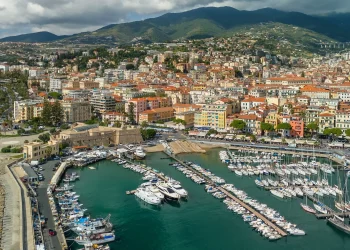
Flower city Sanremo: luxury, blossoms and dolce vita on the Riviera
Sanremo: A Blend of Glamour and Tradition—A Stroll Through the City of Flowers Sanremo, the sparkling jewel on the Ligurian coast, embodies the timeless charm of the Italian Riviera like no other place....
Conclusion: a love song as an objection
«Chiamami ancora amore» shows that a Sanremo winner can be more than a radio ballad. Vecchioni brings tenderness and anger together so naturally that they belong to the same song. If you like festival winners with a message, listen next to «Non mi avete fatto niente» by Ermal Meta and Fabrizio Moro, who won in 2018 with a song against terror, or «Canzone per te», with which singer-songwriter Sergio Endrigo won in 1968. You can find all our song profiles in our overview of Italian music.
FAQ: Frequently asked questions about «Chiamami ancora amore»
Sources and Further Information
- Wikipedia (English): Chiamami ancora amore (accessed November 2026)
- Wikipedia (Italian): Chiamami ancora amore (single) (accessed November 2026)
- Wikipedia (English): Sanremo Music Festival 2011 (accessed November 2026)
- AGI: Vecchioni, mio pezzo autoplagio scandaloso ma riuscito (accessed November 2026)
- Eurovisionary: Vecchioni on culture in Italy (accessed November 2026)
- Il Fatto Quotidiano: Vecchioni remembers Vessicchio (accessed November 2026)