A window above the sea, a carnation on the sill and a man with a guitar: these became one of the most famous Neapolitan songs. «Marechiare», often called «Marechiaro» as well, combines a poem written by Salvatore Di Giacomo in 1885 with music by Francesco Paolo Tosti. The Milan publisher Ricordi issued the song around 1886. Its title is the Neapolitan name for Marechiaro, an old fishing village on Posillipo, the hill west of Naples.
More than 140 years later, «Marechiare» remains a staple of the great tenors’ repertoire. Tito Schipa recorded it, as did Beniamino Gigli and Luciano Pavarotti. And the window described in the words still stands in Marechiaro, with a fresh carnation on its sill.
«Marechiare» by Francesco Paolo Tosti: facts and figures
A poet from Naples, a composer from Abruzzo, a window by the bay: the key facts about the song of Marechiaro.
| Feature | Information |
|---|---|
| Music | Francesco Paolo Tosti (1846 to 1916) |
| Text | Salvatore Di Giacomo (1860 to 1934) |
| Language | Neapolitan, printed with an Italian translation by Rocco Pagliara |
| Cast | Voice and piano, D minor in the edition for high voice |
| Publisher | Ricordi, Milan, first edition around 1886 |
| Setting | Marechiaro on Posillipo, Naples |
As of November 2026 · Information according to IMSLP, Wikipedia, Napolike and Discography of American Historical Recordings.
How was «Marechiare» created?
Salvatore Di Giacomo was born in Naples in 1860 and became the most important poet writing in the Neapolitan dialect of his time. He wrote poems, plays and song lyrics, including «Era de maggio». On 25 March 1885, he published his verses about Marechiaro in the Roman newspaper «Capitan Fracassa».
Francesco Paolo Tosti came from Ortona, the port town in Abruzzo where he was born in 1846. At age eleven, he entered the San Pietro a Majella Conservatory, Naples’ renowned music school. He later taught singing to Margherita of Savoy, the future queen of Italy, went to London in 1875 and became a singing teacher to the British royal family in 1880. King Edward VII knighted him in 1908.
According to tradition, Tosti urged the poet to let him turn the poem into a song and is said to have offered him a gold pound sterling for it. The song for voice and piano was published by Ricordi in Milan; the first edition is dated to around 1886.
What is «Marechiare» about?
«Marechiare» is a serenade, known in Italian as a serenata. A man in love stands beneath his beloved’s window in Marechiaro on a moonlit night, calls for her to wake up and wants to bring her a song with his guitar.
The landscape plays the other leading role. Moon, sea and rocks are more than scenery; they seem to fall in love too. This combination of nature imagery and courtship is precisely what made the song so popular.
The Lyrics, Verse by Verse
You can find the complete lyrics on Spotify and Apple Music; here we focus on their imagery. The song is sung in Neapolitan, as the title itself shows: Marechiare is the dialect form of Marechiaro.
The first verse begins with the moon. As soon as it rises above Marechiaro, the singer says, even the fish fall in love; the waves stir and change colour for sheer joy. Di Giacomo exaggerates deliberately, and that is what makes the opening so cheerful.
The second verse turns to a window, the fenesta. The singer’s passion all but knocks at its pane, a potted carnation scents the sill, and the water murmurs below. This single image later became an attraction in its own right.
In the third verse, the lover compares the stars in the sky with the woman’s eyes. Anyone who thinks the stars are bright, he implies, has not seen those eyes; their light is carried only in his heart.
Finally, he calls the beautiful woman by name: Carulì, an affectionate form of Carolina. She should wake up; the night air is mild, he has waited long enough and has brought a guitar to accompany his singing. The song does not reveal whether she opens the window.
How the verses were written is disputed. Di Giacomo himself said in the «Corriere di Napoli» in 1894 that he wrote them on a boat trip across the bay and afterwards stopped at an inn near the window. Another version says he composed the poem at a table in Caffè Gambrinus without ever having seen Marechiaro.
What does Tosti’s setting sound like?
Tosti was a master of the salon romance, the short art song for voice and piano performed in middle-class drawing rooms in the 19th century. «Marechiare» is in D minor in the edition for high voice; Ricordi also printed a version for low voice in B minor.
The Neapolitan text appeared alongside an Italian translation by the poet Rocco Pagliara so that singers outside Naples could understand the song. French composer Émile Tavan also wrote an arrangement for theatre orchestra. Thus the romance moved from the piano to the great stages.
«Marechiare» on video
At the top of this article you can hear Tito Schipa, the tenor from Lecce in Apulia who was famous for his light, elegant voice. The historical recording comes from a collection of his Neapolitan songs.
Below, Luciano Pavarotti, the tenor from Modena, sings the song live in Barcelona in 1989. Ten years earlier, he had recorded it in the studio for his Decca label with the National Philharmonic Orchestra under Giancarlo Chiaramello.
Available for listening on streaming services:
Listen to Schipa and Pavarotti back to back
Start with Tito Schipa at the top of the article and notice how lightly he delivers the call to wake Carulì, almost as if speaking. Then switch to the Barcelona performance.
Pavarotti sings the same notes with far more brilliance and power, turning a serenade beneath a window into a performance before a large audience. For us, this comparison best shows the range Tosti’s little romance allows: it works as a whisper or in a grand voice.
Who has recorded «Marechiare»?
For the great tenors of the 20th century, «Marechiare» was essential repertoire. Tito Schipa recorded it for the American label Victor in New York on 14 February 1930. Beniamino Gigli, the tenor from Recanati in the Marche, followed in London on 6 April 1938 under conductor Walter Goehr.
Giuseppe Di Stefano, the tenor from Sicily, and Mario Lanza, the American tenor and film star, also recorded the song. Lanza sang it on the radio and at concerts in 1958. Luciano Pavarotti recorded «Marechiare» for Decca in 1979 and repeatedly performed it afterwards, including in his hometown of Modena in 1987 and in Barcelona in 1989.

Marechiaro: the fishing village with the famous window
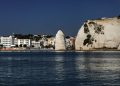
Marechiaro is an old fishing hamlet on Posillipo, the affluent residential hill west of Naples. Its name probably refers not to clear water but to calm water: medieval documents use the words mare planum, which became Marechiaro in Neapolitan. Sheltered behind the Scoglione, a rocky barrier in the water, the hamlet looks out towards Vesuvius, the Sorrento peninsula and Capri.
The window from the song, the Fenestrella, really exists. A carnation always stands on its sill, and below hangs a white marble plaque with the song’s notes and its writers’ names. The city of Naples put it up in 1922. Around 10.000 people came to the celebration, and tenor Fernando De Lucia sang «Marechiare» with an orchestra. In the sixties, Marechiaro and its restaurants overlooking the bay became a meeting place of the dolce vita. For more things to see by the bay, read our guide to the highlights of the Bay of Naples.

Gulf of Naples: The 11 Most Beautiful Highlights in Campania
Naples, Capri, Ischia, Procida, Vesuvius, Pompeii, and more: the 11 most beautiful highlights in the Gulf of Naples—with tips on how to get there, prices, and attractions.
Conclusion: a serenade that made a place famous
«Marechiare» turned a small window on Posillipo into a landmark, and Tosti’s melody has carried Di Giacomo’s moonlit night through salons and concert halls for more than 140 years. To hear more music from the bay, continue with «Torna a Surriento» by the De Curtis brothers or with «’O sole mio» by Eduardo Di Capua, the Neapolitan composer of perhaps the city’s best-known song. You can find all our song profiles in our overview of Italian music.
Sources and Further Information
- IMSLP: Marechiare (Tosti, Francesco Paolo) (accessed November 2026)
- Napolike: Marechiaro e la fenestrella, storia della canzone e del luogo (accessed November 2026)
- Wikipedia (en.): Paolo Tosti (accessed November 2026)
- Wikipedia (en.): Salvatore Di Giacomo (accessed November 2026)
- Wikipedia (en.): Marechiaro (accessed November 2026)
- Discography of American Historical Recordings: Gigli, Marechiare (1938) (accessed November 2026)