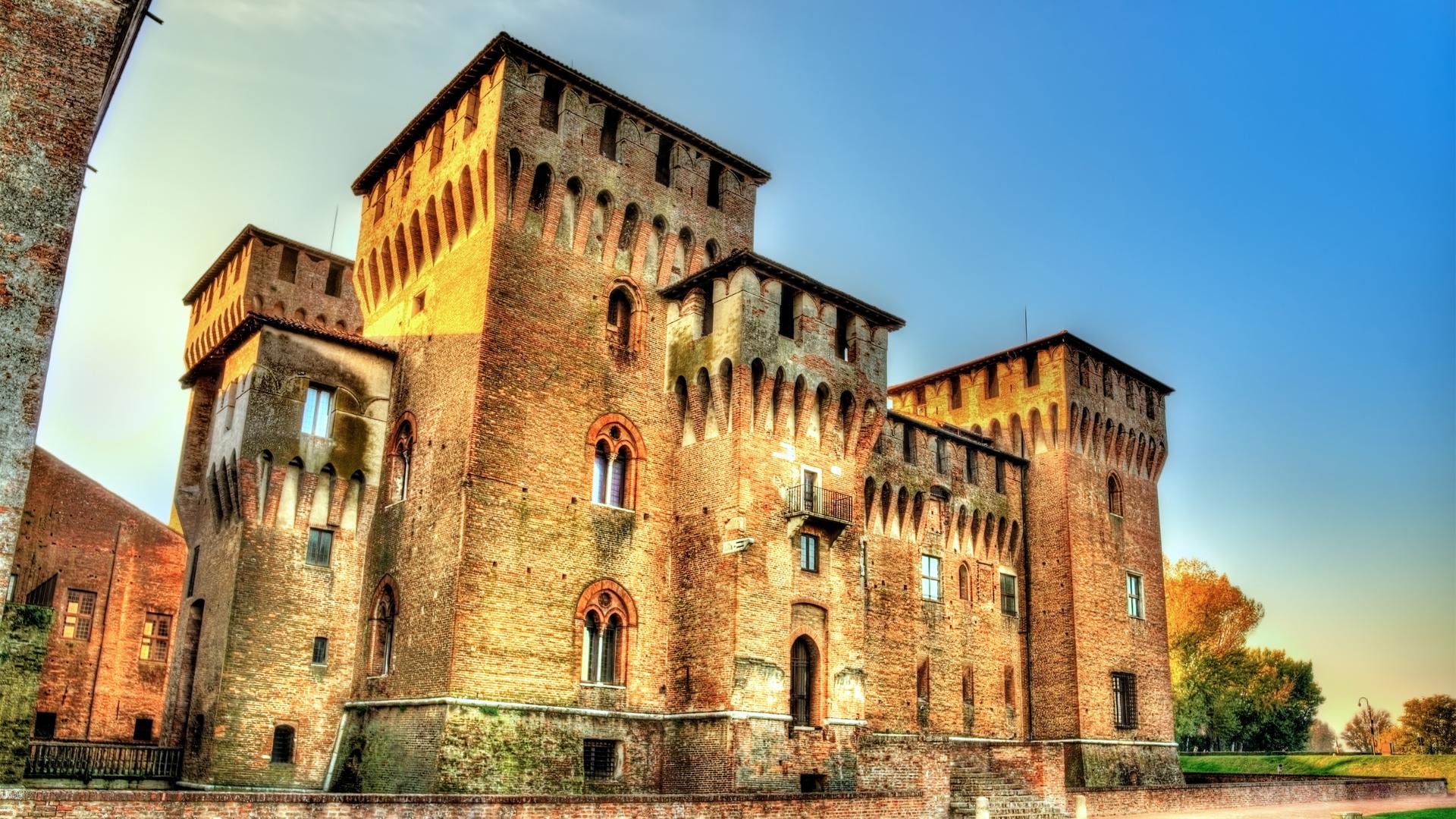


Mantua – Anyone walking across the pier Ponte di San Giorgio As you approach, you see the castle of the Gonzaga ruling family: four corner towers rising out of the water. The Castle of San Giorgio Francesco I Gonzaga had it built as a fortress between 1395 and 1406, and Andrea Mantegna painted the Camera degli Sposi, one of the most famous rooms of the Renaissance. There is no separate ticket: The castle is part of the Palazzo Ducale, the city's ducal palace, and the €18.00 admission fee includes the Castello and Camera degli Sposi It is open Tuesday through Sunday from 8:15 a.m. to 7:15 p.m.
Here you can read about what to see at the Castello, why there’s a time slot for Mantegna’s room, what’s been open to the public since 2026, and how to get there without any detours. Our guide to the city’s other highlights provides an overview of the Sights in Mantua, the [name] lists all the attractions in the region Lombardy Travel Guide.
Castello di San Giorgio by the Numbers
The Castle of San Giorgio is now part of the museum complex Palazzo Ducale, a state museum under the Ministry of Culture. The palace covers approximately 35,000 square meters and has over 1,000 rooms, as well as courtyards and gardens. Admission to the Camera degli Sposi is included in the regular ticket, but entry to the Castello is by group.
As of October 2026 · Information provided by the Palazzo Ducale di Mantova and CoopCulture.
What is the Castello di San Giorgio?
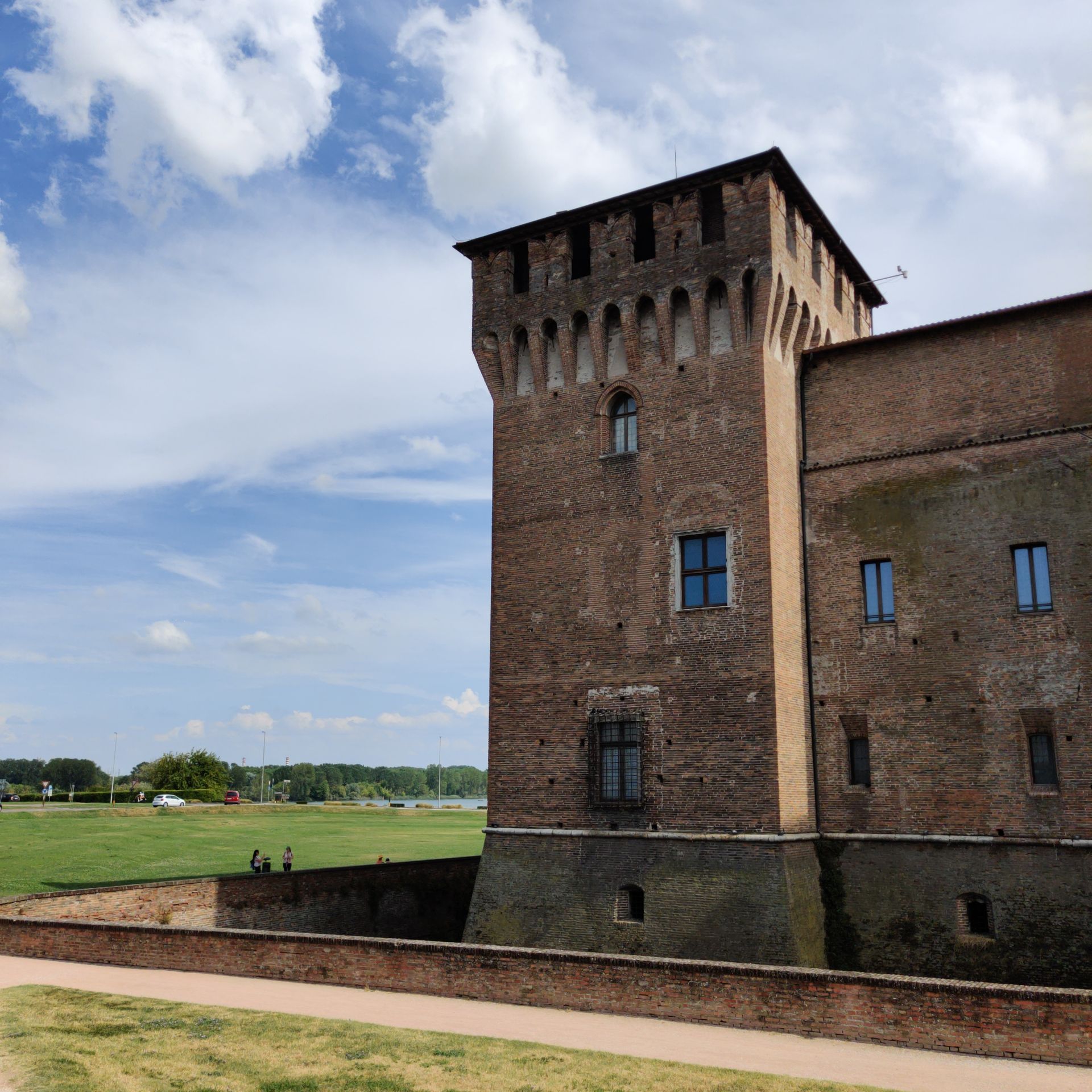
The Castle of San Giorgio is the fortress of the Gonzaga family, who ruled Mantua from 1328 to 1707, and one of the most significant examples of late-medieval military architecture in the region. The fortress was commissioned by Francesco I Gonzaga, who was known as People's Captain, who ruled the city as captain of the people. The plans were provided by the architect Bartolino da Novara, who had already built the Este family’s castle in Ferrara beginning in 1385. Between 1395 and 1406, a square structure with four corner towers was constructed, surrounded on all four sides by a moat.
The castle stands on the banks of the Lago Inferiore, the lowest of the three lakes fed by the river Mincio around Mantua. Right next to it, the Ponte di San Giorgio across the water, the bridge that leads to the Lago di Mezzo from the Lago Inferiore ...separates them. So when you drive across the bridge into the city, the first thing you see is the castle, with the domes of the Old Town behind it.
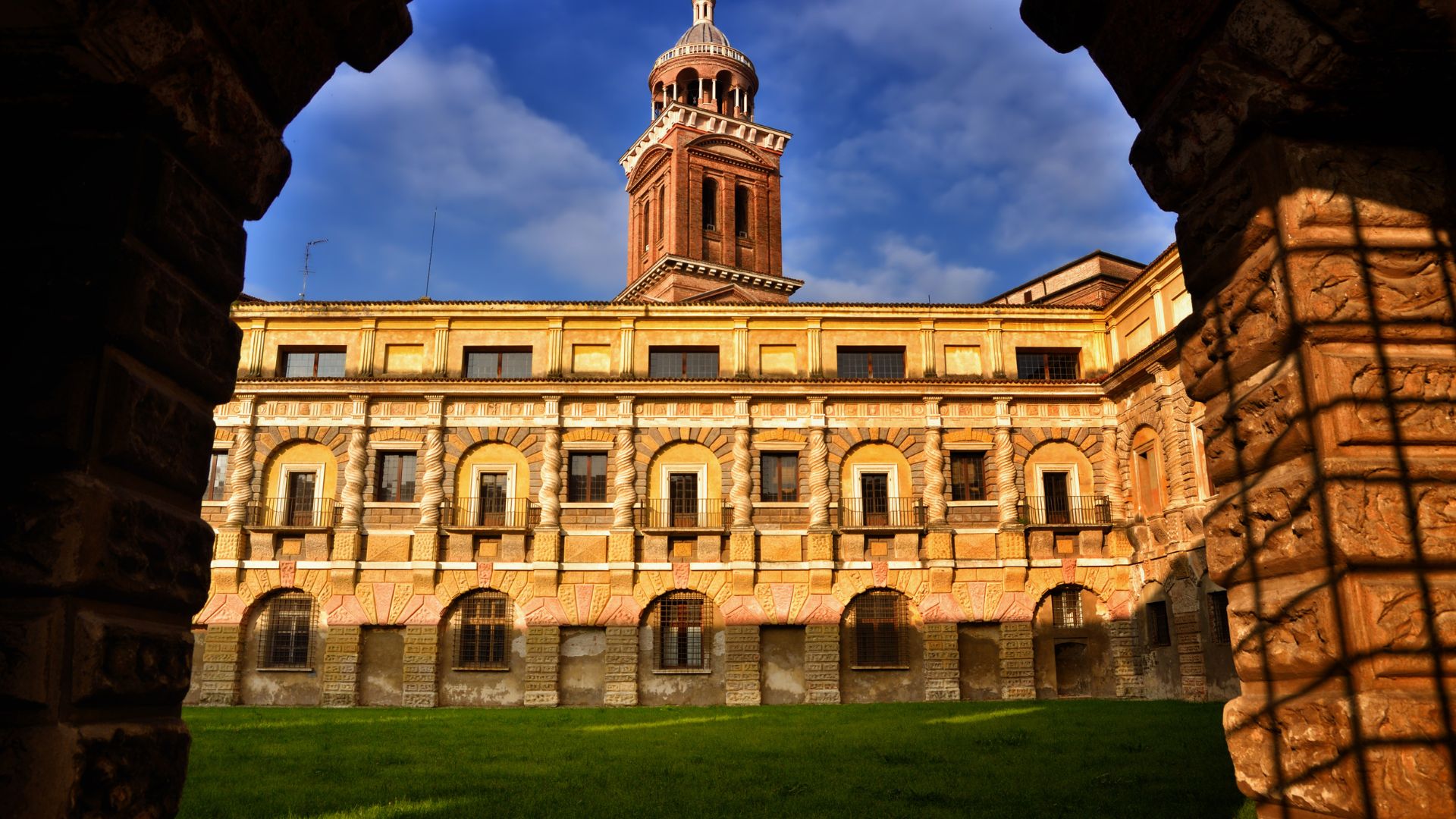
The fortress became a residence. Beginning in 1459, Margrave Ludovico Gonzaga moved from the Corte Vecchia, the old palace on the Piazza Sordello, into the Castello and had it converted into the family's residence. In the first half of the 16th century, the castle, palaces, courtyards, and gardens grew to become the Palazzo Ducale together, forming a single large complex. Since 2008, Mantua, along with the neighboring town of Sabbioneta, has been a UNESCO World Heritage Site.

From Piazza Castello up to the Camera degli Sposi
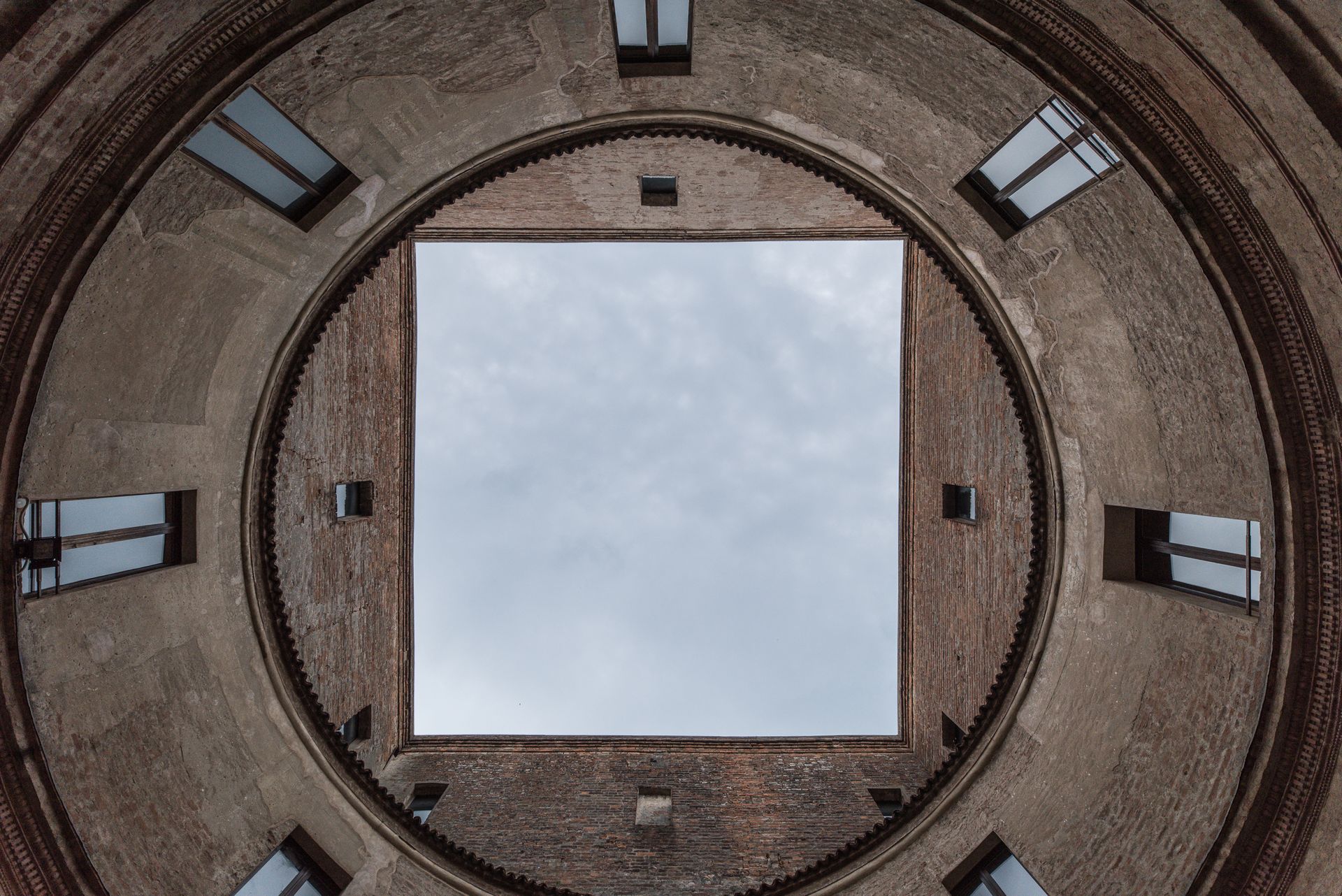
The path to the Castello begins at the Castle Square, the arcaded courtyard between the palace and the castle. Through a semicircular vestibule, which esedra, you enter the fortress. The path leads up through the Scala dei Cavalli, the horse staircase, a spiral staircase that leads up to just before the Camera degli Sposi leads to. So you can reach the room without having to walk far, but you’ll need to follow a strict schedule: Every ten minutes, the museum admits 30 people; the reserved time slot applies to entry into the Castello.
After the Camera degli Sposi The tour continues through the Stanza dei Soli, the Hall of the Suns, and, weather permitting, out onto the ballatoio, the gallery in the castle courtyard, which was renovated in the 15th century. From there, the same spiral staircase leads back down and on into the Corte Nuova, the wing that the architect Giulio Romano began building in 1536 for Duke Federico II. The main floor also once housed the first Studiolo and the first Grotta Isabella d’Este’s study and collection room. After the death of her husband, Margrave Francesco II, she moved into the Corte Vecchia, where you can now tour the rooms she would later call home.
Good to know: Most of the tour is neither heated nor air-conditioned. In winter, keep your jacket on; in the height of summer, it’s best to go in the morning. You can leave large backpacks and bags in the lockers at the entrances.

What is on display in the Camera degli Sposi?
The Camera degli Sposi is a room in the northeast tower of the Castello that Andrea Mantegna, the Gonzagas' court painter, painted intermittently from 1465 to 1474. It was originally called Camera picta, the painted chamber. The date June 16, 1465, is inscribed on a window reveal on the north wall; this is presumably the date work began. On the west wall, cherubs hold a painted dedication plaque bearing the year 1474.
Mantegna transforms the room into a stage. Curtains part above a painted marble pedestal, revealing the court: Margrave Ludovico is seen with his wife Barbara of Brandenburg and the entire court when a messenger brings him a letter. In it, he learns that Francesco Sforza, the Lord of Milan—in whose service he had served as a military commander—is gravely ill. The journey there is depicted on the west wall: Along the way, in Bozzolo, a town on the route to Milan, Ludovico meets his son Francesco, who has just been made a cardinal.
Then your gaze wanders upward. The vault is raised so that the room takes on the proportions of a cube, and at its center opens the famous oculo, a painted round window opening onto the sky. Over the balustrade, about a dozen cherubs, a peacock, and figures look down at you; next to them, a basket of citrus fruits balances precariously on the edge. The vaulted caps feature the busts of twelve Roman emperors, while the lunettes depict scenes from the myths of Hercules, Arion, and Orpheus. You’ll get the best view from the center of the room.
Mantegna in Mantua
Andrea Mantegna was born around 1431 in Isola di Carturo, north of Padua—now known as Isola Mantegna. In 1459, Ludovico Gonzaga summoned him to the court by decree; by 1460 at the latest, he was living with his family in Mantua, where he died on September 13, 1506. He is buried in the Chapel of San Giovanni Battista in the basilica Sant’Andrea, designed by the Renaissance architect Leon Battista Alberti. His home, the Casa del Mantegna Located at Via Acerbi 47, it is now managed by the Province of Mantua: You can visit the courtyard and the permanent exhibition on the upper floor free of charge.

Mantua Attractions: 8 Highlights & Tips
Mantua combines Mantegna’s frescoes, Giulio Romano’s Palazzo Te, and three lakes to create one of Italy’s most beautiful Renaissance cities—this guide provides prices, highlights, and tips.
Prisons and Battlements: The Castle from Above
There is another floor above the main floor. Under Austrian rule in the 19th century, it served as a prison, and this is where the Martyrs of Belfiore, the Martyrs of Belfiore: Patriots of the Risorgimento, members of the Italian unification movement, nine of whom were executed by the Austrians in the Belfiore Valley outside the city between December 1852 and March 1853. From these cells, the revolutionary Felice Orsini managed to escape on the night of March 29–30, 1856.
The 2012 earthquake had damaged the Castello. After initial safety measures were taken, it reopened in March 2015; the most recent restoration began in 2021 and was completed in 2026. Since then, the cells of the patriots Carlo Montanari, Giovanni Grioli, Felice Orsini, Tito Speri, and Ciro Menotti have been restored, and for the first time ever, the southwest tower is open to the public: From the battlement walkway between the battlements, you can look out over the lakes and across the rooftops of the city.
The museum offers guided tours of the Carceri and the battlements only. Starting in October 2026, individual visitors can join tours on Fridays at 2:30 p.m. and on Saturdays at 11:00 a.m. and 2:30 p.m. The guided tour costs €5.00 and can be booked by phone at the museum’s Infopoint at 0376 352100. The route involves climbing many stairs: it is not suitable for people with mobility impairments, and the museum advises against participation for those with heart or respiratory conditions.
How much is admission to the Castello di San Giorgio?
There is no separate admission fee for the Castello. You buy the ticket for the Palazzo Ducale with Castello, Camera degli Sposi and the National Archaeological Museum, the complex’s National Archaeological Museum: Admission is €18.00; €2.00 for EU citizens aged 18 to 25; and free for those under 18. Those who only want to tour the other palace wings pay €11.00, but will not be able to enter the castle.
Admission to the Palazzo Ducale and Castello
All prices are per person. Admission is free on the first Sunday of the month, as well as on April 25, June 2, and November 4.
| Offer | Price |
|---|---|
| Palazzo Ducale, including the Castello and the Camera degli Sposi | 18,00 € |
| EU citizens aged 18 to 25 | 2,00 € |
| Children and adolescents under the age of 18 | free |
| Palazzo Ducale without the Castello | 11,00 € |
| Additional fee for the Camera degli Sposi with the Abbonamento Musei or the Mantova-Sabbioneta Card | 7,00 € |
| Prisons and Battlements with a Guide | 5,00 € |
| Weekend Tour | An additional 9.00 € |
| Annual Subscription to *Amico di Palazzo Ducale* | 25,00 € |
Online at CoopCulture, the museum's ticketing partner, a full-price ticket also costs €18.00. A reservation fee of €1.00 applies only to discounted and free tickets.
As of October 2026 · Information provided by the Palazzo Ducale di Mantova and CoopCulture.
It is open Palazzo Ducale Tuesdays through Sundays from 8:15 a.m. to 7:15 p.m.; last admission is at 6:20 p.m. The ticket office at the Piazza Sordello 40 closes as early as 6:15 p.m. Everything is closed on Mondays and on December 25, with one exception: On Monday, December 7, 2026, it will be open during regular hours. Arrive about 15 minutes before your time slot so you can pick up your ticket without rushing. On holidays, long weekends, and the first Sunday of the month, it’s worth buying tickets in advance; otherwise, seats in the Camera degli Sposi go quickly.
Hours of Operation for the Palazzo Ducale and Castello
The appointment for the Camera degli Sposi is for entry at Piazza Castello. You can visit Corte Vecchia and Corte Nuova before or after that.
| When | Time |
|---|---|
| Tuesday through Sunday | 8:15 a.m. to 7:15 p.m. |
| Last admission | 6:20 p.m. |
| Ticket office at Piazza Sordello 40 | 8:15 a.m. to 6:15 p.m. |
| Monday and December 25 | closed |
| Evening hours on October 31 and December 19, 2026 | until 11:15 p.m. |
| Monday, December 7, 2026 | Open, regular hours |
| Prisons and Battlements | Fri at 2:30 p.m., Sat at 11 a.m. and 2:30 p.m. |
As of October 2026 · Information provided by the Palazzo Ducale di Mantova and CoopCulture.
The ticket includes admission to two exhibitions. Through January 10, 2027, the palace is hosting an exhibition at the Santa Croce Apartment, a series of rooms in the Corte Vecchia, the exhibition „Sole mirabile per luce propria“ about Ferdinando Gonzaga, the duke, collector, and patron who died in 1626; among the works on display is a loan from the Louvre. In the Corte Nuova „Le fiabe sono vere“ runs through January 17, 2027, featuring nearly 500 works and objects related to the world of Italian fairy tales.
How do you get to the Castello di San Giorgio?
The cash register is located at the Piazza Sordello 40, the large cathedral square in the north of the Old Town, the entrance to the Castello at the Castle Square right behind it. The most convenient way to get there is by train: It takes about 45 minutes from Verona, about 55 minutes from Modena, and about two hours and a quarter from Milan. From the train station at the Piazza Don Leoni It's about 1.5 kilometers on foot, which takes about 20 minutes. Alternatively, city buses 4 and 12 run from APAM, the public bus service in Mantua, to the Piazza Sordello. A 75-minute ticket costs €1.70; if purchased on the bus, it costs €2.50.
By car, take the A22 Brenner Highway to the Mantova Nord exit; from there, it's about four kilometers to the city center. The Old Town is monitored by security cameras ZTL, a restricted-access zone that you may not enter without a permit. Paid parking spaces are located on the lakeshore at the Gonzaga Lakeside, at the Piazza Virgiliana and in the Via San Giorgio. Parking on the blue parking spaces in the innermost zone is required ASTER, the municipal parking company, charges €1.70 per hour. You can park for free at the park-and-ride lot Campo Canoa; the shuttle bus from there to the city center is free on weekdays and costs €1.00 per ride on holidays. The nearest airport is Verona Villafranca.
Here's how to get to the Castello di San Giorgio
The ticket office and information desk are located at Piazza Sordello 40; the entrance to the Castello is on Piazza Castello.
| Connection | Duration or Price |
|---|---|
| Train from Verona | about 45 minutes |
| Train from Milan | about 2 hours and 15 minutes |
| Walk from the train station to Piazza Sordello | about 1.5 km, about 20 minutes |
| City bus 4 or 12, 75-minute ticket | €1.70; €2.50 on the bus |
| A22, Mantova Nord exit | about 4 km to the city center |
| Parking lane in the innermost zone | €1.70 per hour |
| Campo Canoa Park-and-Ride with Shuttle Service | Free on weekdays; €1.00 per ride on holidays |
As of October 2026 · Information provided by the Palazzo Ducale di Mantova, APAM, and ASTER Mantova.

Accessibility, Dogs, and Audio Guides
To the main floor of the Castello and thus all the way to the Camera degli Sposi There is a 75-centimeter-wide elevator located on the ground floor near the castle courtyard. Because the palace consists of many buildings of varying heights, the tour for wheelchair users follows a separate route. The Corte Vecchia You can reach it via a lift; ramps and stair lifts bridge other height differences. Only the Carceri and the battlement are excluded because of the stairs.
Small dogs are allowed if they remain in a closed bag or carrier throughout the entire visit; guide dogs and therapy dogs are always allowed. The audio guide is available free of charge, including in German, with a „Capolavori“ route featuring the masterpieces and a family route for children.
Good to know: The Camera degli Sposi It’s a single room that you share with the other visitors in your time slot—up to 30 people. If you’re coming just to see Mantegna, you’ll be missing out on a lot. Be sure to set aside time for the rest of the palace; your ticket covers it anyway.
- Anyone who wants to see Renaissance paintings
- Families with children under 18 who can enter for free
- History buffs who want to experience the Risorgimento in the Carceri
- Walk-ins on the first Sunday without a reservation
- Visitors with large dogs
- a winter day without a warm jacket
Seven euros more for a whole year and the view from the bridge
If you’re staying in Mantua for a while or plan to come back, do the math: The „Amico di Palazzo Ducale“ annual pass costs €25.00—just €7.00 more than a single ticket. It’s valid for 365 days from the date of purchase for as many visits as you like, including access to the Camera degli Sposi (subject to availability on the day), and the guided tour of the Carceri and the battlements is free for subscribers. This way, you can explore the vast palace in stages instead of trying to see everything in one day.
And save the most beautiful view for the evening: head out onto the Ponte di San Giorgio. The bridge dates back to the early 12th century—it was made of wood back then. Francesco I Gonzaga had it covered with a roof in the early 15th century, and its current form dates from the 20th century. From there, the castle and Lago Inferiore lie at your feet, and as the sun sets, the brickwork takes on an almost red hue.
Is the Castello di San Giorgio worth a visit?
Yes. For €18.00, you get a castle from the late 14th century, one of the most significant Renaissance rooms, and the enormous Gonzaga Palace; if you’re under 18 or visiting on the first Sunday of the month, admission is free. Since 2026, the Carceri and the battlements have been added, offering a glimpse into a part of the history of the Risorgimento that had long been closed off.
Our advice: Book an early time slot, get the audio guide, and take your time exploring the palace. If you're arriving by bike, take the Mincio Bike Path, the approximately 48-kilometer-long bike path along the river from Lake Garda through Peschiera del Garda and Valeggio sul Mincio all the way to Mantua. For other things you shouldn't miss in Mantua, check out our guide to the Sights in Mantua.
Valeggio sul Mincio Attractions: 6 Highlights & Tips
A castle, a fortified bridge, Mühlendorf, and a 60-hectare garden: Valeggio sul Mincio, south of Lake Garda, packs six attractions into less than three kilometers.
Map: Castello di San Giorgio in Mantua
FAQ - Frequently Asked Questions About the Castello di San Giorgio
Prices, hours of operation, and schedules are subject to change; please check the official websites for the latest information before your trip.
Sources and Further Information
- Palazzo Ducale in Mantua, The Castle (accessed in October 2026)
- Ducal Palace of Mantua, Camera Picta (accessed in October 2026)
- Palazzo Ducale in Mantua: Its Origins (accessed in October 2026)
- Palazzo Ducale in Mantua: Tickets, Season Passes, and Discounts (accessed in October 2026)
- Palazzo Ducale in Mantua, Opening Hours (accessed in October 2026)
- Palazzo Ducale in Mantua, Reception (accessed in October 2026)
- Palazzo Ducale in Mantua, How to Get There (accessed in October 2026)
- Palazzo Ducale in Mantua: The Dungeons of San Giorgio Castle Reopen (accessed in October 2026)
- Palazzo Ducale in Mantua, October at the Ducale (accessed in October 2026)
- CoopCulture, the Doge's Palace with San Giorgio Castle and the Bridal Chamber (accessed in October 2026)
- Ministry of Culture, #domenicalmuseo (accessed in October 2026)
- Treccani, Biographical Dictionary: Andrea Mantegna (accessed in October 2026)
- Treccani, Biographical Dictionary: Bartolino da Novara (accessed in October 2026)
- Municipality of Mantua, The Lakes of Mantua (accessed in October 2026)
- Mincio Park, Ponte di San Giorgio (accessed in October 2026)
- Casa del Mantegna, Province of Mantua (accessed in October 2026)
- APAM, Urban Fares (accessed in October 2026)
- ASTER Mantua, Parking and Restricted Traffic Zone (ZTL) (accessed in October 2026)
- UNESCO World Heritage Center, Mantua and Sabbioneta (accessed in October 2026)