
Mantua – This city rises directly out of the water on three sides, and anyone who reaches it for the first time via the pier immediately understands why the dukes didn’t want to leave here for four hundred years. Mantua’s most important sights are all located in the compact city center: the Lombard The Ducal Palace, with over 500 rooms; Giulio Romano’s Palazzo Te; and the Basilica di Sant’Andrea, along with three lakes that encircle the old town like a moat. Since 2008, Mantua, together with Sabbioneta, has been listed as a UNESCO World Heritage Site.
In this guide, you'll find the city's eight highlights, including prices and opening hours; the best places to try tortelli and sbrisolona; three recommended accommodations; and a plan for a day trip to the "ideal city" of Sabbioneta.
Mantua by the Numbers
With a population of about 48,000, Mantua is a small city whose center you can explore entirely on foot. Admission to the two major palaces is €18.00 each; the 72-hour pass for Mantua and Sabbioneta costs €48.00; and on the first Sunday of every month, admission to the Palazzo Ducale is free.
As of September 2026 · Information provided by the Ministry of Culture, the Fondazione Palazzo Te, and the City of Mantua.
- Fans of Renaissance art and architecture
- Foodies looking for their own urban kitchen
- Cyclists on their way to Lake Garda
- City travelers who want to avoid the hustle and bustle
- Night owls and clubbers
- Beachgoers looking forward to the beaches
- People Sensitive to Heat in Midsummer
- Anyone who wants to visit museums on Mondays
How much do the attractions in Mantua cost?
Admission to the Palazzo Ducale costs €18.00 and includes the famous Camera degli Sposi; admission to the Palazzo Te also costs €18.00 and includes two satellite museums. You’ll save money with the city passes: €20.00 for 24 hours in the downtown museums, or €48.00 for 72 hours in Mantua and Sabbioneta, including the city bus. On the first Sunday of every month, admission to the state-run Palazzo Ducale is free.
Admission Tickets and Passes in Mantua
| Offer | Price |
|---|---|
| Palazzo Ducale, including the Camera degli Sposi and the National Archaeological Museum | 18.00 € · EU citizens ages 18 to 25: 2.00 € |
| Palazzo Te, including the MACA Museum and the Tempio di San Sebastiano | €18.00 · reduced price €13.00 |
| Mantua Historic Center Pass, 24 hours, 9 museums and monuments | €20.00 · Family €26.00 |
| Mantua and Sabbioneta Pass, 72 hours, including city bus | €48.00 · Family €85.00 |
| Sabbioneta All-Access Pass: 6 Monuments, Valid for 1 Year | €20.00 · Family €45.00 |
| Boat tour departing from Grazie di Curtatone, 1 to 1.5 hours | €13.00 to €15.00 |
The Camera degli Sposi is included in the standard ticket for the Palazzo Ducale; a small surcharge applies for the pass. Children 11 and under can visit the Palazzo Te for free; in Sabbioneta, this applies to children 12 and under.
As of September 2026 · Information provided by cultura.gov.it, Fondazione Palazzo Te, Comune di Mantova, and Visit Sabbioneta.

Valeggio sul Mincio Attractions: 6 Highlights & Tips
A castle, a fortified bridge, Mühlendorf, and a 60-hectare garden: Valeggio sul Mincio, south of Lake Garda, packs six attractions into less than three kilometers.
Which 8 sights in Mantua are must-sees?
All eight highlights are located in or right next to the historic center; none is more than a twenty-minute walk away. The order follows a walking tour from Piazza Sordello in the north to Palazzo Te on the southern edge of the old town.
1. Palazzo Ducale – The City Within the Palace
The Gonzagas, the ducal family that ruled Mantua for nearly four centuries beginning in 1328, did not build a palace but rather a city of their own: The Palazzo Ducale on Piazza Sordello—the vast cathedral square in the northern part of the Old Town—comprises over 500 rooms, courtyards, gardens, and churches. Allow at least two hours for the tour; the distances are long and the signage is sparse.
The real reason for the visit lies in the northeast tower: the Camera degli Sposi, the studiolo with the frescoes that Andrea Mantegna, the Gonzagas’ court painter, completed in 1474. His illusionistic circular ceiling painting, from which cherubs and court ladies gaze down at you, is considered one of the most significant fresco cycles of the Italian Renaissance. Admission is limited to 30 people every 10 minutes; on weekends, it’s best to make a reservation in advance. Open Tuesday through Sunday from 8:15 a.m. to 7:15 p.m., closed Mondays; admission is €18.00.
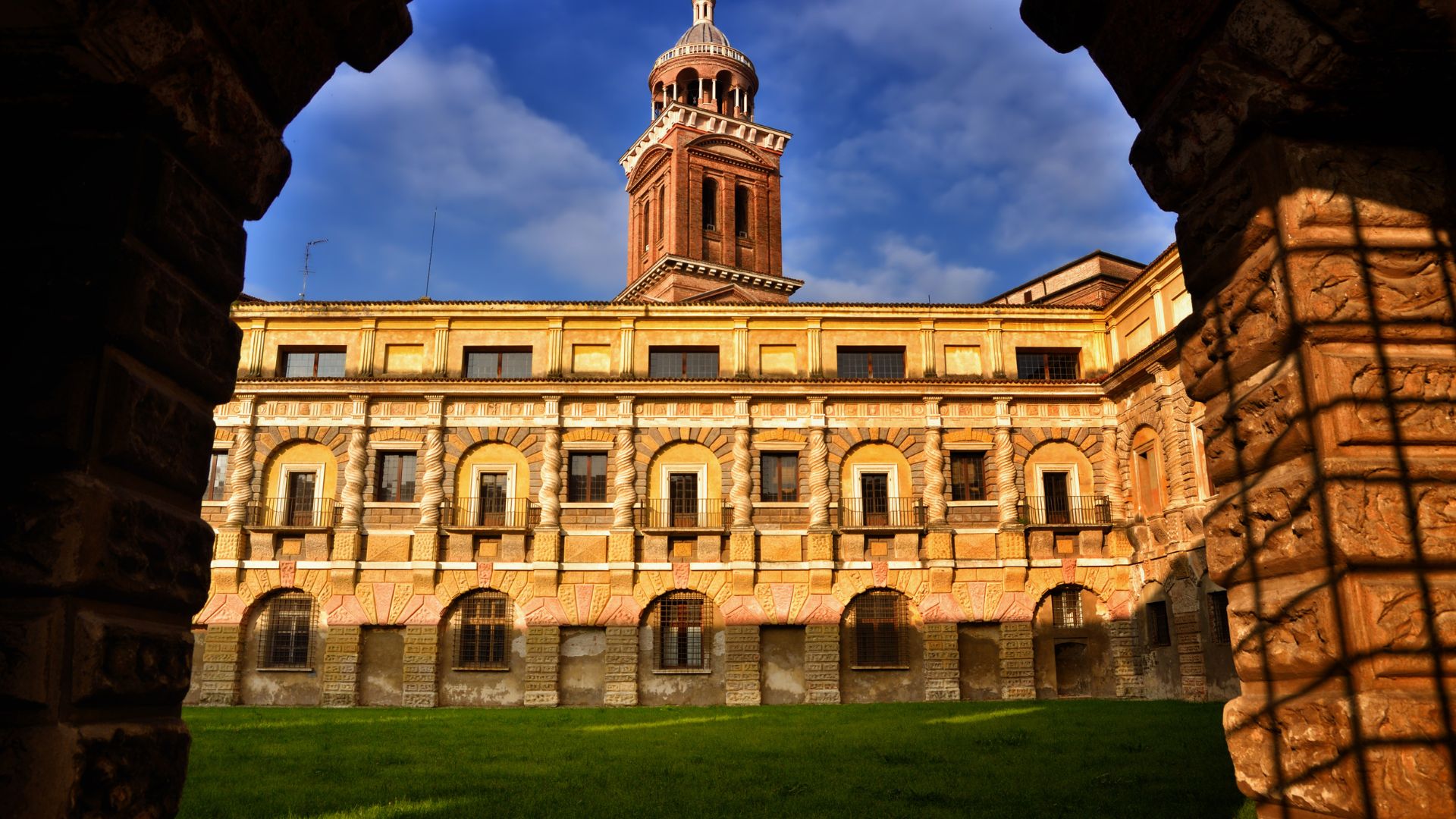
2. Castello di San Giorgio – the fortified castle by the lake
The massive brick structure with its four corner towers and moat is now part of the Palazzo Ducale complex, but was built in the 14th century as a standalone fortress to defend against attacks from the water. From the pier, the Castello is the city’s most iconic photo spot, looking its best in the evening light when the bricks glow.
Inside, you can climb up to the Camera degli Sposi; outside, you’ll find Mantua’s best walking path: once around the Castello and then along the shore of Lago di Mezzo. Good to know: You can only tour the castle with a ticket to the Palazzo Ducale; there is no separate admission fee.

3. Palazzo Te – Giulio Romano's Summer Palace
On the southern edge of the historic center, a twenty-minute walk from Piazza Sordello, stands the city’s second wonder of the world: the Palazzo Te, the summer residence that Giulio Romano—a student of Raphael—began building and painting in 1525 for Federico II Gonzaga. Its most famous room is the Sala dei Giganti, where falling giants seem to be shattering the walls and ceiling, and you find yourself standing right in the middle of the painting.
Admission costs €18.00 and includes the MACA Museum in the Palazzo San Sebastiano as well as the Tempio di San Sebastiano, the central building designed by Leon Battista Alberti. Useful for planning your week: The Palazzo Te is also open on Mondays from 9 a.m. to 7 p.m., on Tuesdays starting at 1 p.m., and is closed only on December 25. Starting September 26, 2026, the major exhibition will also be on view. Taking Stock of Nature featuring works by Leonardo, Arcimboldo, and Caravaggio.
4. Piazza delle Erbe with the Rotonda and the Torre dell’Orologio
The bourgeois counterpart to the courtly Piazza Sordello is Piazza delle Erbe, the old market square with arcades, cafés, and market stalls. On its narrow side, three buildings stand side by side: the Palazzo della Ragione, the medieval courthouse; the Torre dell’Orologio with its 15th-century astronomical clock; and the Rotonda di San Lorenzo, a Romanesque round church that lies below the level of the present-day square.
You can visit the tower and the palazzo with the city passes; you can usually enter the Rotonda for a small donation. The best time to visit the square is in the early evening, when the arcades fill up and the light casts a glow on the facades.

5. Basilica of Sant’Andrea – Alberti’s Legacy
With its imposing dome, the city’s largest church dominates every view of Mantua. It was designed by Leon Battista Alberti, the polymath of the Early Renaissance, in 1472—the year of his death. The construction was carried out by Luca Fancelli, the Gonzagas’ court architect, who began erecting the façade and nave in 1472; the Gothic campanile next to it was retained from the previous structure.
The crypt houses the Sacri Vasi, two reliquaries that, according to tradition, contain soil mixed with the blood of Christ. On Good Friday, they are displayed and carried in a procession through the city, and Mantua is then filled with pilgrims. Andrea Mantegna is buried in a side chapel. The church interior is accessible outside of Mass times, and the audio guide tour is included in the city passes.

6. Teatro Bibiena—the gem where Mozart performed
Unassuming from the outside, yet inside a whirlwind of curved box seats: The Teatro Bibiena on Via Accademia, built between 1767 and 1769 by Antonio Galli Bibiena as the Accademia’s scientific theater, seats just 338 people. Bibiena painted the monochrome frescoes in the boxes himself.
Just a few weeks after the grand opening, on January 16, 1770, a guest who was about to turn 14 gave a concert here: Wolfgang Amadeus Mozart, on his first trip to Italy with his father, Leopold. Today, you can visit the theater freely during opening hours; admission is included with the 24-hour pass. It remains closed to visitors before concerts and conferences, so a quick call to the information desk will save you a wasted trip.
7. Le Pescherie di Giulio Romano – Fish Market by the Canal
Where the Rio—the medieval canal that runs straight through the Old Town—flows under Via Pescheria, you’ll find the Pescherie: the old fish market halls with their double rows of stone columns, designed by Giulio Romano in the 16th century. Nothing has been sold here for a long time, but the bridge over the Rio is one of the city’s most atmospheric spots.
The detour is especially worth it in the morning, when the sun hits the canal and the building facades are reflected in the water. It’s less than a five-minute walk from Piazza delle Erbe.

8. The Three Lakes – Mantua's Waterfront
Lago Superiore, Lago di Mezzo, and Lago Inferiore are the names of the three lakes into which the Mincio River was dammed and diverted in the 12th century to protect the city. Today, they are a nature reserve and represent Mantua’s green side: lakeside paths, reed beds, and—in midsummer—entire fields of lotus flowers on Lago Superiore.
The best way to experience the lakes is from the water. The Barcaioli del Mincio, the boatmen’s cooperative from Grazie di Curtatone, navigate flat-bottomed boats through the reeds and water lilies; a one-hour trip costs €13.00, and a one-and-a-half-hour trip costs €15.00—reservations are required. Alternatively, you can simply take a stroll along the lakeside promenade at Lago di Mezzo, with the castle always in view.

How do you get to Mantua?
The most relaxing way to get there is by train: Trenord, Lombardy’s regional rail service, connects Mantua directly to Verona and Milan; the train station is located on the western edge of the old town. The nearest airport is Verona Villafranca, about 43 kilometers away; Bergamo and Milan Linate are 141 and 174 kilometers away, respectively.
You can reach the city by car via the A22 Brenner Highway or the A4. The Old Town is subject to a camera-monitored restricted traffic zone (ZTL), which restricted traffic zone, which you are not allowed to enter without a permit. It’s best to park in the blue zones on the outskirts of the Old Town: ASTER, the city’s parking authority, charges €1.70 per hour or €8.50 per day in Zone 1; payment is required daily from 8 a.m. to 1 p.m. and from 2:30 p.m. to 8 p.m.; rates are lower further out. The Lungolago Gonzaga area, which includes the Gonzaga Parking garage, is also located along the waterfront.
The most athletic way to get there is via the Ciclabile del Mincio, the 48-kilometer-long, flat bike path from Peschiera del Garda on Lake Garda, which is over Valeggio sul Mincio and leads from Borghetto to Mantua in four to five hours.
Access to the Centro storico is monitored by cameras and permitted only with authorization. Any unauthorized entry—even accidental—will result in a fine.

What should you definitely try in Mantua?
Mantua's cuisine is worth a trip in itself, and it begins with the Pumpkin Tortelli, the pumpkin tortelli, which are traditionally seasoned with mostarda in the filling and served with butter and sage. Their sweet-and-salty flavor combination is the city’s hallmark. Next comes the Risotto alla Pilota, the dry-cooked rice dish with crumbled pork sausage, named after the piloti, the rice farmers of the Po Valley.

Coffee goes well with sbrisolona, the crumbly almond cake that you don't cut, but break apart by hand. And then there's the Mantua-style mostarda, candied fruit with mustard oil, served with cheese and cooked meat, the Mantua-style salami and Grana Padano from the surrounding area. The perfect pairing is Lambrusco Mantovano, a ruby-red sparkling wine that has had its own DOC designation since 1987: fruity, smooth, low in tannins, and best served chilled.

Where's the best place to eat in Mantua?
Two restaurants epitomize the city's cuisine; both are in the center, and both are small. Making a reservation is considered good form in Mantua, and on weekends it's a must.
Two Places to Try in Mantua's Culinary Scene
| Restaurant | Here's what you can expect |
|---|---|
| Osteria dell’Oca Mantua, 10 Via Trieste | A small osteria with red walls covered in pictures, tortelli di zucca served either with butter and sage or with tomato and salsiccia, and Lambrusco served in a copper carafe. Closed on Tuesdays. |
| Trattoria Due Cavallini Mantua, 5 Via Salnitro | A traditional restaurant since 1939 that serves the classics of Mantua cuisine—from risotto alla pilota to sbrisolona—without any frills. |
As of September 2026 · Both restaurants are small—call ahead before your visit to reserve a table.

Where's the best place to stay in Mantua?
Mantua is small enough that any address in the old town is the right one. Three hotels offer three different styles: modern design, a cozy location between the squares, and Baroque suites with frescoes.
Three Houses in Mantua's Old Town
| Accommodations | Here's what you can expect |
|---|---|
| Hotel Casa Poli Mantua, 32 Corso Garibaldi | Four stars, clean, modern design, and quiet rooms, a ten-minute walk from Piazza Sordello. |
| Broletto Hotel Mantua, Via Accademia 1 | Eleven rooms in a prime location between Piazza Sordello and Piazza delle Erbe, right next to the Teatro Bibiena, with breakfast featuring regional products. |
| Palazzo Valenti Gonzaga House Museum Mantua, Old Town | Suites up to 70 m² in a Baroque city palace with frescoed halls, where you literally sleep in a museum. |
As of September 2026 · Festivaletteratura takes place in early September—so book early, because the city gets crowded.

Peschiera del Garda Attractions: 6 Highlights & Tips
The Venetian fortress in Peschiera del Garda has been a UNESCO World Heritage Site since 2017 and has no admission fee—six highlights on the southern shore of Lake Garda, including 2026 prices, travel information, and honest tips.
When is the best time to visit Mantua?
The best months are April through June and September through October: mild, clear, and with the most beautiful light over the lakes. Midsummer in the Po Valley is hot and humid, but in July and August, the lotus fields on Lago Superiore come into bloom. Between November and February, fog often settles over the city and the water, giving Mantua a unique, tranquil atmosphere.
In terms of the calendar, early September is a great time to visit, when Festivaletteratura transforms the city into a reading room, and Good Friday, with the Sacri Vasi procession. In both cases, be sure to book your accommodations early.

Which holidays should you plan for?
The biggest event of the year is Festivaletteratura, the literary festival that has been bringing authors from all over the world to courtyards, theaters, and squares every year in early September since 1997; in 2026, it celebrated its 30th edition. During those days, the city is fully booked like never before.
The second fixed date is Good Friday: On that day, the Sacri Vasi are brought out of the crypt of Sant’Andrea and carried through the city—one of Mantua’s oldest traditions. Visitors who come outside of these dates will find the city pleasantly quiet, even on regular weekends.
What You Should Know About Mantua
1. We are closed on Mondays. The Palazzo Ducale and the monuments in Sabbioneta are closed on Mondays. The Palazzo Te is open on Mondays but closed on Tuesday mornings—plan your palace visits accordingly.
2. The ZTL shows no mercy. The cameras in the Centro storico record every vehicle entering the area. Park your car in the blue zones or along the Lungolago and walk the last few meters—it’s never more than ten minutes.
3. Admission to the Camera degli Sposi is limited. 30 people every 10 minutes—if you show up on a whim on Saturday afternoon, you'll either have to wait or be turned away. Reserve your time slot online as soon as you know your appointment date.
4. Summer means muggy weather—and the lakes bring mosquitoes. From June through August, be sure to pack a water bottle and mosquito repellent, especially when you're out by the water in the evening. You'll be rewarded with long, warm evenings in the parks.
5. Fog reigns in winter. Between November and February, the lakes are sometimes shrouded in gray for days on end. The museums and the local cuisine more than make up for it; only the boat tours are on hiatus during that time.

Who should visit Mantua?
For art and architecture lovers A visit to Mantua is a must: Mantegna, Alberti, and Giulio Romano, all within a twenty-minute walk of each other—without the lines you find in Florence.
For Connoisseurs The city offers one of the most distinctive cuisines in northern Italy, ranging from pumpkin tortelli to sbrisolona.
For Cyclists Mantua is the perfect stopover: an easy ride along the Mincio Bike Path, with culture and cuisine to reward you.
For Families The boat tours through the reeds and water lilies are a real highlight, along with the short distances and ice cream shops at every stop.
For Night Owls The city is too quiet—after 11 p.m., the alleys belong to the cats. That’s exactly what makes it so pleasant for everyone else.
Combine Mantua with Sabbioneta, Verona, and Lake Garda
The most obvious day trip is to Sabbioneta, about 30 kilometers southwest: the “ideal city” that Vespasiano Gonzaga, a cousin of the Dukes of Mantua, had built on the plain in the 16th century according to Renaissance principles—with a star-shaped fortification wall, a theater, and dead-straight alleys. The Biglietto Unico for all six monuments costs €20.00; it’s closed on Mondays, and on weekdays, the 72-hour pass even gets you there for free on bus line 17.
Located to the north Verona with the Arena and Casa di Giulietta just an hour's train ride away, and the Lake Garda about 50 kilometers. Anyone cycling along the Mincio Bike Path will stop in Valeggio sul Mincio and the Borghetto stop; in the spring, it's worth Parco Giardino Sigurtà to the tulip blossoms right next door.


5 Days in Verona: Itinerary with Route, Excursions, and Tips
Three days exploring Verona on foot, two days of day trips to Lake Garda and Valpolicella—with an itinerary, verified ticket prices, and train connections instead of a rental car.
Through the Water Lily Fields with the Barcaioli
Skip the big pier and the buses, and head instead to Grazie di Curtatone, the pilgrimage village on Lago Superiore, a ten-minute drive from the city. From the small pier below the Santuario, the Barcaioli del Mincio set out and row you in flat-bottomed boats through reed-lined channels, carpets of water lilies, and—in midsummer—right through the lotus blossoms, until the towers of Mantua appear on the horizon.
One hour costs €13.00, and you’ll hear stories about the river that you won’t find in any palace. Call ahead to make a reservation—the boats don’t run on a schedule, but rather based on demand.
Our conclusion: Mantua is the most underrated art city in Lombardy
Hardly any other Italian city offers so much Renaissance art in such a small area, and hardly any other is visited by so few people. If you want to see Mantegna’s ceiling fresco, Alberti’s domed church, and Giulio Romano’s giants all in a single day, you can only do so here—and you’ll rarely have to wait in line.
It’s a great deal, too: Palazzo Ducale, Palazzo Te, and Sabbioneta cost a total of €56.00 when purchased individually, while the 72-hour pass costs €48.00 and includes city bus rides and admission to a dozen other museums. Two nights’ stay, a boat ride, a plate of tortelli: that’s all you need for a perfect weekend.
The best next step: Set your date for the first Sunday of the month, reserve the Camera degli Sposi, and plan your trip via the Lake Garda right along with it.
Map: Mantua, Lombardy
Photo Gallery: Mantua


FAQ - Frequently Asked Questions About Mantua
Experiences & sights
Prices, hours of operation, and schedules are subject to change. Check the official websites for the latest information before your trip.
Sources and Further Information
- Ministry of Culture – Ducal Palace of Mantua (accessed in September 2026)
- Fondazione Palazzo Te – Hours and Tickets (accessed in September 2026)
- Municipality of Mantua – Mantua and Sabbioneta Pass (accessed in September 2026)
- Visit Sabbioneta – Prices and Hours (accessed in September 2026)
- ASTER Mantova – Parking in the City (accessed in September 2026)
- in Lombardy – Mincio Bike Path (accessed in September 2026)