Naples – When you step out of the narrow alleys of the city center, you suddenly find yourself in a vast open space unlike any other square in Italy. On one side stands the 169-meter-long facade of the Palazzo Reale, the former royal palace; on the other, a colonnade encircles the domed church of San Francesco di Paola. The square itself is free—it’s a pedestrian zone—and you only pay an admission fee to enter the Palazzo Reale: €15.00 for adults; free for those under 18.
This page brings together everything you need to know for a visit: prices, hours of operation, how to get there, and the times of day when the park is at its most beautiful.
Piazza del Plebiscito by the Numbers
The park is open 24 hours a day, and admission is free. You'll only have to pay at the Palazzo Reale—and even there, only if you want to visit the royal apartments.
As of September 2026 · Information provided by the Palazzo Reale di Napoli, the Comune di Napoli, and the Ministero della Cultura.
- Architecture and Photography
- a quick stop between two museums
- Families with children who need space to run
- Evening walks
- Hot summer afternoons with no shade
- Days spent setting up the stage
- Anyone looking for a bench
- Drivers
What makes Piazza del Plebiscito so special?
It’s the sense of openness. There isn’t a single car around the square, and because it slopes gently upward, from the center you can see past the dome to the hill beyond. Until the 19th century, it was simply called Largo di Palazzo—Palace Square—and served as the royal court’s forecourt. It received its current name following the 1860 plebiscite, in which the Kingdom of the Two Sicilies confirmed its unification with the emerging Italy. “Plebiscito” is the Italian word for it.
The four sides date from four different periods of construction. To the east stands the Palazzo Reale; to the west, the church with its colonnade; to the north, the Palazzo della Prefettura, built by Leopoldo Laperuta in 1815; and to the south, the 18th-century Palazzo Salerno by Francesco Scuro. Together, they form a closed ring, the likes of which is rarely found in any other Italian city. The rest of the old town is just around the corner: from here, it’s only a few minutes to the Spaccanapoli, the dead-straight alley that cuts right through the historic center.
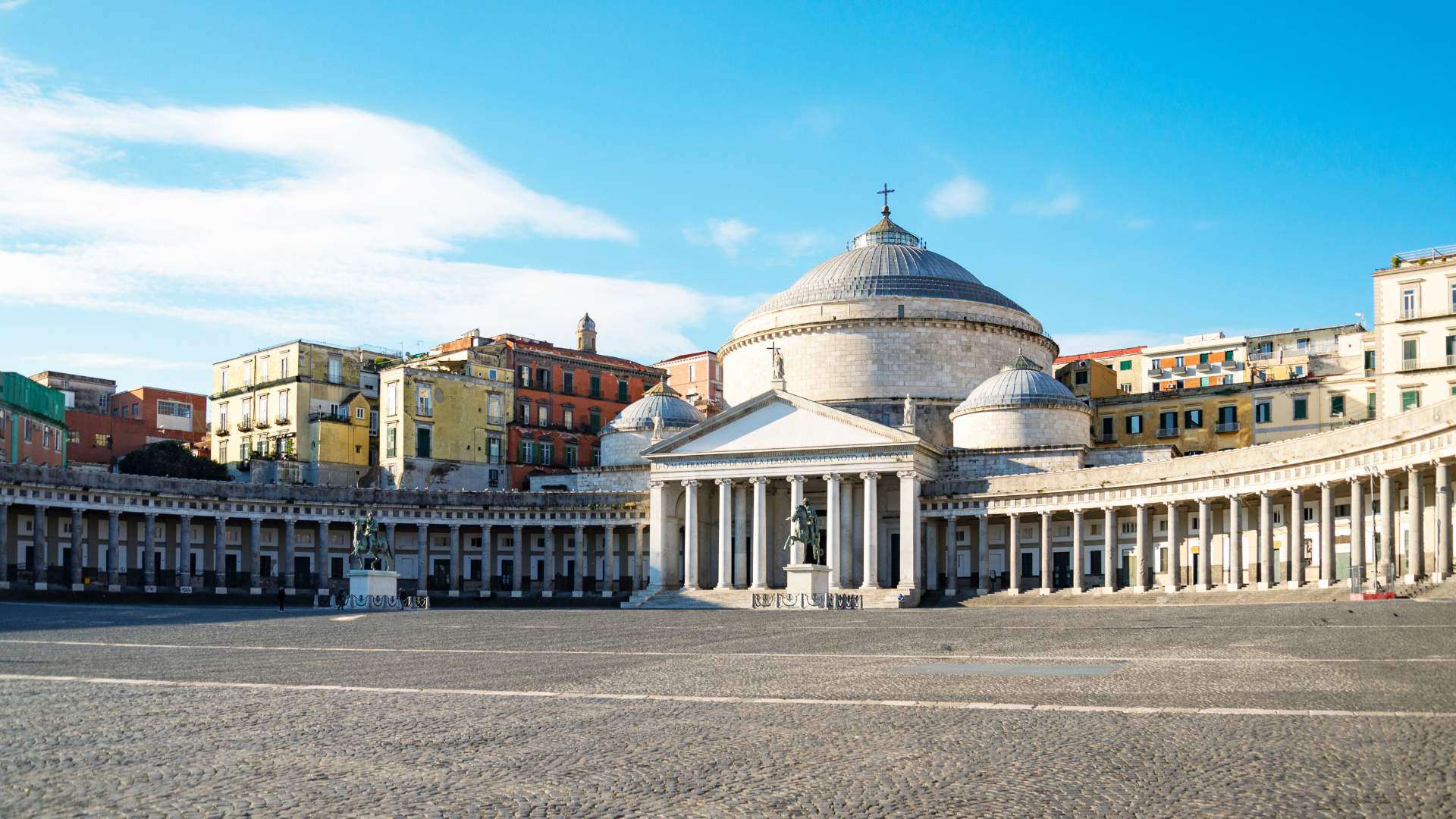
The Basilica of San Francesco di Paola and its colonnade
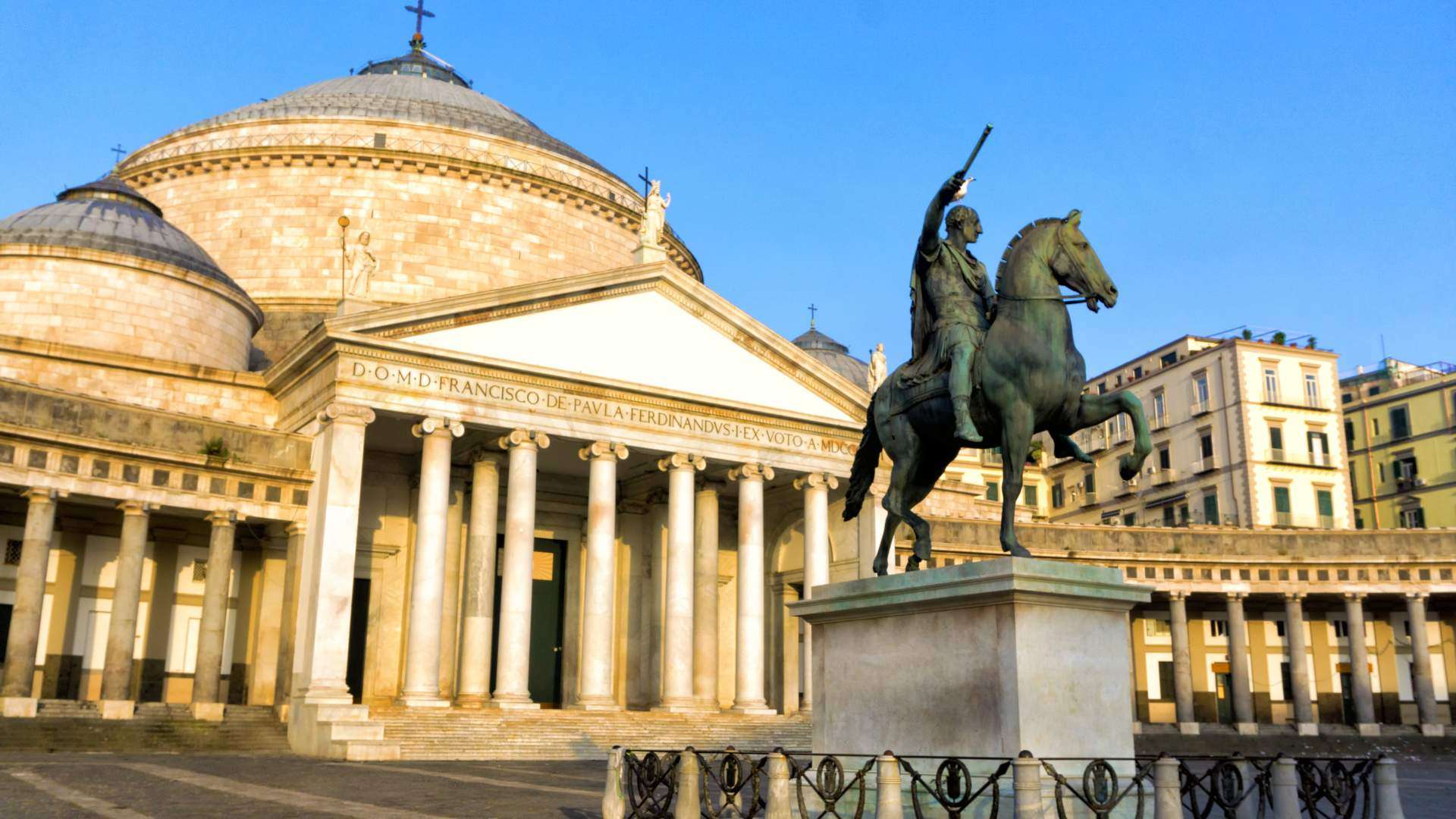
The semicircular colonnade that encloses the square on the west side was designed by the architect Pietro Bianchi and was built beginning in 1817. At its center stands the Basilica of San Francesco di Paola, a domed church with a portico. Anyone familiar with the Pantheon in Rome will immediately recognize the inspiration: a circular interior, a large dome above it, and a portico with a pediment in front.
Admission is free. It’s open daily from 9 a.m. to 12 p.m. and from 4 p.m. to 7 p.m.; be sure to factor in the lunch break. During church services, the church is open to worshippers, so that’s not a good time to visit. Inside, it’s worth looking up at the dome; outside, take a stroll along the colonnade—it’s the only place on the square where you’re sure to find shade in the summer.

How much does it cost to visit the Palazzo Reale?
The Palazzo Reale is the only part of the complex for which you pay an admission fee. The tour of the royal apartments, the Appartamento di Etichetta, costs €15.00; the reduced rate is €2.00 for everyone between the ages of 18 and 25. Admission is free for those under 18. If you want to combine a visit to the palace with a visit to the Museo Pignatelli, a nobleman’s palace in the Chiaia district, you pay €17.00 for both on the same day. Tickets are available at the ticket office or in advance through the Ministry of Culture’s website.
Entrance at Piazza del Plebiscito
| Offer | Price |
|---|---|
| Palazzo Reale, State Apartment | €15.00 Adults |
| Palazzo Reale, Ages 18 to 25 | 2,00 € |
| Palazzo Reale, under 18 | free |
| Special Evening Hours | 5,00 € |
| Palazzo Reale and Museo Pignatelli | €17.00 for one day |
| Un anno Reale Annual Pass | 25,00 € |
| Naples Artecard, three days | €27.00 · €16.00 for ages 18 to 25 |
Admission to the square itself, the Basilica of San Francesco di Paola, and the passageway under the colonnade is free. The Napoli Artecard is valid for three days at approximately 80 venues throughout the city and includes local public transportation.
As of September 2026 · Information provided by the Palazzo Reale di Napoli and Campania Artecard.


Naples Attractions: 7 Highlights You Can't Miss
From the Veiled Christ to 40 meters beneath the city: Naples’ highlights, including prices, hours, and honest recommendations—plus the best neighborhoods to stay in and the pizza that’s worth every...
When is the Palazzo Reale open?
The palace opens at 9 a.m., and the royal apartments remain open until 8 p.m. It is closed on Wednesdays, as well as on January 1 and December 25. The smaller areas close earlier, most notably the Museo Caruso, which is dedicated to the tenor Enrico Caruso and closes as early as 2 p.m. So if you want to see everything, come in the morning.
Palazzo Reale and the Basilica on the daily itinerary
| Area | Open |
|---|---|
| Etichetta Apartment | 9 a.m. to 8 p.m., last admission at 7 p.m. |
| Factory Museum | 9 a.m. to 7 p.m., last admission at 6:30 p.m. |
| Caruso Museum | 9 a.m. to 2 p.m., last admission at 1 p.m. |
| Romantic Garden | 9 a.m. to 7 p.m., last admission at 6 p.m. |
| Palazzo Reale's Day Off | Wednesday, plus January 1 and December 25 |
| Basilica of St. Francis of Paola | Daily from 9 a.m. to 12 p.m. and 4 p.m. to 7 p.m. |
As of September 2026 · Information provided by the Palazzo Reale di Napoli and InfoPoint Napoli.

The two equestrian statues in the center
In the center of the square stand two bronze equestrian statues: Charles III of Bourbon, who expanded Naples into a royal capital in the 18th century, and his son Ferdinand I. Both were created by Antonio Canova, the most famous sculptor of Italian Classicism. The statue of Ferdinand was created by Antonio Calì, a Neapolitan sculptor, after Canova’s death.
There’s a game that Neapolitan children like to play around the two pedestals: walking blindfolded from the palace gate through the gap between the horses. It almost never works because the square is slightly sloped, and you drift to the side without noticing. Try it on a quiet morning, with someone watching over you.

How do you get to Piazza del Plebiscito?
The easiest way is by metro. Line 1 stops at the Toledo and Municipio stations; from both, it’s just a few minutes’ walk. If you’re coming from the hills, take the Funicolare Centrale, one of the city’s four funiculars, and get off at the Augusteo station, right behind the square. From Capodichino Airport, the Alibus goes to the main train station at Piazza Garibaldi and continues on to the Molo Beverello ferry terminal; from there, the route follows the waterfront to the palace.
It's a hassle to get there by car. The square itself is a pedestrian zone, and the surrounding streets are narrow and largely closed to through traffic. Park your car in a parking garage at the harbor and walk the last few minutes.
You won't find out how much parking costs until you get to the barrier. Expect to pay big-city parking garage rates, and be sure to bring a card—contactless payment is faster at many payment terminals.

When is it worth visiting?
Early in the morning, you’ll have the square almost all to yourself, and the light streams in from the east, across the palace and onto the dome. In the evening, the scene changes: the colonnade and the church are illuminated—on holidays, sometimes in green, white, and red. At New Year’s, the city of Naples regularly hosts a free concert here that draws tens of thousands to the square.
Good to know: These events are exactly the catch. Once the stage is set up, half the square is fenced off, and the unobstructed view of the colonnade is blocked for a few days. The city announces the barriers on short notice. If you’re flexible, you can postpone your visit by a day and have the entire area to yourself the next morning. And even with the stage set up, the path under the columns remains clear—there you can stand dry and in the shade.

The Colonnade at Blue Hour
Come half an hour after sunset and stand in the colonnade instead of in the open area. From there, two columns frame the illuminated dome; the sky is still blue, and the lights from the houses above the square add a second layer to the scene.
That’s also the quietest time of the day: the tour groups are gone, and the Neapolitans are still enjoying their aperitifs. Around 8:30, the square starts to fill up again.

Our conclusion
Piazza del Plebiscito isn't a place where you spend half a day, but one you pass by twice: once in the morning to see the palace and the church, and once in the evening to see the lights. Together with the Naples Cathedral and the Castello dell'Ovo That adds up to a full day in the city center. To find out which other buildings belong on the list, check out our overview of the Sights in Naples, and you can find everything else you need to know about the city in the Naples City Guide.
The Royal Palace and the Basilica at a Glance
| House | Contact us |
|---|---|
| Royal Palace 1 Piazza del Plebiscito | 80132 Naples, Phone +39 081 5808255, Tickets available at the box office and through the Ministry of Culture's website |
| Basilica of St. Francis of Paola Piazza del Plebiscito | 80132 Naples, Parish Office of the Archdiocese of Naples, Phone +39 081 294797 |
As of September 2026 · Information provided by the Palazzo Reale di Napoli and the Archdiocese of Naples.
FAQ - Frequently Asked Questions About Piazza del Plebiscito
Prices, hours of operation, and schedules are subject to change. Check the official websites for the latest information before your trip.
Sources and Further Information
- Royal Palace of Naples, Visitor Information (accessed in September 2026)
- Ministry of Culture, Royal Palace of Naples (accessed in September 2026)
- City of Naples, Piazza del Plebiscito (accessed in September 2026)
- InfoPoint Napoli, Basilica of St. Francis of Paola (accessed in September 2026)
- Archdiocese of Naples, Directory of Parishes (accessed in September 2026)
- Campania Artecard, Rates (accessed in September 2026)