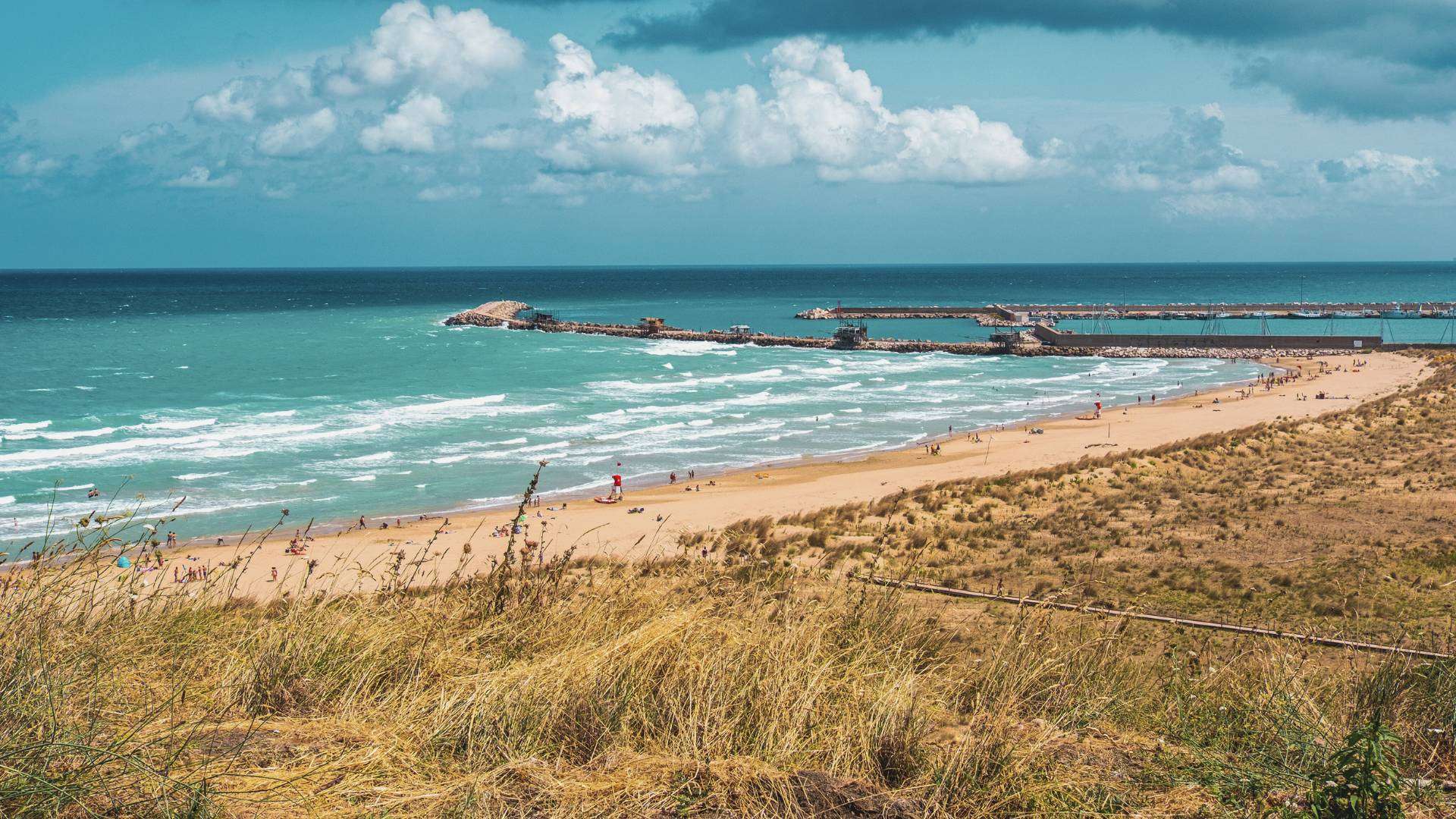
Costa dei Trabocchi – the Trabocchi Coast is a stretch of coastline about 70 kilometers long in the province of Chieti, along which 32 wooden fishing structures jutting out into the sea on stilts. A car-free bike path along the old Adriatic railway line connects Francavilla al Mare and San Salvo. Here, you can combine swimming, biking, and dinner overlooking the water all in one day.
This coast isn't another Amalfi. It's quieter, more affordable, and much less developed. That's exactly what makes it appealing to anyone looking to experience Italy away from the tour buses. We'll show you the Seven Highlights, how much they cost, where you can eat really well, when it gets crowded—and which sections will be closed in the summer of 2026.

The Costa dei Trabocchi at a Glance
The coastline lies on the Adriatic Sea in Abruzzo, in the province of Chieti, and stretches from Francavilla al Mare to San Salvo. Its landmarks are the trabocchi — Wooden fishing structures standing on stilts in the sea.
The most famous attractions are the Trabocco Turchino, the Via Verde dei Trabocchi, and the Abbazia di San Giovanni in Venere. You can reach the region via Pescara Airport, the A14 highway (which has four exits), or the „Trabocchi Line“ train route.
As of August 2026 · Most of the highlights are accessible for free.
- Cyclist
- Connoisseur
- Nature Lovers
- Couples
- Individual travelers by car
- Travelers without a car
- Anyone expecting wide sandy beaches
- Anyone who wants to go out to eat on the spur of the moment

Why is the Costa dei Trabocchi worth visiting?
Because it has preserved a design that is otherwise almost nonexistent. A trabocco is a platform built on driven piles, from which long arms lower a net covering more than 270 square meters into the water. This meant the fisherman never had to venture out into the open sea—an advantage on a coast where the weather can change quickly. The first facilities are intended for the The year 1627 It has been documented that, since the 1970s, they have been using decommissioned Railroad tracks increased.
Gabriele D’Annunzio, who spent the summer of 1889 here, described one of these structures as a „giant fishing machine made of intertwined logs, planks, and ropes.“ That description captures it better than any photo: these things look like beached insects. Anyone who Fishing huts near Cesenatico Anyone familiar with it will recognize the principle—though the Abruzzo version is significantly larger and protrudes further.
There is also a second, more recent reason. Because the railroad line was rerouted inland in 2005, there is now a car-free route right on the water. It winds through converted tunnels, past coves, and right through the heart of the Trabocchi landscape. For the Abruzzo region, which is otherwise best known for its mountains and national parks, this is an unusual attraction.

What are the 7 must-see highlights of the Costa dei Trabocchi?
These seven destinations span the coast from north to south and can easily be visited over two to three days. They are all within an hour's drive of each other.
1. Trabocco Turchino near San Vito Chietino
The Trabocco Turchino is the most famous on the coast and the only one you can look inside without ordering a meal. The municipality San Vito Chietino has him Purchased in 1981 and was deliberately not converted into a restaurant. It is a listed historic building and served as the setting for D’Annunzio’s novel *Il trionfo della morte*.
You can only tour it on a guided tour: 10 euros for adults Ages 15 and up, 5 euros for children ages 4 to 14, free for children under 3. The tour lasts just under two hours; the meeting point is the Welcome Point at the Via Lungomare Sud, Ericle d’Antoniola. Important: You need at least six participants, otherwise the tour will be canceled—so be sure to register early. In the summer of 2026, there will also be a sunset cocktail reception from June 26 through August 28, between 6:00 p.m. and 9:00 p.m.
Our take: If you just want to see the inside of a trabocco, this is the one to visit. The view from the Belvedere above is free and almost just as good.

2. The Via Verde dei Trabocchi
The Via Verde dei Trabocchi is the bike path along the abandoned railroad right-of-way, and it is the very reason why this stretch of coastline has been rediscovered in recent years. The main section measures 42 kilometers from Ortona Lido until Marina di Vasto. If you calculate the official coastal route from Francavilla al Mare to San Salvo Marina, you'll get 64.5 kilometers through nine municipalities.
The route is almost flat, paved for 52 kilometers, and open to cyclists and pedestrians. It's free to use. An audio guide in the izi.TRAVEL app explains what you're passing by for 2.49 euros. Rental stations are located in Ortona, San Vito Chietino, Fossacesia, Torino di Sangro, and Vasto; providers usually quote prices only over the phone.
But the truth remains: The Via Verde 2026 is not open to traffic along its entire length. Between Mottagrossa and at the mouth of the Sinello River near Punta Aderci, the road has been closed since a landslide in March 2025; the detour is about seven kilometers long. At Lago Dragoni Coastal erosion forces you to take the SS16 for about two kilometers. You drive this stretch in a truly relaxed manner Ortona to Torino di Sangro, a good 21 kilometers with rest areas and beach access points.

3. Abbey of San Giovanni in Venere in Fossacesia
The Abbey of San Giovanni in Venere It stands 107 meters above the Gulf and is the most impressive structure on the coast. Benedictines built it on top of the ruins of a Temple of Venus, hence the unusual name. The abbey was founded in 1015 by Trasmondo II, Count of Chieti; construction of the present-day building began in 1165.
Admission is free. In July and August, the complex is open on weekdays from 8:30 a.m. to 10:00 p.m., and on Sundays and holidays starting at 8:00 a.m. — unusually long hours for an Italian church. During services, the basilica, crypt, and cloister are closed to visitors; guided tours are available only by prior telephone reservation.
You should check this out Portals of the Moon, the marble Moon Gate: On the summer solstice, the light of the setting sun shines all the way into the crypt. There, columns from the ancient temple still stand, along with frescoes from the late 12th and 13th centuries. The cloister, with its 68 small columns, has been partially reconstructed but still looks harmonious. Since 1954, Passionists the abbey.

4. Punta Aderci Nature Reserve near Vasto
The Punta Aderci Regional Nature Reserve is with 285 hectares The first coastal protected area in Abruzzo, established in 1998. It stretches from the beach Punta Penna all the way to the mouth of the Sinello. From the 26-meter-high cape, on a clear day, you can see as far as the Gran Sasso and the Maiella.
The beaches are all unoccupied and undeveloped: the long sandy beach at Punta Penna, the pebble coves Libertini Beach and Mottagrossa as well as the small cove on the other side of the cape. About 80 steps lead down to the Libertini. Since the 2026 season, the Parking: 1 euro per hour or 5 euros per day; From July 1 through August 30, a shuttle runs every ten minutes during the day between the parking lot and the beach.
Dogs are allowed only on Mottagrossa Beach; in the rest of the reserve, they must be kept on a leash. Fires and off-road driving are prohibited. The panoramic trail along the old railroad right-of-way is The road toward Sinello remains closed – Plan your return trip accordingly.
5. Ortona, with the Castello Aragonese and the Passeggiata Orientale
Ortona is the largest city on the coast and the only one with a train station close to the city center. The Castello Aragonese Dating from 1452, it stands on the cliff above the harbor and is a ruin steeped in history: In 1943, it was Battle of Ortona It was bombed; in 1946, the section on the hillside slid down, taking one of the four towers with it. Three still stand, and the site has been open to the public again since 2009. Inside, you won’t find a museum tour, but rather a garden and a view.
Right next to it begins the Passeggiata Orientale, a promenade with a 19th-century white marble balustrade. On a clear day, the view extends all the way to the Tremiti Islands. In the Basilica of St. Thomas the Apostle have been in place since September 6, 1258 The relics of the Apostle Thomas, which a man from Ortona brought back from the island of Chios on three galleys. The crypt beneath the main altar is open to the public, but the parish only publishes Mass times—it’s worth calling ahead.
About five kilometers to the south lies the Moro River Canadian War Cemetery with 1,615 graves, including 1,375 Canadians. It is open year-round and is one of the quietest places on the entire coast.

6. The Old Town of Vasto
Vasto With a population of about 41,000, it is the most urban town on the coast and lies 143 meters above sea level. Its centerpiece is the Palazzo d’Avalos Dating from the second half of the 16th century, it was built after the destruction of the previous structure during the Turkish invasion of 1566. Today it houses four museums: Archaeology, the Pinakothek with works by the Palizzi family of painters, contemporary art, and a costume museum. The A single-ride ticket costs 6 euros, From July 1 through August 31, it is open daily from 10 a.m. to 1 p.m. and from 6 p.m. to midnight.
From the palace garden, the Amblingh Loggia a suspended balcony-like road running along the edge of the old town, overlooking olive and orange groves. It is named after a man from Graz who served as secretary to the d’Avalos family in the early 18th century. The Castello Caldoresco on Corso Garibaldi impressive from the outside with its bastions – The interior is not open to the public, it is privately owned.
North of the city stands the The 70-meter-high Punta Penna Lighthouse, the second-tallest in Italy after the Lanterna of Genoa. It was destroyed in 1944 and reopened in 1948. It is staffed and in operation; tours of the interior are only available during rare special openings.

7. Dinner on a trabocco
About half of the 32 trabocchi are now operated as restaurants, and that’s the real attraction of the coast. You sit on wooden planks over the water, with nets hanging below you, and you’re served a Set Menu From what was online this morning. There usually aren't any alternatives to the map.
Houses for which there is reliable documentation are Trabocco at Punta Cavalluccio and Sasso della Cajana in Rocca San Giovanni, Trabocco Valle Grotte in San Vito Chietino, Dogfish and Punta Rocciosa in Fossacesia, as well as Cungarelle in Vasto. At Cavalluccio, the set menu costs 70 euros per person, not including wine; Punta Rocciosa's prices were most recently 60 euros, and it has just 35 seats.
There are two things you need to know. First: You can't do anything without a reservation. Seats are limited, and several websites explicitly state „prenotazione obbligatoria.“ During peak season, you should book three to four weeks in advance. Second, very few restaurants list their prices online—be sure to confirm the menu price over the phone, or the bill will come as a surprise.


Abruzzo Travel Guide
Abruzzo Travel Guide: the most beautiful places and mountain villages, three national parks, the Trabocchi Coast, the best time to visit, and how to get there—an overview of all Abruzzo articles from italien.news.
What other sights are worth seeing?
The Job's Shelters South of Ortona lies a cove with white pebbles nestled beneath a steep, vegetated cliff, which has been protected as a 35-hectare nature reserve since 2007. A wooden staircase with about 190 steps leads down to the cove; it was renovated in June 2026 and is now fully accessible again. In 2026, the cove bears the Blue flag.
Rocca San Giovanni is the only place on the coast that is among the Borghi più belli d'Italia is considered one of Italy's most beautiful villages. Only about 470 people still live in the historic center. Worth seeing are the Romanesque Church of St. Matthew and the medieval watchtower overlooking the hamlet Vallevò.
With Torino di Sangro protects the Riserva Lecceta a holm oak forest spanning 175 hectares just behind the coast—its heraldic animal is the Greek Tortoise. In Casalbordino it says Shrine of Our Lady of Miracles, designated a minor basilica since 2010, with a 37-meter-high dome; the Lido in front of it preserves one of the last intact dune systems on the Abruzzo coast.
The Dannunziano Hermitage Near San Vito Chietino, there is not a hermitage, but a 19th-century farmhouse where D’Annunzio spent the summer of 1889 with Barbara Leoni. It is privately owned and operated as a house museum; the The opening hours are inconsistent – Check with the town hall in San Vito Chietino before you go.
Which museums are worth visiting?
The number of museums is manageable. The most important one is the one already mentioned, Palazzo d’Avalos in Vasto, with its four collections, for a 6-euro flat-rate ticket.
The Museum of the Battle of Ortona within the complex Sant’Anna On Corso Garibaldi, it displays about 1,000 artifacts related to the 1943 battle and is the 1,314 civilian casualties Dedicated to... Please note: The Ministry of Culture lists the venue as „temporarily closed for restoration work,“ but the municipality still lists its opening hours. Call ahead before visiting, or you’ll find yourself standing in front of a locked door.
Anyone interested in the trabocchi themselves will find the educational exhibits more informative than any museum: Punta Tufano In Rocca San Giovanni, groups of ten or more can take a guided tour of the structure for 3 to 5 euros, Punta le Morge Near Torino di Sangro, it's run by a club and charges 2 to 3 euros per person. Both are No restaurants For individual guests.

How much do the attractions along the Costa dei Trabocchi cost?
Not much, compared to the coasts further north. The most expensive part isn't the admission fee, but the food. A day spent cycling along the bike path, visiting the abbey, and going to the beach will cost less than that—even without eating out. 10 euros per person from.
| Offer | Price |
|---|---|
| Via Verde dei Trabocchi | Free · Audio Guide App €2.49 |
| Guided Tour of Trabocco Turchino | €10 for adults ages 15 and older · €5 for children ages 4–14 · Free for children under 3 |
| Museums of Palazzo d’Avalos, Vasto | €6 single-ride ticket · Free for children 10 and under |
| Guided Tour of the Trabocco at Punta Tufano | 3–5 € per person · groups of 10 or more only |
| Tour of the Trabocco at Punta le Morge | €2 for school groups · €3 for other groups |
| Parking at Riserva Punta Aderci | 1 €/hour · 5 €/day |
| Menu at a Trabocco Restaurant | 60–80 € per person; drinks are usually extra |
Admission is free to the Abbazia di San Giovanni in Venere, all the beaches in the Punta Aderci Nature Reserve, Ripari di Giobbe, the Castello Aragonese in Ortona, the Passeggiata Orientale, the Loggia Amblingh, and the Moro River Canadian War Cemetery.
Bicycle rental companies along the coast generally do not publicly list their prices. Expect the usual Italian rates and call ahead to ask, especially if you’re renting a E-bike you'll need for the entire route.

How do you get to the Costa dei Trabocchi?
The easiest way is to travel by car or fly to Pescara and then rent a car. The Abruzzo Airport in Pescara is located about four kilometers from the city center and is the nearest airport. From German-speaking countries, Ryanair flies from Memmingen direct flights; you should check the other available connections yourself before booking.
The following will take you from the airport to downtown: Pescara Airlink, a combined bus and train route with no stops along the way. The bus fare is 1.40 euros and takes no more than 25 minutes. At the train station Pescara Central You'll transfer to the regional trains heading south.
You can reach the coast by train via what Trenitalia calls the „Trabocchi Line“ between Pescara Centrale and Termoli. The stops are called Francavilla al Mare, Ortona, San Vito-Lanciano, Fossacesia–Torino di Sangro, Casalbordino-Pollutri and Vasto-San Salvo. Only Ortona is still located near the town center, right at the harbor entrance. All other stations were built in 2005 when the line was rerouted inland and are now located three to five kilometers outside the town.
If you're driving, take the A14. From north to south, you can take the following exits: Pescara Sud–Francavilla al Mare, Ortona, Lanciano, Val di Sangro, Vasto Nord–Casalbordino, and Vasto Sud–San Salvo. The SS16 Adriatica runs close to the coast for long stretches and is the more scenic, though slower, route. You don’t have to worry about restricted traffic zones (ZTL) like those in big cities, but you should expect crowded parking lots in August.

How do you get from place to place?
The best way to get around is by bike; the next best option is by train. Although there is a public bus service along the coast, it is infrequent and varies by season.
The Combining a regional train and a bicycle It works better on this coast than anywhere else in Italy because the Via Verde connects the train stations. For example, you can take the train to Ortona, rent a bike there, and ride the 21 well-maintained kilometers to Torino di Sangro. Rental stations are located in Ortona, San Vito Chietino, Fossacesia, Torino di Sangro, and Vasto, with several of them right along the route.
The regional operator TUA It serves the coastal towns with buses; the region sets the fares. Schedules and stops change seasonally—the operator’s route finder is more reliable than any posted schedule. In Vasto, Line 3 takes you to the Punta Aderci Nature Reserve; in midsummer, this is supplemented by a shuttle from the parking lot to the beach. If you want to see the entire coast, however, you’ll still need a car or an e-bike.

What must you definitely try on the Costa dei Trabocchi?
The competent court is called Vastese-style fish stew and differs from every other Adriatic fish soup in that not goes into it. No soffritto, no water, no broth, no vinegar, and never potatoes. It’s cooked in the Terracotta Pot, the fish is left whole. It’s served with ripe tomatoes, sweet bell peppers, peperoncino, parsley, garlic, and olive oil. The dish must include at least six species of rockfish from the sea between Ortona and Vasto: scorpionfish, weever, gurnard, red mullet, cuttlefish, and sea locust. The bread is toasted and served on the side; the pasta is cooked separately and mixed with the cooking liquid only at the table.
From the hinterland comes the Ventricina del Vastese, a coarse, uncooked sausage made from high-quality cuts of pork, which is used as Slow Food Presidium is protected. Its territory lies between the Trigno and Osento rivers and encompasses about 30 municipalities. Chemical preservatives are prohibited, and the animals’ feed must be GMO-free.
When it comes to wine, the province of Chieti is at the heart of Abruzzo’s wine-growing region. In addition to the ubiquitous Montepulciano d'Abruzzo The indigenous white grape variety is worth it Cococciola, which grows almost exclusively here and has a pronounced acidity. One distinctive feature is Tullum DOCG: The growing region includes only the municipality of Tollo in the hinterland, making it one of Italy's smallest DOCG regions. When it comes to olive oil, look for the DOP Colline Teatine with the additions „Frentano“ or „Vastese.“.
Sweets come from the interior of the country: The Sise delle Monache In 1884, a pastry chef named Giuseppe Palmerio from Guardiagrele invented a dessert consisting of two layers of sponge cake with pastry cream, shaped like three hills.

Where's the best place to eat on the Costa dei Trabocchi?
You have two options: the experience on a trabocco or the hearty cuisine in the old towns. You’ll pay significantly more for the first, but you’ll often get better fish with the second. These five spots on land are currently well-rated and are confirmed to be open in 2026.
| Restaurant | Here's what you can expect |
|---|---|
| Hostaria del Pavone Vasto, Via Barbarotta | Raw fish and modern interpretations, listed in the Michelin Guide. The most sophisticated restaurant on the coast. |
| Lo Scudo Restaurant Vasto, Corso Garibaldi | The flagship is the Vastese-style fish stew. If you want to try the original without the Trabocco topping, go here. |
| Trattoria Da Mario Ortona, Via Cavour | Seafood trattoria since 2006, brodetto served in a terracotta pot, chitarrina with clams and mullet bottarga. |
| Trattoria San Domenico Ortona, across from the Castello | Set menus featuring the day's catch, along with the Ortonesian version of brodetto. A small menu, a clear concept. |
| Bottega Culinaria San Vito Chietino, Contrada Pontoni | Creative, vegetable-focused cuisine in a rural setting, listed in the 2026 Michelin Guide. Open only a few days a week. |
On the trabocchi themselves are Punta Cavalluccio and Sasso della Cajana in Rocca San Giovanni, as well as Valle Grotte is most reliably documented in San Vito Chietino. Valle Grotte is the only one with its own secure parking lot – a real selling point on this coast. For most places, the season runs from April through October.
One more note: The former resort Villa Vignola The hotel and restaurant near Vasto have been permanently closed since 2025. Older recommendations online lead nowhere.
Restaurant and hotel recommendations are based on current reviews and market research (as of August 2026) and do not constitute paid advertising.

Where's the best place to stay on the Costa dei Trabocchi?
The rule of thumb: Vasto Marina for a beach vacation with amenities, Ortona For those traveling without a car, San Vito Chietino and Fossacesia for its proximity to the Trabocchi and the Via Verde. Cyclists should look for houses with bike storage and rental services—there are a striking number of them here.
| Accommodations | Here's what you can expect |
|---|---|
| Excelsior Hotel & Spa Marina di Vasto | Four stars, 55 rooms, spa and pool, private sandy beach 300 meters away via a private underpass. Special offers for cyclists; check-in and check-out on Saturdays. |
| Hotel Perrozzi Vasto Marina | A three-star hotel with a pine grove, pool, and private beach. From August 1 to 22, 2026, a double room with breakfast costs 146 euros per night; during the off-season, rates start at 91 euros. The most transparent price list on the coast. |
| Hotel Mara Ortona, Lido Riccio | Four-star, open year-round, right on the beach, with a semi-Olympic-sized pool, a beach club, and bike and e-bike rentals. |
| The Key to the Trabocchi San Vito Chietino, Contrada Portelle | A four-star hotel with a private beach overlooking the trabocchi, a seasonal pool, a shuttle to the beach, and free bike rentals. |
| Traboccante B&B Fossacesia Marina, Waterfront | B&B, about 50 meters from the pebble beach and right on the Via Verde. The obvious choice for cyclists on a budget. |
| Agriturismo La Costa dei Trabocchi Torino di Sangro | A four-room agriturismo on a panoramic plateau, located roughly halfway between Vasto and Ortona. Bicycle-friendly, with horseback riding facilities; dogs welcome. |
| La Foce Campground Lido di Rocca San Giovanni | Campground and Bungalow Village. During the high season, from July 18 to August 23, 2026, a RV site for two people with electricity costs 38 euros per day, and a bungalow for four people costs 120 euros. |
If you're coming in August, book by May at the latest. The houses are small, and starting around Ferragosto, the coast is fully booked.
Top Accommodations on the Costa dei Trabocchi, Italy

When is the best time to visit the Costa dei Trabocchi?
For Cycling and Culture May through June and September through early October, for swimming in July and August. The old railroad right-of-way has very little shade, and with average high temperatures of 28 degrees in July, it becomes unbearable at midday.
The waters of the Adriatic Sea reach here in the August: an average of 26.7 degrees and is therefore the warmest; in July the temperature is 26.2 degrees, and in June it’s 23.2. The swimming season lasts practically from June through October, since even in October the water is still around 20 degrees. Lifeguards are on duty at the supervised sections from June 1 through September 13.
The high season is indicated in the price lists: It runs from July 18 through August 23, with rates peaking around Ferragosto on August 15. Starting on August 23, room rates drop noticeably, and by the first week of September, they’re back down to off-season levels. Visitors in May can expect five days of rain and 11.5 hours of sunshine per day—the best combination for the Via Verde. The wettest months are November through January.

What holidays and celebrations should you plan for?
The biggest religious festival is the Perdono of Ortona celebrating the Apostle Thomas, held annually on the first Sunday in May and featuring the historic procession of the Silver Keys and a fireworks display at the Castello Aragonese. Sixtus IV specifically moved the festival to this date because of the large number of pilgrims.
In Casalbordino will take place from June 10 to 12 Madonna of Miracles celebrated in commemoration of a Marian apparition on June 11, 1576. Slow Food Abruzzo organizes the festival in Vasto in early June Fish Stew & Sides, where several restaurants prepare the fish soup the traditional way—you should check the date for 2026 in advance.
The busiest month is August in Vasto. Scheduled for 2026 are the Sagra della Ventricina on July 25 and 26, the Festa del Ritorno on August 2, Sagne e Fasciule on August 9 and 10, the Sagra delle Campanelle di San Rocco on August 16, and the historical reenactment of the Toson d’Oro on August 22 and 23. From August 1 through 12, the Midnight Concerts. The Sagra del Pesce will take place on September 4 and 5.
Let's be honest: These dates fall right during the time when the coast is already packed. If you're looking for peace and quiet, avoid Vasto between August 10 and 20. A taste of Abruzzo's festival culture away from the coast is the Cocullo Snake Festival inland.


Scanno Attractions: 5 Highlights Around the Heart-Shaped Lake
A mountain village at 1,050 meters, a heart-shaped lake, and a traditional black costume found nowhere else. We'll show you the most beautiful sights in Scanno—including prices, how to get there...
What You Should Know About the Costa dei Trabocchi
This coastline is undergoing major changes, and some of them are taking a toll on visitors. Here are five things you should know before you go.
- Erosion is real: On April 6, 2026, the historic building Trabocco Canale near Vasto, one of the last where fishing still took place. At Punta le Morge The beach has practically disappeared since February 2026. The region has approved protective measures totaling 2.56 million euros, but they are still barely visible.
- There are gaps in the Via Verde: The section near Punta Aderci has been closed since March 2025; although the hole was filled in July 2026, a second roadblock remained in place. Expect detours ranging from two to seven kilometers, some of which run along the SS16, which has no shoulder.
- Reservations are required, not just recommended: Some of the Trabocco restaurants have as few as 35 seats and serve set menus. You can't just drop in on a whim, and anyone with allergies or a vegetarian diet should mention this when making a reservation.
- Many beaches are pebbly, not sandy: Fossacesia Marina, Punta le Morge, Mottagrossa, Spiaggia dei Libertini, and Ripari di Giobbe have pebble beaches. You’ll find sandy beaches at Punta Penna, Vasto Marina, and Lido di Casalbordino. Sturdy water shoes are a must here.
- Opening hours are unreliable: The Ministry and the municipality disagree about the Museo della Battaglia in Ortona; there are three different sets of information circulating about the Eremo Dannunziano; and the Castello Aragonese has no reliably published hours. A quick phone call beforehand will save you a wasted trip.

Who would enjoy the Costa dei Trabocchi?
Cyclist Here you’ll find the best route along the entire Adriatic: an almost flat, car-free path right along the water, with rental stations and bike-friendly hotels along the way. If you factor in the breaks, you’ll have three to four very relaxing days.
Connoisseur You’ll discover a cuisine that hasn’t yet been watered down for tourists. Brodetto alla vastese is an authentic regional dish with its own set of rules; the wines of the province of Chieti are underrated; and an evening on a trabocco is an experience you won’t find anywhere else.
Nature Lovers We head for the Riserva Punta Aderci, the Lecceta near Torino di Sangro, and the dunes of Casalbordino. Three protected areas along 70 kilometers of coastline represent a remarkable density for Italy.
Families with young children should take a closer look. Many beaches are pebbly, the paths to the most beautiful coves lead down stairs, and the trabocco restaurants aren't very suitable for children. Vasto Marina and Lido di Casalbordino are the most family-friendly sections.
What's going on in the evenings on the Costa dei Trabocchi?
Not very much—and I mean that honestly. If you're looking for clubs, you should head to the Riviera delle Palme would be better off further north.
The liveliest neighborhood is the Old Town of Vasto around Piazza Rossetti and Corso Garibaldi. Bars and wine bars line the streets here, and in August, concerts are held at night in the gardens of the Palazzo d’Avalos. Down by the water, there is Vasto Marina the classic beach promenade scene with aperitivo bars and restaurants that stay open late.
Francavilla al Mare In the north, this is the second town with a real summer scene, largely because of its proximity to Pescara. In Ortona The evening takes place on the Passeggiata Orientale and in the harbor district, which are quieter and more local. The small coastal towns in between are quiet after dinner—that’s part of the deal.

Combine the Costa dei Trabocchi with Pescara, the Maiella, and Termoli
The coast is ideally situated for round-trip excursions because it is nestled between the sea, the mountains, and two regions. To the north, it is only a few kilometers from Francavilla al Mare to Pescara, the largest city in Abruzzo, with a long sandy beach and an airport that serves as a convenient point of entry or departure.
To the west, the terrain rises steeply. In just over an hour, you'll be at the Maiella National Park and in the mountain villages of the province of Chieti. If you continue on, you’ll reach the province of L’Aquila with Scanno on the heart-shaped lake – The contrast between Trabocchi in the morning and the mountain village in the afternoon is one of the most striking experiences the Abruzzo region has to offer.
To the south, the Via Verde ends in San Salvo Marina, and just beyond that begins Molise. Termoli With its walled borgo on the headland, it’s a good half hour away and serves as the ferry port for the Tremiti Islands. For those who want to travel the entire length of the Adriatic: North of Abruzzo lies the Marche region, where the Blue flag is awarded with a similar frequency.

The magic of the Capanni da pesca: 7 unforgettable reasons for a trip to Cesenatico
Discover the fascinating Capanni da pesca, which, as silent guardians of tradition, define the coastline of Cesenatico in Emilia-Romagna. These historic fishing huts not only offer a unique backdrop for photos,...
The view from the esedra del vate
Drive up to the Abbey of San Giovanni in Venere in the late afternoon, but don't go inside right away. To the right of the church is a semicircular stone bench that esedra of the poet, named after D’Annunzio. From there, you can see the entire gulf, the mouth of the Sangro River, and—when the light is right—the trabocchi as black lines on the water. In July and August, the abbey is open until 10 p.m.—so you have a good hour after sunset when almost no one else is around. After that, it’s a ten-minute walk down to Fossacesia Marina, where the restaurants close later than the church.
Our conclusion: a coastline for anyone who’s still looking to discover Italy
The Costa dei Trabocchi is the most unusual stretch of the Adriatic coast because it has visibly preserved a craft that has disappeared elsewhere. The 32 wooden structures are not mere scenery, but rather buildings that are protected as historical monuments, operated by local associations, and steeped in authentic fishing history. In addition, the Via Verde is a bike path unlike any other on the Italian coast.
In terms of price, it’s one of the most affordable destinations in Italy. Most attractions are free; a museum ticket in Vasto costs 6 euros; and a three-star double room at the marina costs 146 euros, even in the first half of August. The only expensive item is dinner over the water, which costs between 60 and 80 euros—and that’s an experience, not just a meal.
However, anyone traveling here should expect roadwork and closures and check the opening hours in advance by phone. To get started, we recommend spending three days based in Vasto or Fossacesia: one day cycling, one day in Ortona and at the abbey, and one day at Punta Aderci with a trabocco dinner. If you want to explore more of the region afterward, you’ll find Abruzzo Travel Guide plus the mountains, national parks, and mountain villages.
Photo Gallery: Costa dei Trabocchi


Map: Costa dei Trabocchi, Abruzzo
FAQ - Frequently Asked Questions About the Costa dei Trabocchi
Video: Costa dei Trabocchi, Abruzzo
Experiences & sights
Sources and Further Information
- Trabocchi Cycling Network – GAL Costa dei Trabocchi (accessed August 2026)
- Destination Costa dei Trabocchi – Official Destination Portal (accessed August 2026)
- Abbey of San Giovanni in Venere, Fossacesia (accessed August 2026)
- Punta Aderci Regional Nature Reserve, Vasto (accessed August 2026)
- Palazzo d’Avalos Municipal Museums, Vasto (accessed August 2026)
- Trabocco Turchino, San Vito Chietino (accessed August 2026)
Prices, opening hours, and schedules are subject to change—please check the official websites for the latest information before your trip. Restaurant and hotel recommendations are editorial in nature and are based on publicly available reviews.