On stage, a man spreads his arms wide as if he were about to take flight, and Italy takes flight with him. With «Nel blu dipinto di blu,» Domenico Modugno won the Sanremo Festival on February 1, 1958; the single was released by the record label Fonit. The title translates to „In the Blue, Painted Blue,“ but the song is known worldwide by the first word of its chorus: «Volare,» „to fly.“.
It then took the world by storm. «Nel blu dipinto di blu» topped the U.S. charts for five weeks, and in 1959 it won the first two Grammys in history for Record of the Year and Song of the Year. Dean Martin, the Gipsy Kings, and David Bowie have recorded their own versions of it, and on the waterfront promenade of Polignano a Mare—Modugno’s birthplace in Apulia—his bronze statue still stands with outstretched arms to this day.
«Nel blu dipinto di blu» by Domenico Modugno: Facts and Figures
A festival victory, international success, two Grammys: the key facts about Domenico Modugno's most famous song.
| Feature | Information |
|---|---|
| Performer | Domenico Modugno, alternating with Johnny Dorelli in Sanremo |
| Lyrics and Music | Lyrics: Franco Migliacci and Domenico Modugno, Music: Domenico Modugno |
| Arrangement | Alberto Semprini with the Sestetto Azzurro |
| Single | Fonit 1958, B-side: «Nisciuno po‘ sapè» |
| Album | «La strada dei successi,» 1958 |
| Award | Grammy for Record of the Year and Song of the Year, 1959 |
As of October 2026 · Information sourced from Wikipedia, Stereogum, and italia.it.
How was «Nel blu dipinto di blu» created?
Domenico Modugno was born on January 9, 1928, in Polignano a Mare, a small coastal town southeast of Bari. He grew up in San Pietro Vernotico in the Salento region starting at the age of nine and rose to fame in the 1950s as a singer, actor, and songwriter. Many consider him the first cantautore Italy's—that is, the first singer to write his own songs.
Over the years, the two authors have given differing accounts of how the song came to be. Lyricist Franco Migliacci, Modugno’s longtime partner, spoke of two prints by the painter Marc Chagall in his apartment. In «Le coq rouge,» a man is floating in the air; in «Le peintre et la modèle,» half of the painter’s face is blue. This gave rise to the idea of a man who paints himself blue and can fly. The working title was «Sogno in blu,» „Dream in Blue.“ Modugno himself, however, spoke of gazing at the sky from the window of his apartment on Piazza Consalvi in Rome, and his widow, Franca Gandolfi, recalled in 2008 a thunderstorm that flung the window open and inspired him to say the word to fly brought.
The jury almost didn't allow the song to be entered in the festival at all. On January 31, 1958, Modugno and singer Johnny Dorelli performed it for the first time; in the final on February 1 at the Sanremo Casino, it prevailed over «L’edera» by Nilla Pizzi—the winner of the first two festivals—and Tonina Torrielli. You can learn more about the festival in our article on the Sanremo Festival. The single was released by Fonit and recorded in Milan with pianist and conductor Alberto Semprini. On August 18, 1958, the U.S. version reached No. 1 on the Billboard Hot 100, where it remained for a total of five weeks, and was the year’s best-selling single in the U.S. by the end of the year. In Italy alone, the single sold an estimated 800,000 copies, according to RAI.
What is «Nel blu dipinto di blu» about?
«Nel blu dipinto di blu» tells the story of a dream of flying and turns it into a love song. The singer paints himself blue, soars into the sky, and feels free. But he doesn’t truly feel at home until he looks into the blue eyes of the woman he loves.
The surreal image almost looks like a painting, and it is precisely this lightheartedness that has captivated listeners around the world, even without a single word of Italian.
The Lyrics, Verse by Verse
You can find the full lyrics on Spotify and Apple Music; here, we're focusing on the imagery. In the calm intro, the singer believes that a dream like this will never come again: He painted his hands and face blue, and then suddenly the wind swept him up and carried him into the endless sky.
Joy bursts forth in the chorus. Two verbs drive it, to fly and cantare, „fly“ and „sing.“ The singer floats happily higher than the sun, while the world below him grows smaller and smaller and music plays for him in the distance.
The second verse brings him back to reality. The dream ends with the dawn; the moon sets, and with it, the blue disappears. But the singer doesn’t lose it: he finds it again in the eyes of his beloved, which are as blue as a sky full of stars. And so the double blu in the title, its second meaning: sky and view.
At the Eurovision Song Contest on March 12, 1958, in Hilversum, Modugno sang his song twice. During his first performance, there was a broadcast glitch and the song could not be heard in several countries, so he was allowed to take the stage again before the voting began. In the end, he finished in third place.
Why did that song sound so fresh in 1958?
«Nel blu dipinto di blu» remains true to the classic Italian canzone in terms of harmony, but the arrangement was unusual for Sanremo. Alberto Semprini performed with his Sestetto Azzurro, a small ensemble featuring drums, bass, Hammond organ, guitar, harp, and piano. Instead of a large orchestra, the song has an American swing feel.
Then there is the structure. A quiet, narrative introduction is followed by a chorus that swells to a grand climax. In the history of Italian music, the song is therefore regarded as a break with the traditional canzone and as the beginning of a new era.
«Nel blu dipinto di blu» on video
At the top of this post, you can see Modugno’s performance at the 1958 Eurovision Song Contest in Hilversum. Below that, he sings the song on August 17, 1958, on The Ed Sullivan Show, the popular television show on the U.S. network CBS. One day later, the single reached No. 1 on the Billboard Hot 100.
Available for listening on streaming services:
Listen to the prelude that many people skip
Many cover versions skip the beginning and start right with the chorus. So start with Modugno’s original recording from 1958 and listen carefully to the beginning: the soft, narrative prelude where the dream begins.
Only then do you understand why the chorus feels so liberating. It’s not a cheerful pop song, but rather waking up from a dream. For us, that’s the best way to listen to the song anew.
Who has covered «Nel blu dipinto di blu»?
The most successful of the early versions was by Dean Martin, the Italian-American singer and entertainer, with a version that alternates between the Italian original and the English lyrics by U.S. lyricist Mitchell Parish. It reached No. 2 in the UK. In 1960, Italian-American pop singer Bobby Rydell reached No. 4 on the U.S. charts with his version of «Volare.».
David Bowie, the British musician, sang the song in 1986 for the movie *Absolute Beginners*, which is set in 1958. The Gipsy Kings, the French rumba-flamenco band, released a version of it in 1989 that blended Spanish and Italian, which topped the Billboard Hot Latin Songs chart in 1990.
In Italy, the song keeps coming back to Sanremo. In 2006, they sang it Laura Pausini and Eros Ramazzotti at the festival's closing ceremony in 2020 Tiziano Ferro, the pop singer from Latina, headlined the first night. In 2025, singer-songwriter Lucio Corsi and the iconic mouse Topo Gigio performed «Nel blu dipinto di blu» at the cover night and took second place.

Polignano a Mare: the birthplace of aviation
If you want to visit Modugno, head to Polignano a Mare. In 2009, his hometown dedicated a bronze statue about three meters tall to him. It stands on the Lungomare Domenico Modugno, with its back to the beach and facing the old town, and spreads its arms just as its model did on the Sanremo stage in 1958.
Polignano has a second connection to Italian music: In 2015, the comedy adaptation of Sergio Endrigo's «I, Who Love Only You» filmed. Everything you need to know about the white old town on the cliffs, Lama Monachile Beach, and how to get there can be found in our Travel Guide to Polignano a Mare.
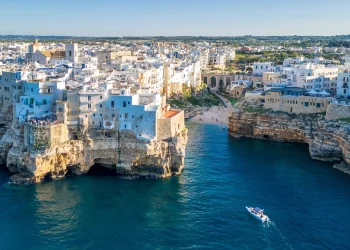
Polignano a Mare: The white coastal pearl of Apulia!
Where the Sea Meets the Rocks: A Stroll Through Polignano a Mare Polignano a Mare is perched in a spectacular location on the rugged limestone cliffs of the Apulian Adriatic coast and is rightly considered...
Conclusion: The Song That Taught Italy to Fly
«In 1958, »Nel blu dipinto di blu” proved that an Italian song can reach the whole world without being translated. If you want to hear more of this spirit, keep listening to «The Sky in a Room» by Gino Paoli, the singer-songwriter from Genoa, or with «Azzurro», the next big hit in Italian music, sung by Adriano Celentano, the rock singer from Milan. You can find all the song profiles in our overview of the Italian music.
FAQ: Frequently Asked Questions About «Nel blu dipinto di blu»
Sources and Further Information
- Wikipedia (Italian): Nel blu, dipinto di blu (accessed in October 2026)
- Wikipedia (en.): Nel blu, dipinto di blu (accessed in October 2026)
- Wikipedia (en.): Domenico Modugno (accessed in October 2026)
- Stereogum: The Number Ones, "Nel blu dipinto di blu" (accessed in October 2026)
- italia.it: Belvedere Modugno, Polignano a Mare (accessed in October 2026)