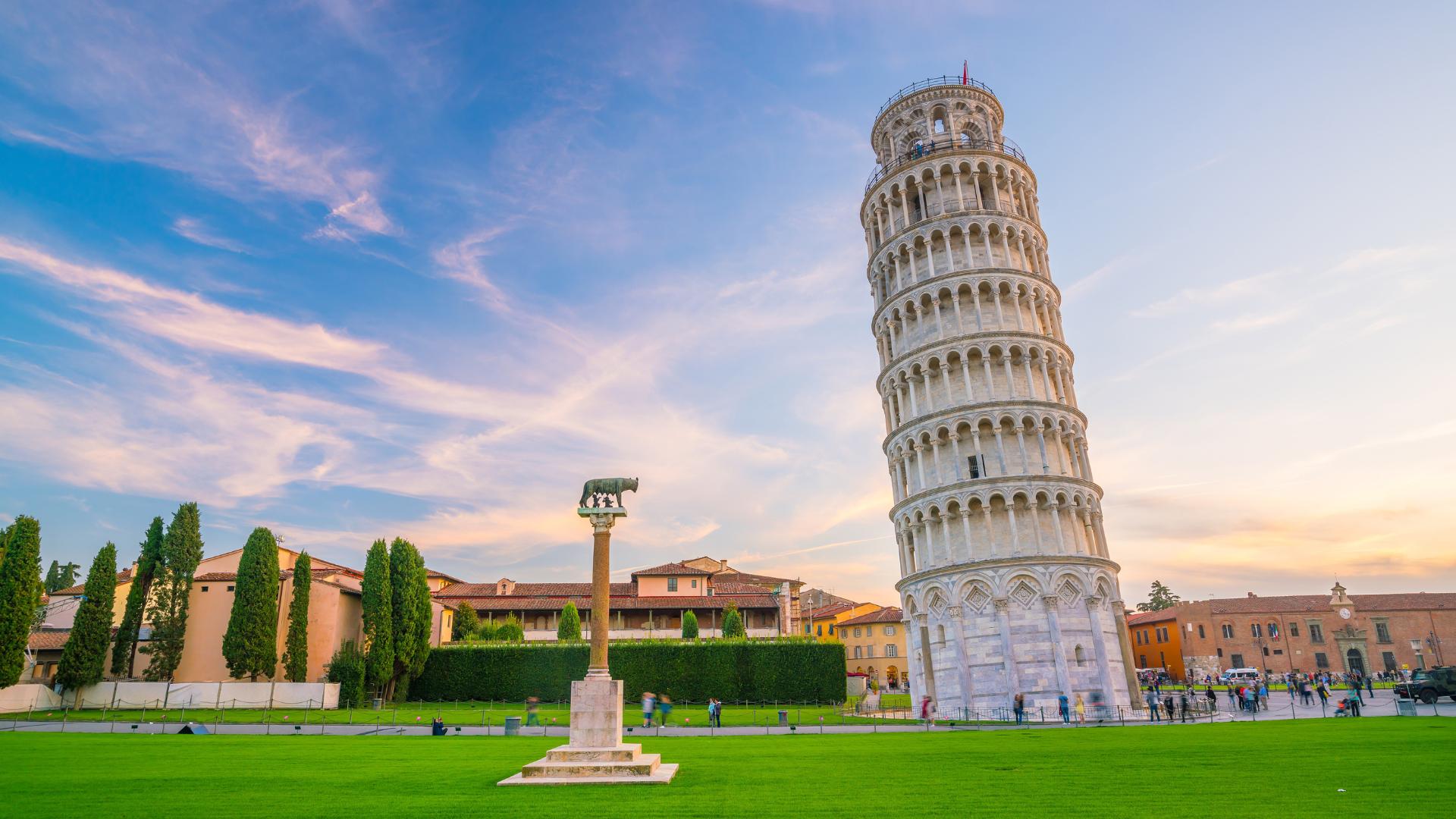

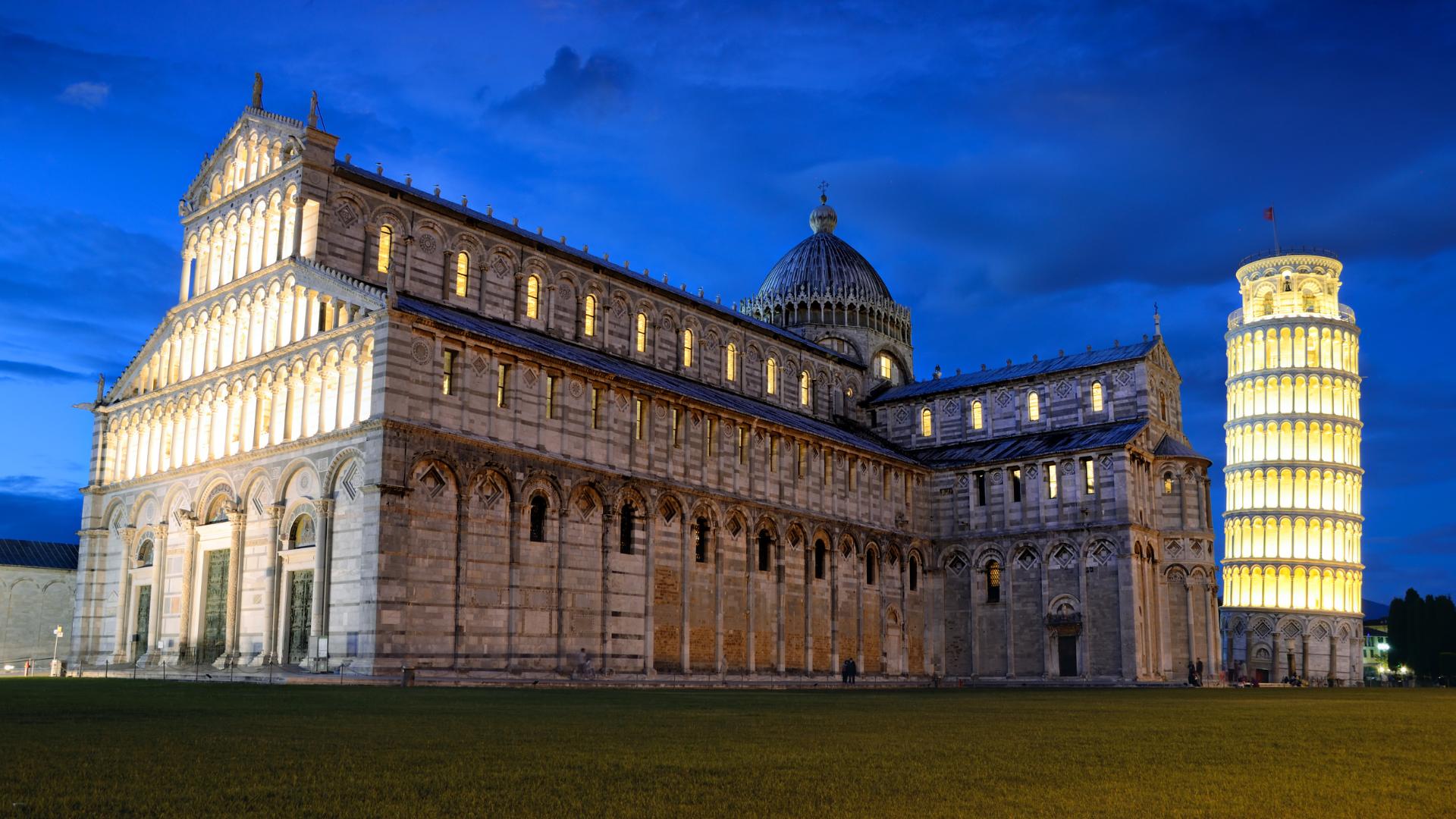
Pisa. The Leaning Tower of Pisa began to tilt during construction because the ground beneath its foundations settled unevenly. At the end of the 20th century, engineers carefully removed soil on the higher northern side to reduce the lean. Today you can climb the cathedral's bell tower with a timed ticket. According to the operator, a ticket for the tower and cathedral costs €20.
The best way to understand the tilt is to walk around the tower once. Depending on where you stand, the pale round building looks almost straight or seems to project far across the square. The cathedral's vertical edges make a better reference than a spirit-level app on your phone.
The Leaning Tower of Pisa at a glance
Information for your visit
As of November 2026 · Sources and further information at the end of the article.
Why the Leaning Tower of Pisa leans
Construction of the bell tower began in the 12th century. The masonry rose on ground that gave way under the load. Settlement was greater on one side, causing the foundation to rotate. The tilt was already noticeable by 1178, when construction had reached the second storey. A heavy tower with a circular base and continuous arcades can look light in photos. Beneath it, however, that weight bore down on a relatively small area.
Look upwards as you walk around. The builders of later stages knew about the tilt and tried to take it into account as they continued. The tower therefore does not have a perfectly straight axis that is simply tipped to one side. The deviations are easier to see from the square if you step back and compare the lines of the galleries.
How engineers stabilised the tower
The tower closed to visitors in 1990. An international team, including British geotechnical engineer John Burland, sought a way to preserve the structure while reducing its critical southward lean. In a process known as soil extraction, small amounts of earth were removed beneath the higher northern side. This allowed the foundation to settle a little in a controlled way, turning the tower slightly back.
The engineers also monitored the groundwater. In their published report, Burland, Michele Jamiolkowski and Carlo Viggiani put the reduction in the southward lean at around ten per cent. The tower reopened in December 2001. The decisive intervention took place underground. On the square, the appearance created by the bell tower's construction history remained.

What awaits at the top – steps, bells and a view of the square
Opera della Primaziale Pisana gives 251 steps and about 30 minutes for the visitor route. Some architectural descriptions give a higher count because they include other stair sections. Inside, the spiral staircase is narrow and the stone is uneven in places. The lean changes the sensation of walking depending on which side of the stair you are on.
At the top, the square appears as a complete ensemble. You look over the long cathedral, the baptistery's dome and the Camposanto along the northern edge of the square. The tower has seven bells. According to the cathedral administration, the largest was cast in 1655 and weighs around three and a half tonnes. If you cannot climb stairs, there are several good views from the square. Opera publishes separate accessibility information for the other monuments.
Tower tickets, cathedral and entrance rules
The tower's time slot sets the pace of your day. According to the operator, arrive at least 15 minutes before it begins. Late arrivals lose entry for that slot. The age rule matters if you are travelling with children: a child must turn eight by the end of the current calendar year. Anyone under 18 needs an accompanying adult. Bring proof of age if in doubt.
The cathedral is included in the paid combinations. If you only want to visit the cathedral, Opera says limited free timed tickets are available at the on-site ticket offices. Services may restrict the sightseeing area. The prices in the table reflect the official tariff overview in November 2026. Check opening hours and available slots in the operator's calendar.
| Ticket | Price | Scope |
|---|---|---|
| Tower and Cathedral | 20 € | Tower with time slot, cathedral included |
| Full ticket with tower | 27 € | Tower and all other open monuments and museums |
| Full ticket without tower | 11 € | Cathedral, baptistery, Camposanto and museums according to the price list |
| Cathedral only | Free of charge | Limited timed tickets on site |
Baptistery, cathedral and Camposanto – the whole square
Piazza del Duomo has been on the UNESCO World Heritage List since 1987. Together with the cathedral, baptistery and Camposanto, the bell tower forms a complex built over several centuries. If you enter through Porta Nuova on the west side, the round baptistery appears first. Behind it, in perspective, come the cathedral and tower.
Cathedral of Santa Maria Assunta
Construction of the cathedral began in 1064, and it was consecrated in 1118. Inside, look for Giovanni Pisano's pulpit and the apse mosaics. In the mosaic programme, the figure of John the Evangelist is by Cimabue. Outside, the alternation of dark and light stone courses stands out. You can view the façade well from a distance between the cathedral and baptistery.
Baptistery of St. John
The baptistery is notable for its circular plan and tall interior. Nicola Pisano's pulpit is among the works that show the development of medieval sculpture. Its acoustics are famous. Only plan around a demonstration if one is announced for your visiting day.
Camposanto Monumentale
The long cemetery rewards a slower visit than the open square in front. Arcades lead past tombs, sarcophagi and wall paintings. One of the best-known frescoes is the Triumph of Death by Buonamico Buffalmacco. If painting techniques interest you, add the Museo delle Sinopie, with the preparatory drawings for frescoes.

A two- to three-hour route and arrival by train
Walk around the square first to locate the entrances. The tower and cathedral then fit well together. If you have another hour, choose the Camposanto for painting and history or the baptistery for architecture. For all four buildings and one of the museums, half a day is more comfortable than a tight schedule.
From Pisa Centrale, you can walk through the city to the square. For a shorter walk, check whether your train stops at Pisa San Rossore. The route from Centrale crosses the Arno and combines well with Piazza dei Cavalieri. If you have more time, our guide to Pisa's sights has a walking route through the old town. The Pisa Botanical Garden is only a few minutes' walk from the square and makes a peaceful final stop.
Map – Piazza dei Miracoli in Pisa
View of the positions of the tower, cathedral, baptistery and Camposanto.
FAQ – frequently asked questions about the Leaning Tower of Pisa
Sources and Further Information
- Opera della Primaziale Pisana – history and purpose of the tower (accessed November 2026)
- Opera della Primaziale Pisana – official prices (accessed November 2026)
- Opera della Primaziale Pisana – time slots and age rules (accessed November 2026)
- Opera della Primaziale Pisana – accessibility (accessed November 2026)
- Imperial College London – research report on stabilisation (accessed November 2026)
- UNESCO – Piazza del Duomo in Pisa (accessed November 2026)
- City of Pisa – the four buildings of the square (accessed November 2026)