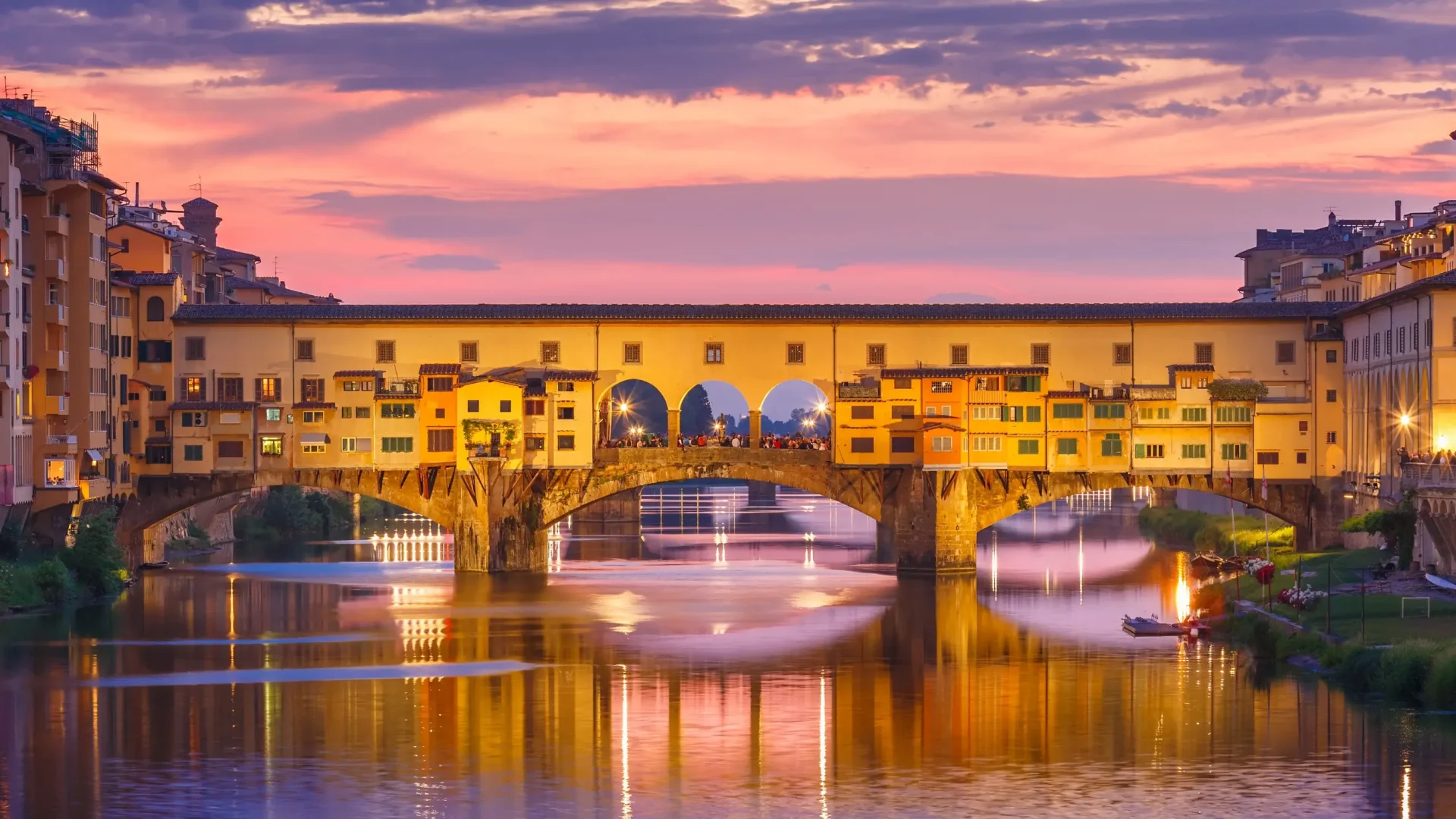

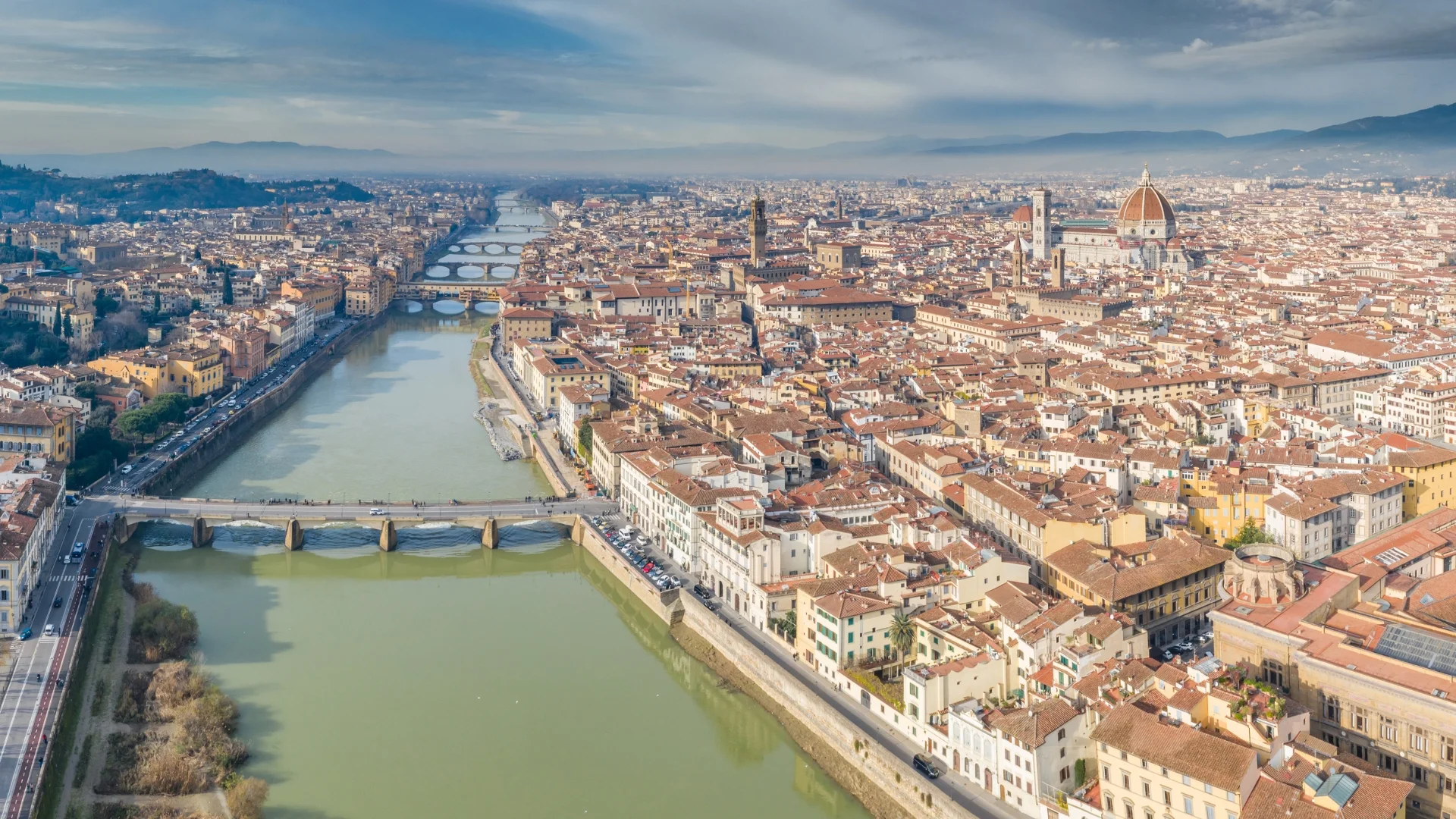
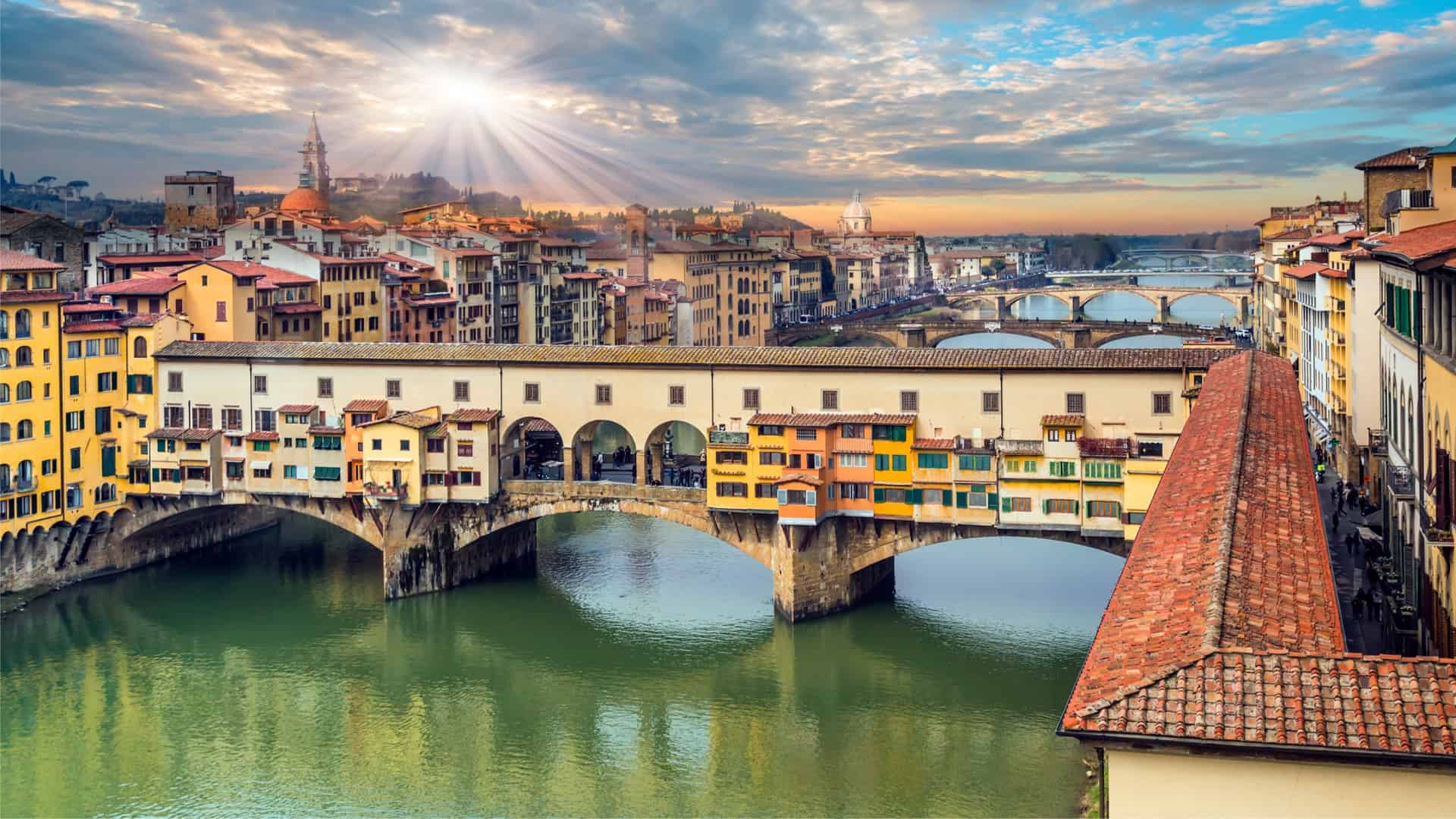
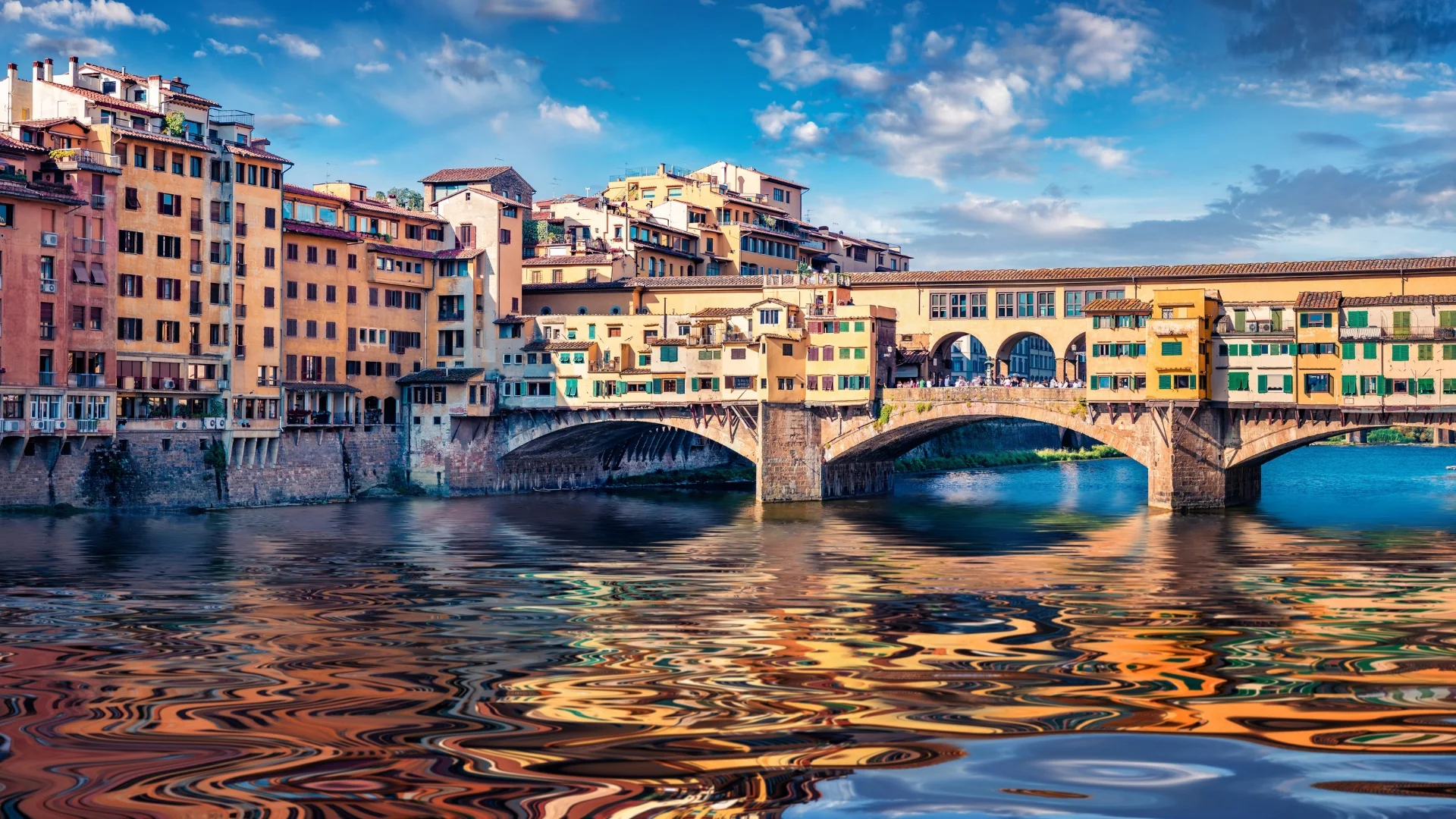
The Ponte Vecchio is far more than just a crossing over the Arno; it is a stone testimony to medieval engineering that has defied all adversities of time and weather since its completion in 1345. As one of the first segmental arch bridges in the western world, it marked an architectural milestone, as its flatter construction required fewer piers in the riverbed and therefore offered less surface area for the dangerous water masses of the Arno to attack during floods. Strolling along the historic pavement today, it is easy to forget that you are above water. The closely-spaced buildings with their characteristic wooden shutters, the so-called „madonie“, give the impression of a bustling medieval alleyway.
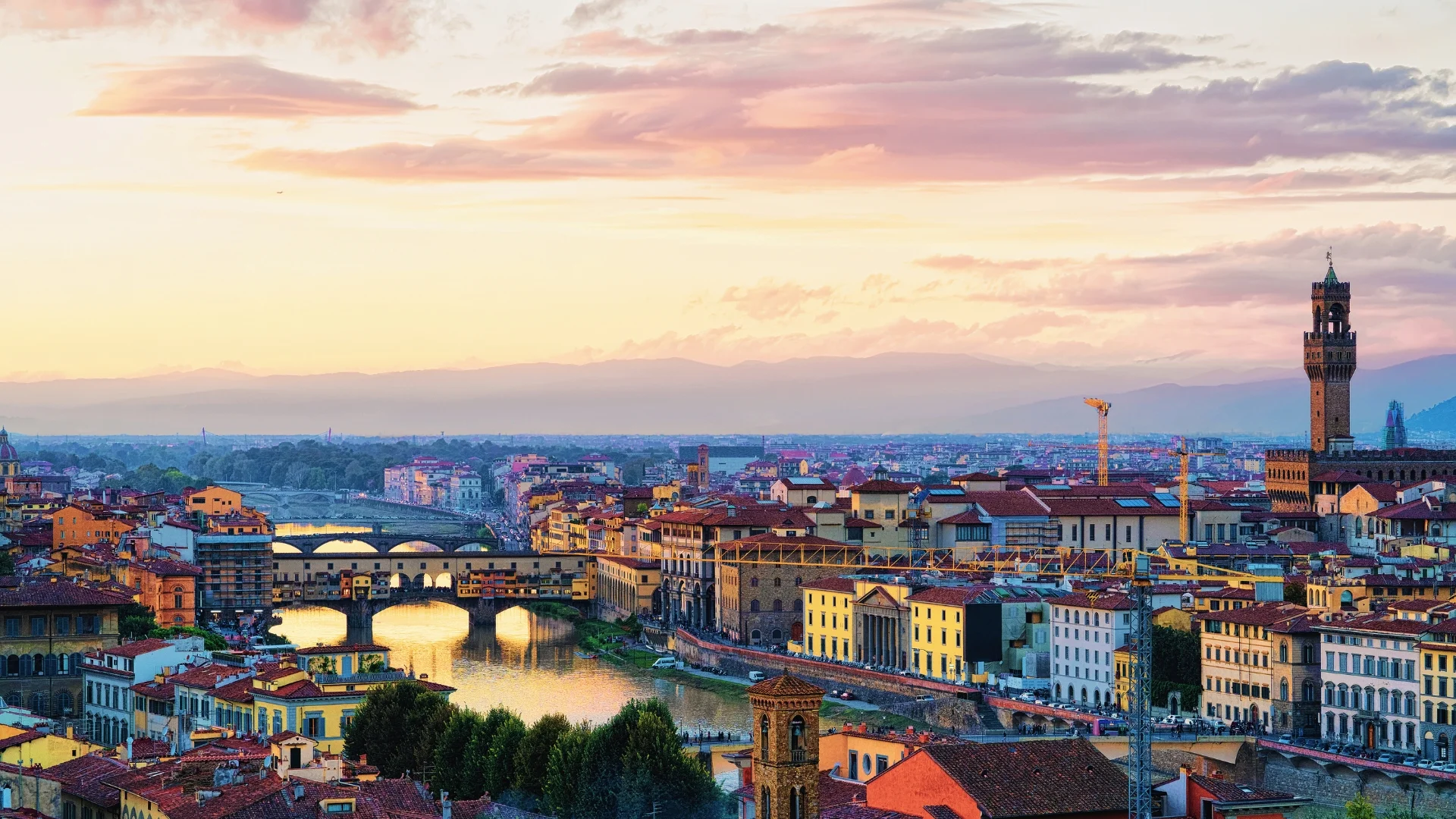
However, the elegant sparkle of the jewelry and goldsmith workshops that characterizes the bridge today was not always part of the plan. Until the end of the 16th century, the area was dominated by boisterous butchers and tanners, who, for convenience, disposed of their foul-smelling waste directly into the river. It was not until 1593 that Grand Duke Ferdinand I decreed that only fine crafts were to be practiced on the bridge. One of the reasons for this was the famous Vasari Corridor, which runs above the merchants’ heads and allowed the Medici to stroll unseen and without having to endure the stench of the butcher shops between the Palazzo Vecchio and the Palazzo Pitti. When the row of shops in the middle of the bridge opens up for a moment, it reveals a view of the city’s glittering panorama—a sight that captures all the magic of Tuscany, especially in the golden light of the evening sun. In this article, you’ll learn everything you need to know for your visit: from its eventful history to hidden culinary gems in the immediate vicinity, right down to the perfect time to snap a photo without the usual crowds of tourists.

Ponte Vecchio at a Glance
- Location: historic center, connecting Via Por Santa Maria with Via de‘ Guicciardini across the Arno
- Year of construction: 1335–1345 – Florence’s oldest surviving bridge
- Highlights: about 40 gold and jewelry stores, the Vasari Corridor, the bronze bust of Cellini
- Admission: Crossing is free and open 24 hours a day; stores are usually open from 9 a.m. to 7 p.m.
- Best time to travel: April, May, September, and October—mild and less crowded
- Arrival: About a 15-minute walk from Santa Maria Novella; the historic center is a restricted traffic zone (ZTL)
- Duration of stay: 30–60 minutes, including window shopping
The stone memory of Florence: a bridge makes history
The Ponte Vecchio is far more than just a picturesque photo opportunity; it is the oldest surviving structure spanning the Arno River in Florence and marks a turning point in the history of European architecture. As far back as Roman times, travelers used a ford at this narrowest point of the river, but it was not until the devastating flood of 1333 that the space for today’s masterpiece was created. Between 1335 and 1345, a structure was built that was far ahead of its time: a Segmental arch bridge. This construction method was revolutionary because the flatter arches required fewer piers in the riverbed, which offered less resistance to the floodwaters and thus greatly increased the structure’s stability. Whether Taddeo Gaddi or Neri di Fioravanti was the visionary behind this stroke of genius remains a matter of debate among historians, but the result has defied the elements for nearly seven centuries.
However, the bridge’s current appearance, with its exclusive splendor, belies its rather unsavory past. In the Middle Ages, the Ponte Vecchio was firmly in the hands of butchers, tanners, and fishmongers, who sold their wares right above the water. There was a pragmatic—albeit smelly—reason for this: waste could be easily disposed of by throwing it directly into the current of the Arno. This situation, however, became a nuisance for the rising Medici ruling family. When Grand Duke Cosimo I commissioned the architect in 1565 Giorgio Vasari By commissioning the construction of a covered corridor above the shops, he wanted to travel between his seat of government in the Palazzo Vecchio and his private residence in the Palazzo Pitti without getting his feet wet and, above all, undisturbed by the common people. The „Vasari Corridor“ still towers over the row of shops today. It was not until 1593 that his son, Ferdinand I, finally put an end to the stench: By decree, he banished the butcher shops and ordered that, from then on, only goldsmiths and jewelers were permitted to operate their workshops on the bridge—a decision that laid the foundation for the bridge’s worldwide fame as a center of luxury.
However, the Ponte Vecchio experienced perhaps its most dramatic moment during the final days of World War II. While the German Wehrmacht blew up all the other bridges leading out of Florence in August 1944 during its retreat to halt the Allied advance, the landmark was miraculously spared. This outcome is largely due to the diplomatic skill of the German consul at the time Gerhard Wolf . Using the influence of his office, he campaigned vigorously to save this cultural heritage and preserved the bridge from destruction. The deep attachment of the Florentines to their „Old Bridge“ and to this act of humanity is still evident today in Wolf’s honorary citizenship and a commemorative plaque, which reminds passersby that this bridge is made not only of stone, but also of an unshakable will to preserve beauty.

What is there to see? - Top highlights and sights
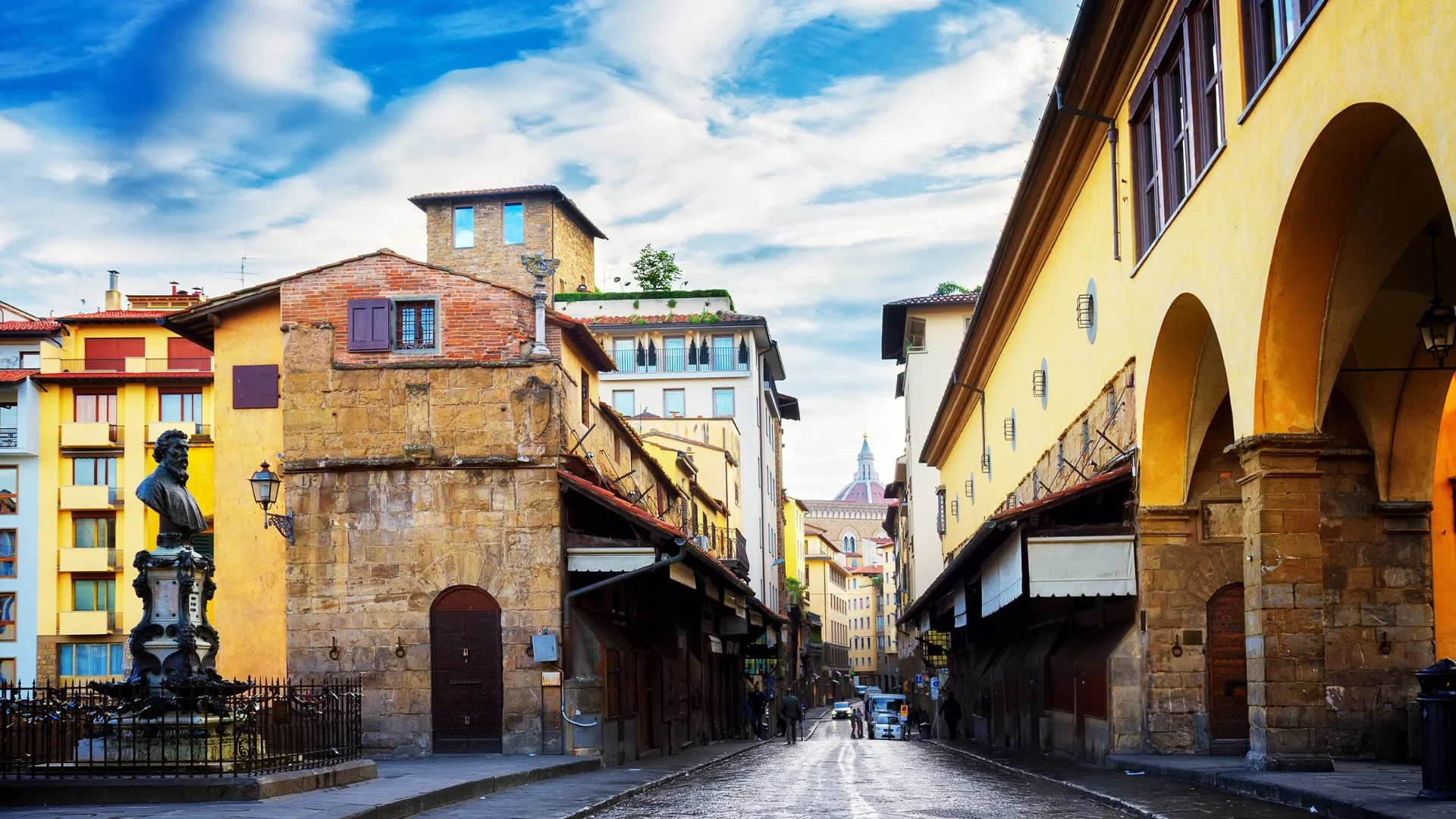
A stroll across the Ponte Vecchio is like a journey through a living museum in a very small space. In addition to the world-famous goldsmith shops, whose rear facades—known as „Retro-Botteghe“—jutt out adventurously over the water, the bronze bust of Benvenuto Cellini the bridge’s central vantage point. While you enjoy the unobstructed view of the Arno from here, high above your heads runs the mysterious Vasari Corridor, which almost imperceptibly connects the luxurious row of shops with the stately history of the Medici.
Where the gold of the Arno shines: the workshops of the bridge
The 40 or so jewelry and goldsmith workshops form the beating heart of the Ponte Vecchio and make it one of the most exclusive shopping streets in the world. Many of these traditional stores have been owned by Florentine families for generations, carrying on the legacy of Renaissance craftsmanship to the present day. In the ornately decorated displays, the light refracts off delicate 18-carat gold jewelry and precious gemstone creations, often made right in the tiny back rooms overlooking the river. If you have no intention of buying a precious souvenir, you can still enjoy the bridge as a free open-air exhibition. It is worth taking a closer look, especially away from the prominent brand names in the middle of the bridge: In the smaller, more inconspicuous workshops at the ends of the bridge, connoisseurs often find more individual one-off pieces and handmade unique items at much fairer prices, as genuine craftsmanship still takes precedence over prestige here.

Box seat above the Arno: the magical vantage point
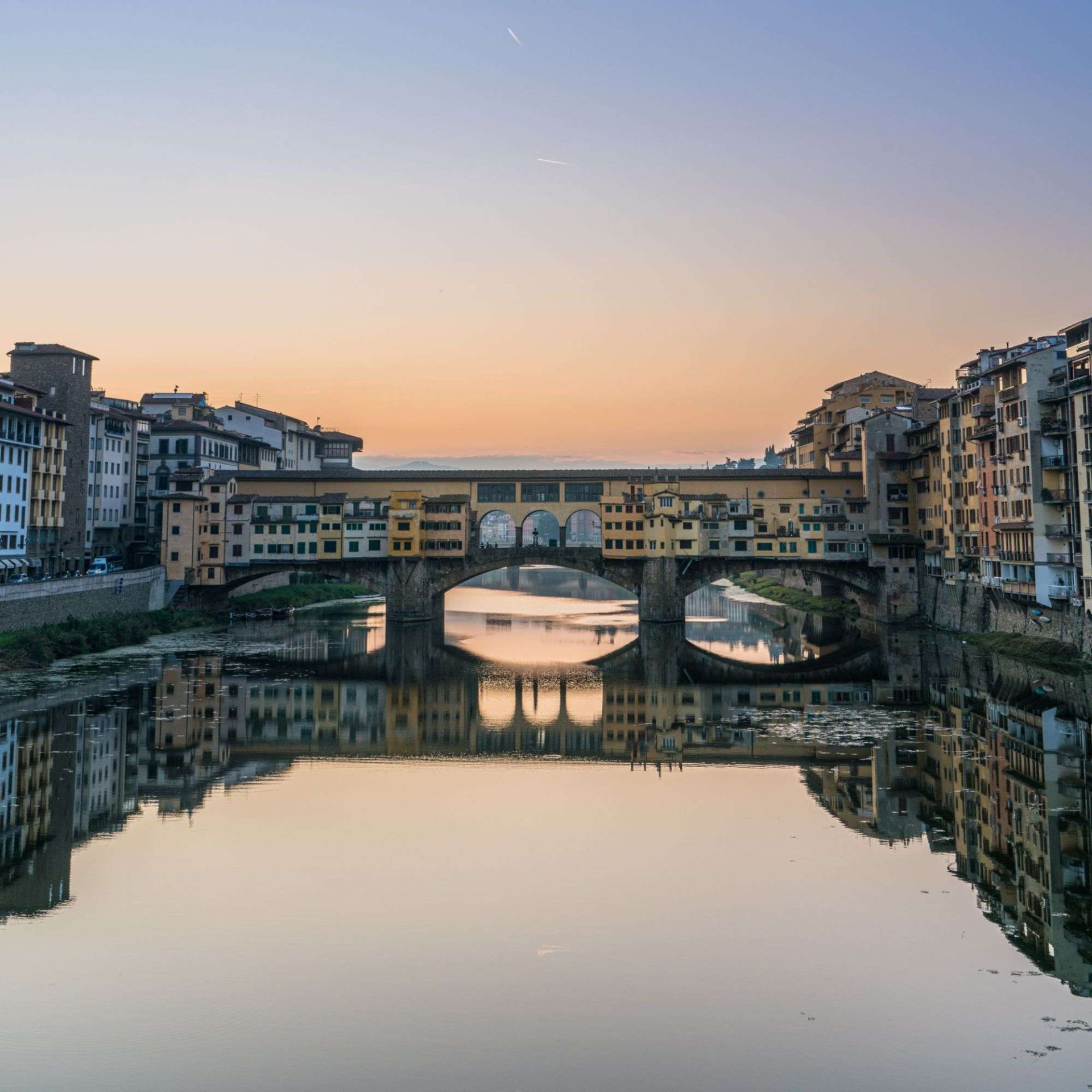
Around the middle of the Ponte Vecchio, the dense buildings give way to elegant architecture consisting of three open arcades that offer a view of the gentle waves of the Arno. This is the only point on the entire bridge where you can actually pause and feel the expanse of the river. In particular, the view to the west of the graceful arches of the Ponte Santa Trinita is considered one of the most romantic places in the city, especially when the setting sun bathes the water in a deep orange. In the center of this square, the bronze bust of Benvenuto Cellini, the most famous goldsmith in Italian history, watches over the hustle and bustle. The monument, erected in 1901, is now a silent witness to permanence, while another tradition has fortunately disappeared: the thousands of love locks that once adorned the bars have been completely removed. In order to protect the historical substance and aesthetics of the World Heritage Site, the city of Florence now consistently punishes the installation of new locks with severe fines, so that the view of the river now remains completely unclouded again.

The Vasari Corridor: On the secret paths of the Medici
After nearly eight years of extensive restoration work, one of the most exclusive Renaissance monuments is finally open to the public again: Since December 21, 2024, the legendary Vasari Corridor can once again be experienced in all its splendor. This elevated passageway, just under one kilometer long, once allowed the Medici rulers to stroll unseen—and, above all, safely—between their seat of government in the Uffizi and their private residence in the Palazzo Pitti. Today, visitors have the rare opportunity to explore this historic passageway in small, guided groups of no more than 25 people. During the approximately 45-minute tour, visitors can experience the city’s history from a completely new, almost floating perspective.
However, a visit to this architectural gem requires a little planning: The tickets, which are available at 47 euros which also include regular admission to the Uffizi, are in high demand and must be reserved at least two weeks in advance through the Uffizi’s official online portal. In terms of timing, the visit can be easily incorporated into your day, as the corridor is open to the public from Tuesday through Sunday between 10:15 a.m. and 4:35 p.m. Only on Mondays is this secret passage—like many other state-run museums in Florence—closed to the public.

The Uffizi Gallery: World art directly on the Arno
Right next to the Ponte Vecchio are the Uffizi Gallery, which, as one of the most important art museums on the planet, preserves humanity’s cultural heritage. In the magnificent marble halls of the former government buildings, visitors encounter the immortal masterpieces of Botticelli, Leonardo da Vinci, Michelangelo, and Caravaggio. But beyond the famous „Birth of Venus,“ the museum offers a visual highlight that is only mentioned in passing in many guidebooks: From the large panoramic windows on the upper floors—especially in the West Corridor—you’ll find a view of the Ponte Vecchio that you could never imagine from street level.
Viewed from above, the bridge looks like a delicate model from another era and you can clearly see how the Vasari corridor glides over the roofs of the goldsmith stores. If you plan your visit wisely, you can combine a visit to the museum in the morning with a subsequent stroll across the bridge towards Oltrarno. This combination is ideal for a half-day excursion that covers everything from the intellectual wealth of Renaissance painting to the lively craftsmanship on the river and thus perfectly captures the essence of Florence.


Fontana del Porcellino di Firenze, the lucky pig of Florence
Fontana del Porcellino di Firenze: symbol of luck and tradition in the Loggia del Mercato Nuovo In the bustling alleyways of...
A stately heritage: Palazzo Pitti and the Boboli Gardens
As soon as you leave the southern end of the Ponte Vecchio, the path leads you almost automatically to the imposing Palazzo Pitti whose imposing facade of rusticated masonry reflects the claims to power of its former inhabitants. Originally built for the Pitti family and later designated as the main residence by the Medici, the palace today houses an impressive collection of museums. The Galleria Palatina stands out in particular, where masterpieces by Raphael, Titian, and Rubens are displayed not in sterile museum rooms but against the magnificent backdrop of Baroque state rooms. Just beyond the palace’s massive walls lie the Boboli Gardens, one of the world’s most significant park complexes. This prototype of the Italian garden is far more than just a green space; it is a sprawling open-air museum full of grottoes, fountains, and ancient statues, offering visitors a welcome respite from the hustle and bustle of the city. Incidentally, those who have the privilege of walking through the Vasari Corridor end their journey right in the heart of this complex, near the famous Buontalenti Grotto, and from there can seamlessly immerse themselves in the princely world of the Renaissance.

The heart of Florence: a stroll through the Oltrarno
Across the Arno, on the „other side“ of the river, it begins with the Oltrarno A neighborhood that has retained its original, almost village-like charm to this day. While the north bank is often dominated by large crowds of tourists, here you can experience the „Diladdarno“—the real Florence of the locals. Hidden away in the narrow, cobblestone alleys are tiny workshops where bookbinders, gilders, and woodcarvers still practice their craft with the same dedication as their ancestors did hundreds of years ago. The social hub of this neighborhood is Piazza Santo Spirito, a lively square that hosts a local market in the morning and transforms into a gathering place for Florentines in the evening, who wind down the day in the cozy trattorias and bars. A stroll through this neighborhood after visiting the Ponte Vecchio is an absolute must for anyone who wants to look beyond the glittering facades of the jewelry stores and discover the authentic soul of Tuscany.

When the bridge becomes a stage: Ponte Vecchio by night
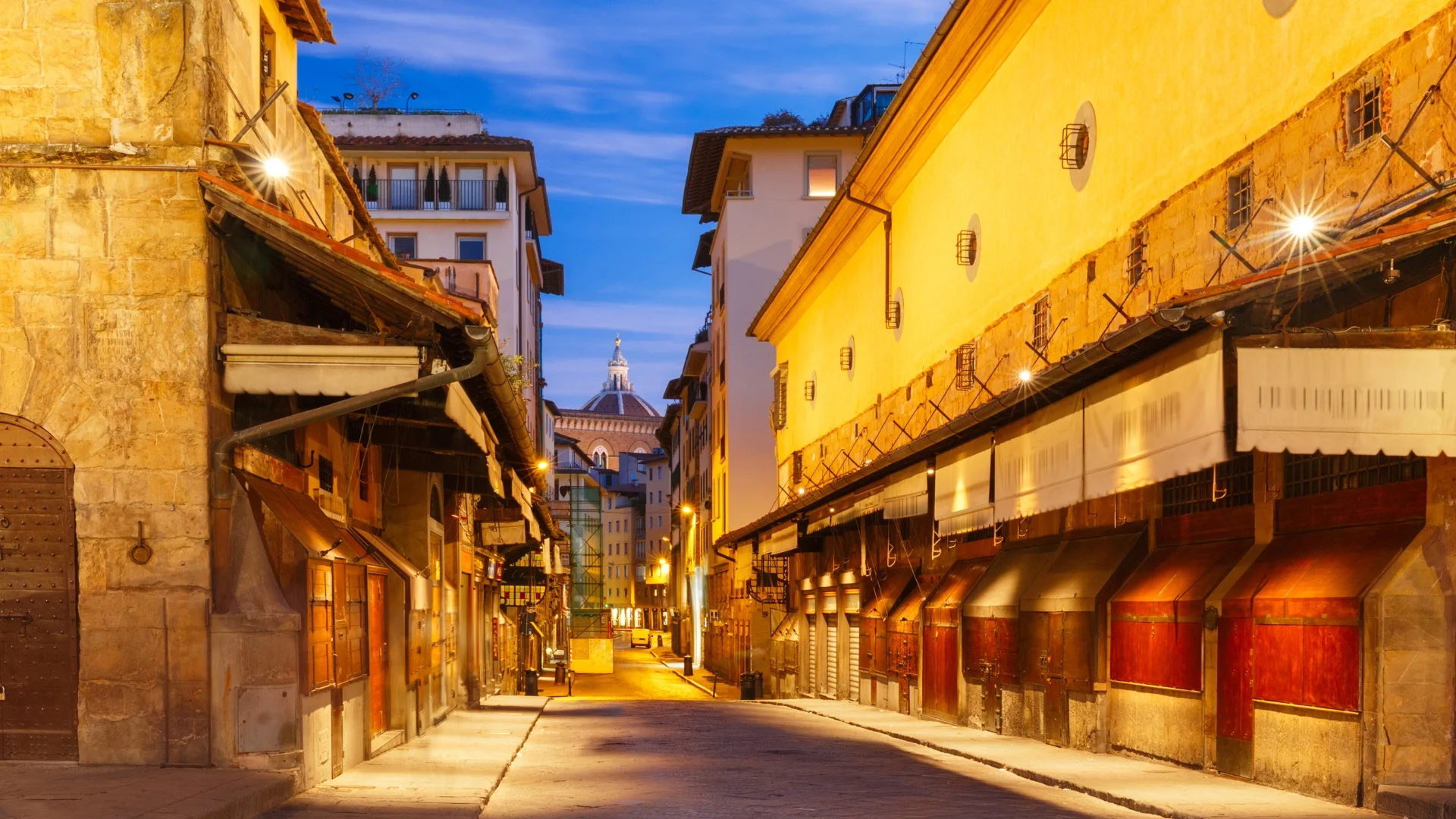
After dark, the Ponte Vecchio transforms into a place of almost surreal romance. As soon as the goldsmiths have locked their heavy, distinctive wooden shutters—known as „Madonie“—the rows of closed shutters resemble ancient treasure chests resting above the dark waters of the Arno. The warm light of the historic streetlamps bathes the stone walls in a golden glow, making you forget the hustle and bustle of the day. The most impressive view of this nighttime landmark can be enjoyed from the neighboring Ponte Santa Trinita from which the brightly lit arches are perfectly reflected in the mirror-smooth river. For photography enthusiasts, this is the ideal moment to capture the interplay of light and shadow. Since the gentle shimmer on the waves of the Arno and the fine details of the architecture at night require a high degree of precision, using a tripod is essential here to capture the magical stillness of this moment in all its depth.
Read more about theTopic


Your visit to the Ponte Vecchio: everything you need to know
Visiting the Ponte Vecchio requires a little logistical skill, as the bridge is located in the middle of Florence's strict restricted traffic zone (ZTL). If you try to drive right up to the Arno without a special permit, you run the risk of incurring heavy fines, which is why walking is the only sensible option. An ideal starting point is the Santa Maria Novella train station, from where it is a 15-minute walk through the heart of the old town. The route along Via de‘ Cerretani past the monumental cathedral and onwards across Piazza della Signoria is already like a short city tour before you finally reach the banks of the Arno. Drivers are advised to leave their cars in the large parking garages on the outskirts of the city, such as at the Fortezza da Basso or in the parking lot in Via del Gelsomino. From there, the city center can be easily reached by bus or on a longer walk, saving you the stress of searching for a parking space in the narrow streets of the city center.
The bridge itself is accessible around the clock and completely free of charge as a public link, but the hustle and bustle is largely determined by the opening hours of the jewelers. They usually open their historic stores between 9 a.m. and 7 p.m., although in some places the traditional lunch break is still practiced. If you want to experience the bridge away from the crowds of tourists, you should choose the early morning hours before 9 am or the late evening after 8 pm, when the day tourists have left and the atmosphere is much more intimate. Especially in the high season between June and August, it can get so crowded during the day that it is difficult to get around. Spring and fall are therefore considered the ideal times to visit to enjoy the architectural details and the special light over the river in peace.
A few practical aspects should also be considered to ensure a smooth stay. As the historic cobblestones of the bridge and the surrounding alleyways are often uneven and polished smooth after centuries of use, comfortable and sturdy footwear is an absolute must. In addition, increased attention must be paid to safety in such highly frequented tourist areas. Pickpockets often shamelessly exploit the dense crowds on the bridge and at the popular photo spots. It is therefore advisable to carry valuables in closed inside pockets close to your body and to take rucksacks to the front in particularly narrow passages in order to keep a carefree memory of your visit to the „Old Bridge“.
Culinary delights around the Arno: where Florence tastes best
Although the bridge itself is all about the precious metal, fortunately you only have to walk a few steps to discover the culinary gold of Tuscany. You won't find any restaurants directly on the Ponte Vecchio, but the adjacent alleyways are home to some of the city's most authentic addresses.
Just a stone's throw south of the bridge, on the first floor of a medieval tower house, the Osteria del Cinghiale Bianco guests in a wonderfully rustic ambience. As the name suggests, everything here revolves around wild boar - a staple of hearty Tuscan cuisine. The wild boar ragout with handmade pappardelle is an absolute classic that fits in perfectly with the cozy, almost informal atmosphere. In terms of price, you should expect to pay around 45 to 60 euros for a full three-course meal including wine, which remains an absolutely fair offer given the quality and prominent location.
For those moments when the experience should sparkle like the jewelry in the shop windows, there is no way around it. Borgo San Jacopo over. Located in the Hotel Lungarno, the restaurant is the proud holder of a Michelin star and offers one of the most exclusive views of Florence. On the small, coveted terrace, the Ponte Vecchio seems close enough to touch, while chef Claudio Mengoni reinterprets regional cuisine with modern precision and creative lightness. An evening here is undoubtedly an investment - the prices for the exquisite tasting menus usually range between 120 and 180 euros - but the combination of culinary perfection and probably the most romantic view in the country is simply priceless for special occasions.
If, on the other hand, you are looking for the genuine flair of the Oltrarno district and prefer to eat where the Florentines meet for lunch, you should visit the Trattoria 4 Leoni on the charming Piazza della Passera. Just a short walk from the bridge, this traditional restaurant serves honest home cooking without unnecessary frills. The „Fiocchetti di pera“ - small pastry pockets filled with pear and pecorino in a creamy Taleggio sauce - have now achieved cult status and are worth the trip alone. In the relaxed atmosphere of the square, you can enjoy excellent value for money, with an extensive meal usually costing between 30 and 45 euros, making it the ideal refreshment after a long day of sightseeing.
Where Florence sleeps best: hotel tips on the Ponte Vecchio
Choosing the right place to stay near the Ponte Vecchio allows you to experience firsthand the city coming to life and the Arno’s nighttime sparkle. Since the bridge is located in the heart of the historic center, you’ll be staying right at the intersection of stately grandeur and the charming artisan district of Oltrarno.
For travelers looking for a solid base in an unbeatable location, the Hotel Pitti Palace al Ponte Vecchio an excellent choice. Housed in an impressive 13th-century tower building - the Torre dei Rossi - the hotel breathes history, while the rooms are modern and comfortable. Of particular note is the panoramic terrace on the top floor, which offers one of the best views of the Vasari Corridor and the Duomo. While prices vary in this sought-after location, you can often find fair value for money here, usually between 160 and 240 euros. A charming, slightly more informal alternative on the north side of the river is the Hotel Hermitage. This little gem is tucked away in a quiet alley just behind the bridge and impresses with its flower-filled roof terrace, where breakfast is served with a view of Palazzo Vecchio. Here you can still feel the personal touch of an owner-run hotel, with overnight prices often starting at a moderate 150 euros.
If you are looking for the classic Florentine splendor of the middle class, the Hotel degli Orafi its perfect home. The former Augustinian monastery is located directly on the north bank of the Arno and became world-famous as the backdrop for the movie „Room with a View“. The rooms are furnished with antique furniture and original frescoes, making your stay a little journey back in time. The hotel's own rooftop bar is a popular meeting place to enjoy the sunset over the bridge with an aperitif. Depending on the season and room category, you should expect to pay around 250 to 400 euros per night, which is a worthwhile investment in the overall Florence experience given the cinematic backdrop.
For absolute exclusivity and modern luxury, the Portrait Firenze the undisputed top address. As part of the Ferragamo family's renowned Lungarno Collection, this boutique hotel offers no ordinary rooms, but spacious suites that combine the glamor of the 1950s with contemporary design. Just 30 meters from the Ponte Vecchio, guests enjoy a discreet, personal service that is second to none. The window fronts open wide over the Arno and offer an almost private box over the river. A stay in this high-end retreat usually starts at 800 euros per night and is aimed at discerning travelers for whom living comfort and design form an inseparable unit. Those not staying there can still enjoy a touch of this luxury with an excellent espresso in the hotel's own Caffè dell'Oro on the terrace directly on the riverbank.
Thinking outside the box: the best day trips from Florence
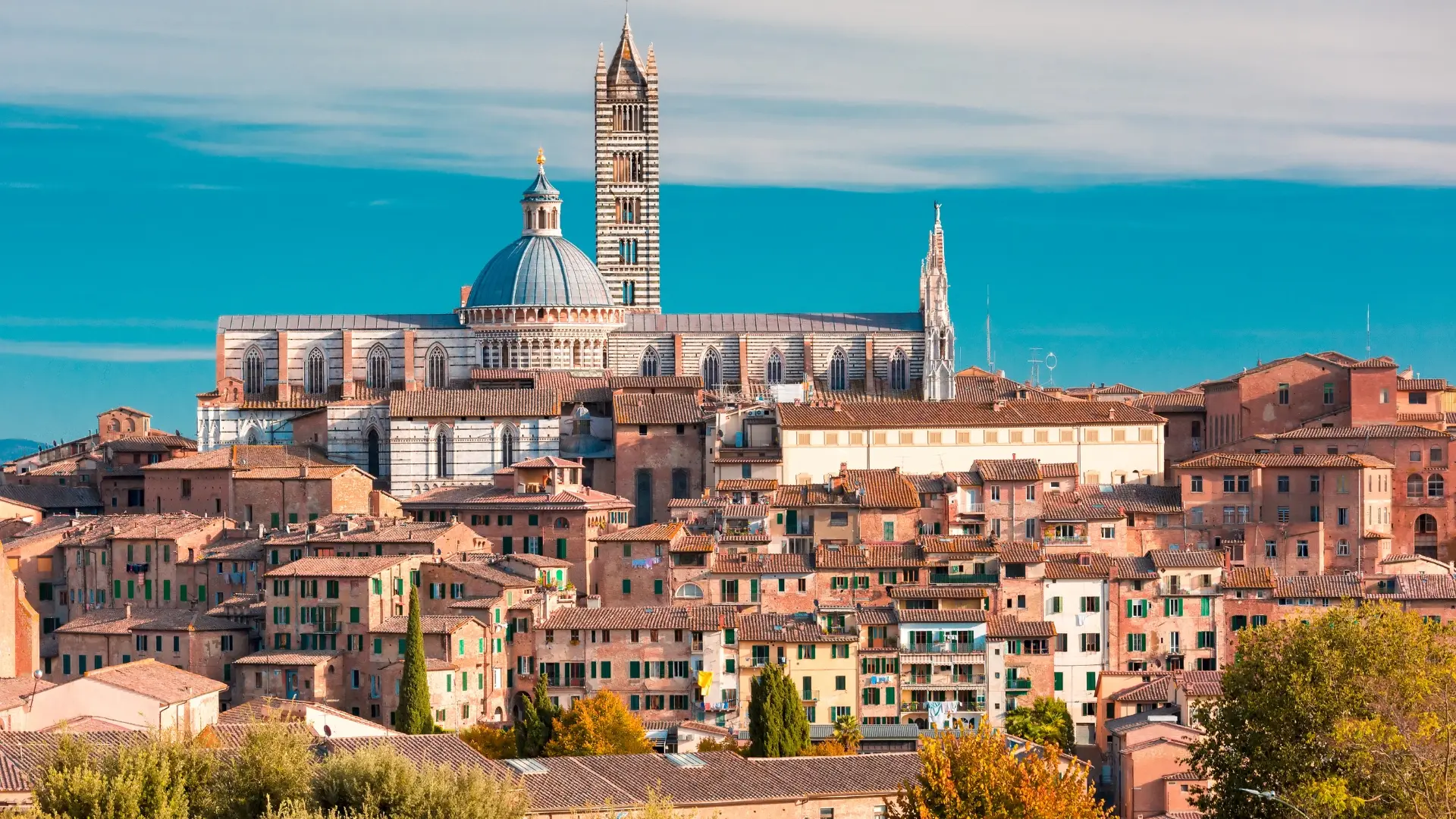
The Ponte Vecchio is not only the crowning highlight of a visit to Florence, but also the ideal starting point for exploring the many facets of the Tuscan countryside. If you leave the city walls behind you, you will reach the Gothic jewel after a 90-minute drive south Siena. The city, which is world-famous for its legendary horse race, the Palio, and the shell-shaped Piazza del Campo, offers a fascinating contrast to the Florentine Renaissance style. Just a short drive away, the towers of the San Gimignano rises from the vineyards like a medieval skyline. The „Manhattan of the Middle Ages“ is not only an architectural wonder, but also the home of Vernaccia, one of the region's few top white wines. Many travelers combine these two places into a full-day tour that offers the perfect cross-section of history and the hilly landscapes of central Tuscany.
For those who prefer to focus on enjoyment, paradise is just a short 30-minute drive into the heart of the Chianti region. The rolling hills, lined with cypress avenues and shimmering silver olive groves, are home to countless family-run wineries. Here, in the realm of the „Gallo Nero“ (Black Rooster), excellent wine tastings can often be combined directly with a tour of historic wine cellars.
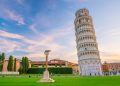
However, if you're looking for another architectural wonder of the world, a trip to Pisa From the Santa Maria Novella train station, you can reach the city of the Leaning Tower in just about an hour by regional express train. Since Pisa Centrale Station is well connected to the city center, you can easily make this iconic photo spot a relaxing half-day trip before returning to the Arno just in time for sunset.
What You Should Know About the Ponte Vecchio
Here are a few things that will make your visit more relaxing:
- Free and always open: You can cross the bridge for free at any time of day or night; the stores are usually open from 9 a.m. to 7 p.m.
- Timing Against the Crowds: It's quietest early in the morning before 9 a.m. or late at night after 8 p.m. — and busiest during the day between June and August.
- No love locks: Posting is prohibited and is punishable by a fine.
- No car: The historic center is a restricted traffic zone (ZTL); it's about a 15-minute walk from Santa Maria Novella.
- Watch out for pickpockets: In a crowd, keep your valuables close to your body and carry your backpack in front of you.
More than just a bridge - why the Ponte Vecchio is here to stay
The Ponte Vecchio is much more than just a stone bridge spanning the river; it is the vibrant Heart of Florence and one of those rare places in the world whose legend does not fade when experienced in person, but rather gains depth. It is the fascinating interplay of architectural permanence and vibrant change that makes this place so unique. Standing on the centuries-old cobblestones, you can feel the unbroken continuity of history—from the visionary master builders of the 14th century to today’s master goldsmiths, who practice their craft with the same passion as their ancestors did during the Renaissance.
The sparkle in the store windows, the gentle murmur of the Arno beneath the three great arches, and the warm light refracting off the colorful facades blend into a total work of art—one that, not without reason, is the only one of its kind to have survived the destruction of World War II. To truly grasp the magic of this place, one should resist the temptation to simply check off the bridge as a quick photo op. Instead, those who visit it in the stillness of the early morning, when the first rays of light touch the statues of the Uffizi, or at dusk, when the closed wooden shutters of the jewelers’ shops look like ancient treasure chests, will be rewarded with a sense of timelessness. It is in this moment of pause that one realizes the Ponte Vecchio not only spans the Arno but also bridges the centuries. It rewards anyone willing to let themselves drift for a moment and seek the soul of Tuscany in its most precious monument. Our guide shows how the Ponte Vecchio, along with the Duomo, the Uffizi, and the Oltrarno, can be combined into the perfect short getaway: 3-Day Itinerary for Florence.
Map: Ponte Vecchio, Florence
Top accommodation in Florence, Tuscany
Video: Highlights in Florence
Experiences & sights
Note: Disclaimer - Italien.news is not the owner or organizer of the sights, accommodations and events published here and therefore not responsible for program changes, cancellation of the event and possibly incorrect information. The editorial team of Italien.news always endeavors to provide detailed and accurate information. However, it is possible that events, attractions, etc. may be changed and not updated promptly. Exact details of dates, times and programs can be obtained directly from the owner of the attractions and accommodation.
Please also check the website or social media of the attractions and events for updates before you travel! Our blog articles contain our personal recommendations in the form of affiliate links. If you book or buy something via the links or simply click on them, we receive a small commission. This does not change the price for you at all. Content and texts © Italien.new & KI / Photos © Canva.com / shutterstock.com / Unsplash.com / Pixabay.com / Pexels.com / Others. Please also visit our Italy Shop!