
The 2027 Ivrea Carnival has already taken place. We will post the next date as soon as it is confirmed. All Upcoming Events in Piedmont
Oranges, courage, and freedom: the legendary heritage of the Carnival of Ivrea
The historic carnival in Ivrea in picturesque Piedmont is much more than just a folk festival. It is a living epic deeply rooted in the past and based on a mixture of traditional legends and historical events. Unlike other carnival celebrations, which are often purely decorative in nature, Ivrea celebrates a collective memory that reflects the irrepressible desire for freedom of its citizens.
The Legend of Violetta and the Fall of the Tyrant
It all began in the Dark Ages, a time when the city suffered under the cruel rule of a tyrant often identified as Ranieri di Biandrate. He tormented the population with oppression, invoking in particular the infamous „right of the first night.“ The turning point finally came with the courageous rebellion of Violetta, the daughter of a local miller. Refusing to bow to the tyrant's will, she summarily beheaded the despot in his own castle, thereby signaling the start of a general popular uprising. As „Vezzosa Mugnaia,“ the graceful miller's daughter, she comes back to life every year during the carnival days. To this day, she remains the undisputed protagonist of the festival and is revered as a timeless symbol of liberation from tyranny and the power of civil revolt.
The General and the Napoleonic Order
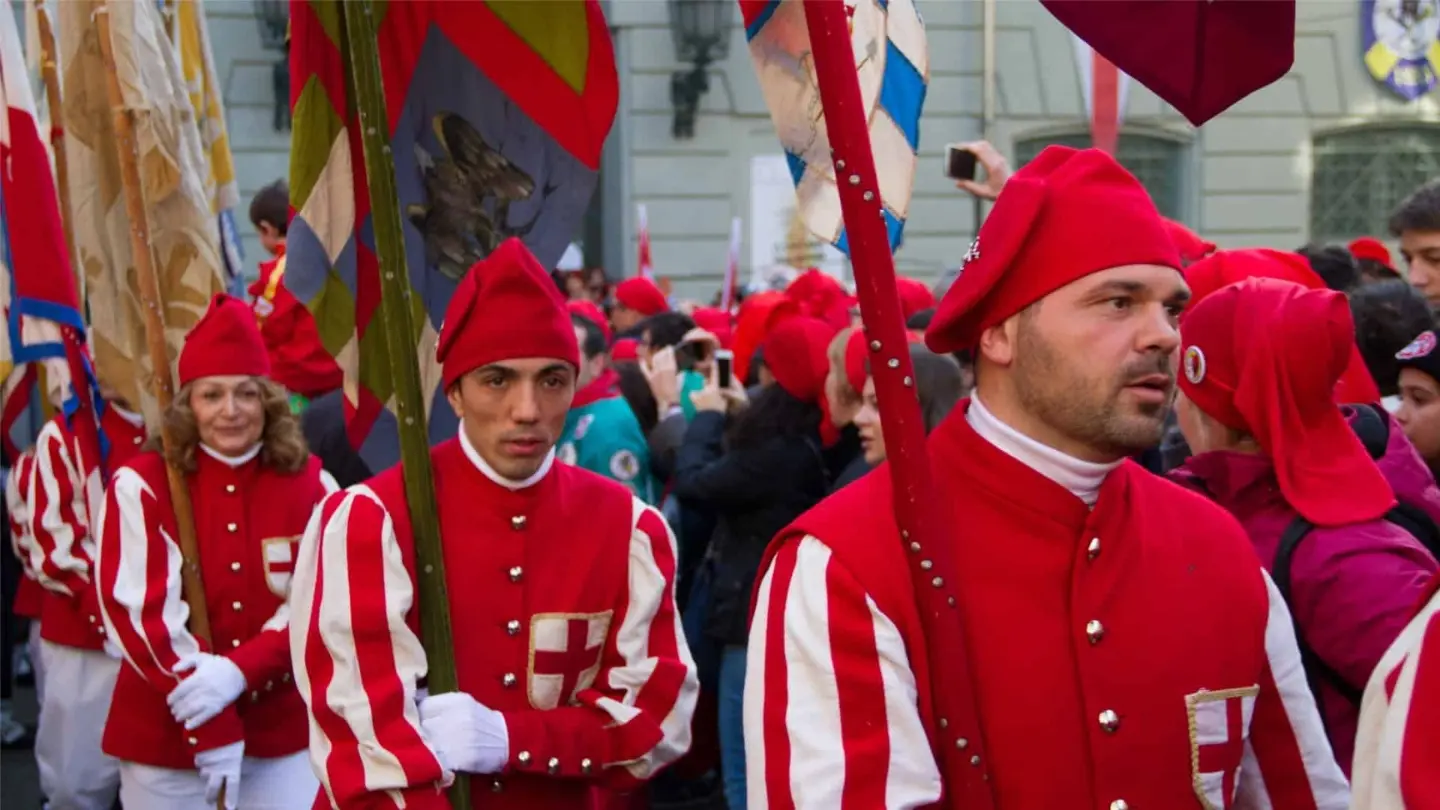
Another central pillar of the historical fabric is the figure of the general. He accompanies Violetta in the festive procession and appears in a magnificent uniform of the Napoleonic army. In this way, he also embodies the city's authority. His presence is closely linked to a decisive turning point in the city's history. Originally, the various districts of Ivrea celebrated Carnival separately, which often led to rivalries and unrest. It was not until 1808, when Piedmont was under French administration, that these scattered festivities were united into a single, joint event. At that time, the General was created to guarantee public order and reconcile the formerly divided districts under one symbolic roof.
The Abbà and the symbolism of resistance
Before the unification in 1808, the organization of the celebrations was in the hands of the so-called Abbà. They acted as elected heads of the five different parishes of Ivrea and represented the youth of the city. Even today, they still play an important role in the historical parade. A particularly impressive detail of their costume is the sword with an orange skewered on its tip. This symbol has multiple meanings: on the one hand, the fruit is reminiscent of the severed head of the fallen tyrant, and on the other, it refers to a tradition from the 18th century, when the Abbà carried a loaf of bread on a skewer to demonstrate the prosperity of the community. Thus, this image combines the memory of the violent struggle for liberation with the celebration of regained livelihoods.
The symbolism of the Battle of the Oranges in Ivrea
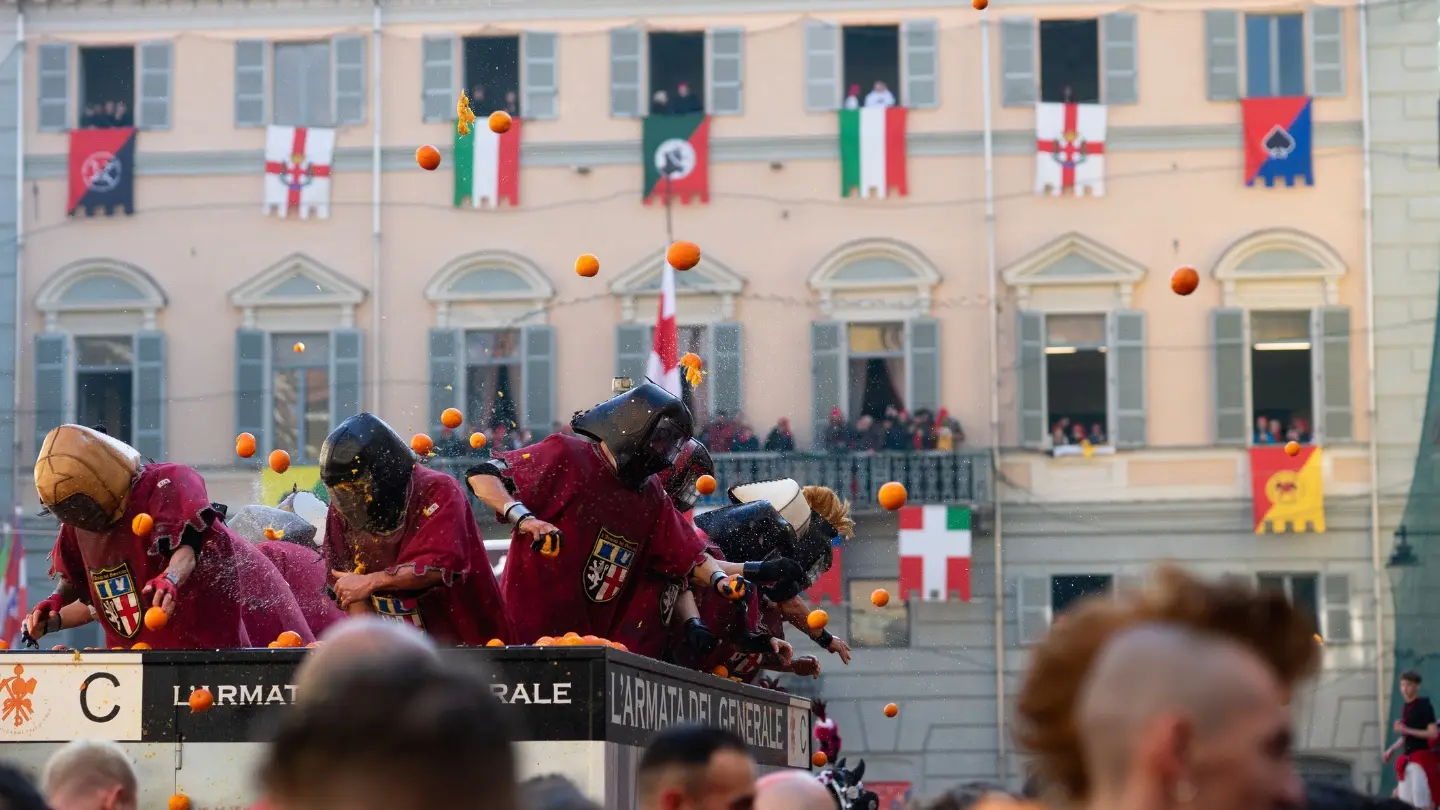
Without a doubt, the famous „Battaglia delle Arance“ is the most spectacular and emotional highlight of the carnival in Ivrea. However, this event is much more than just a food fight: it is a complex web of symbols, deeply rooted traditions, and the living memory of the medieval struggle for liberation. This ritualistic performance faithfully recreates the historical uprising of the people against oppression, which was triggered by Violetta's courageous act. The orange throwers fighting on foot embody the rebellious people who stand up to superior forces with courage and determination. Opposite them are the shooters on magnificent horse-drawn carriages. These represent the tyrant's armies. The crews of these carriages are protected by heavy leather armor and distinctive masks reminiscent of ancient armor, symbolizing the aloofness of the ruling elite of the time.
From despised beans to projectiles
The origins of this throwing ritual can be traced back to the Middle Ages. Curiously, oranges were not used at that time, but simple beans. According to historical reports, it was customary for feudal lords to give away a pot of legumes twice a year as alms to needy families. However, this gesture was often perceived as condescending by the population. As a sign of contempt and protest, people began throwing the gifted beans onto the street instead of eating them. Over time, this developed into a playful, albeit rough tradition during Carnival, in which the beans were used as improvised projectiles to hit symbolic opponents or unpopular contemporaries.
A flirtatious duel on the balconies
The shift to using oranges did not take place until the 19th century and had a surprisingly romantic, if temperamental, background. At that time, young women began throwing oranges from their balconies at the passing parade floats. Along with confetti, sugared almonds, and flowers, the precious tropical fruits served to attract the attention of the young men participating in the parade. What began as flirtatious courtship quickly developed into a playful challenge: the young men on the streets and floats responded to the throws, creating a playful duel between the sexes. This charming exchange laid the foundation for today's form of battle, although the intensity of the throwing spectacle has increased massively over the decades.
Prohibition, resistance, and modern organization
This growing vehemence led the authorities to intervene in 1854. General Panietti issued an official ban prohibiting the throwing of oranges or similar objects with force in order to ensure the proper conduct of the festival. However, the spirit of freedom among the inhabitants of Ivrea could not be so easily regulated: the ban remained largely ineffective and the tradition became even more firmly established over the years. After the hardships of the Second World War, the battle finally underwent a fundamental transformation. The first organized teams, the „Aranceri,“ were formed, giving the battle a fixed structure. The once chaotic melee thus developed into a sporting competition with specific rules and fixed battle zones, which to this day shapes the city's identity and nourishes its pride in the freedom it has achieved.

The Phrygian cap as a symbol of freedom
The bright red Phrygian cap, also known as the „Berretto Frigio,“ is an essential accessory for every visitor and local. From Fat Thursday (Giovedì Grasso) onwards, wearing this distinctive headgear is an absolute must in the contested districts if you don't want to become a target for orange throwers yourself. The cap acts as a kind of diplomatic shield: those who wear it signal their active participation in the festival and are respected and spared by the fighting troops as „civilians.“ But beyond this purely practical use, the cap is the most important visual statement of the identity of Carnival and a powerful expression of solidarity with the values of freedom and independence.
From the Persians to the freed slaves of Rome
Its roots go way back to ancient times and can already be seen in Hellenistic art as a typical feature of Oriental peoples. It was originally worn by the Persians before it took on a whole new, profound meaning in ancient Rome. There, under the name „pileus,” it became the ultimate symbol of freedom. It was customary for Roman masters to give their slaves this special cap at the moment of their release. It was thus much more than a piece of clothing: it was a sign that a person was no longer the property of another, but could claim their place in society as a free citizen.
A legacy of revolution and resistance
In modern times, the Phrygian cap experienced its most significant renaissance during the French Revolution, when it became an icon of revolution and the struggle against absolute monarchy. Since Ivrea was strongly influenced by the Napoleonic administration at the beginning of the 19th century, this symbol fits perfectly into the historical narrative of the Ivrea Carnival. When the citizens of Ivrea put on their red caps today, they are directly linking themselves to this tradition of resistance against tyranny. The cap thus connects the ancient longing for personal freedom with the modern struggle for civil rights. It makes every wearer part of that great history that comes alive every year in Ivrea and shows that the community is still proud of its rebellious roots today.
The calendar of the revolt: places and times of the legendary spectacle
To experience the spectacle of the „Battaglia delle Arance“ up close, you have to keep an eye on the moving fortress calendar of the church year. Since the Ivrea Carnival is inextricably linked to Lent, the dates are based on Easter. The actual highlight of the celebrations spans three intense days from Carnival Sunday until Shrove Tuesday, the eve of Ash Wednesday. From Epiphany in January onwards, the entire city is in a festive mood, and various rituals pave the way until the excitement reaches its first boiling point on Sunday afternoon. During this time, tranquil Ivrea is transformed into an arena where history is not only recounted but reenacted with full force.
The scenes of the action
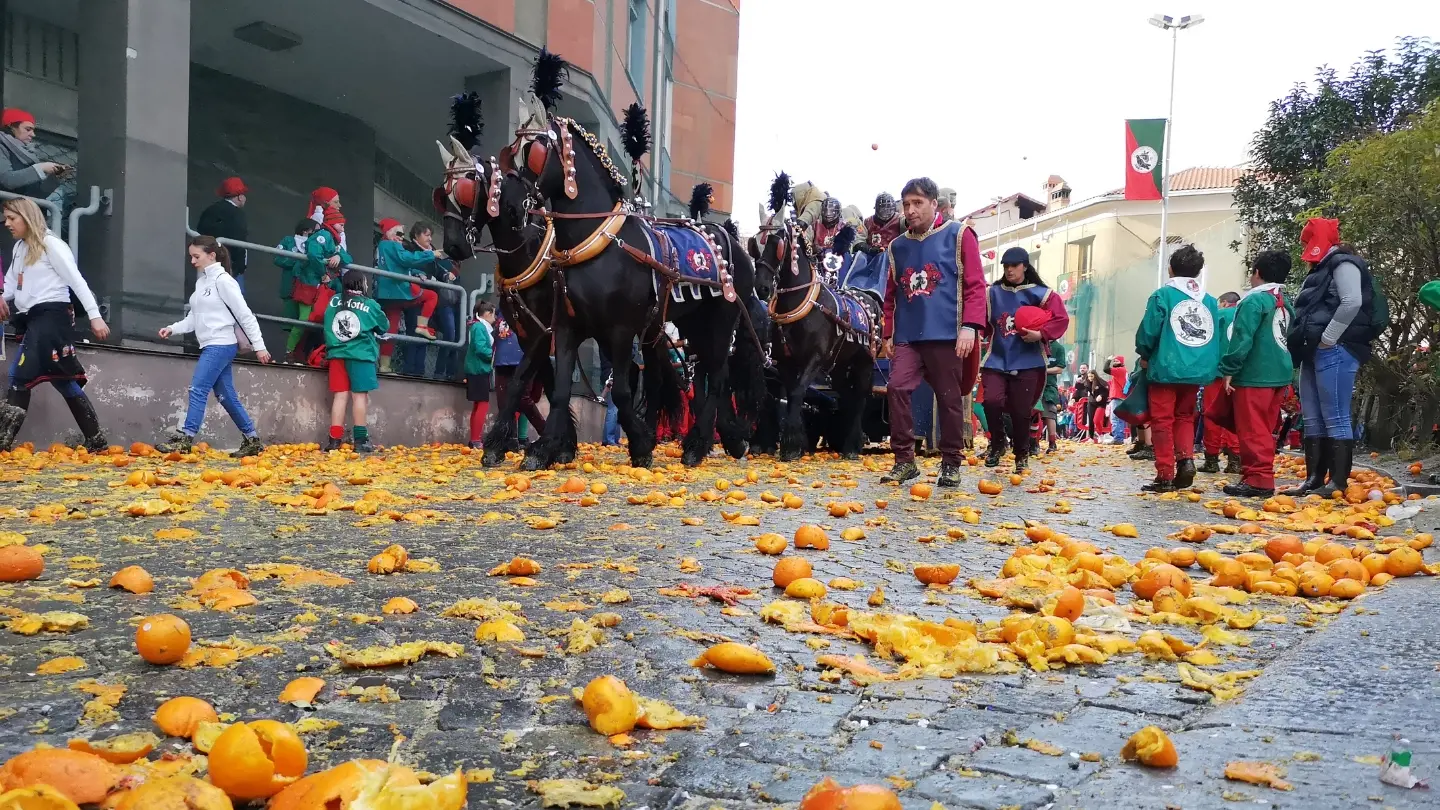
The heart of the battle beats in the historic squares and winding alleys of the city center, which are transformed into another world for these three days. The main venues are the city's large piazzas, such as Piazza di Città, Piazza Ottinetti, and Piazza Rondolino. These wide open spaces are the scene of the fiercest confrontations between the wagon crews and the foot soldiers. Each square has its own special atmosphere and dynamic. During the battle, the cobblestones are transformed into a bright orange carpet of fruit pulp and skins. Visitors who want to watch the action up close often crowd into the narrow connecting alleys. They are always careful to wear their protective red caps visibly. This way, they are recognized as peaceful observers in the midst of the whirlwind of flying fruit. It is this unique interplay of medieval backdrop and pure, modern energy that makes the streets of Ivrea one of the most fascinating places in the world during these days.

Between tradition and sporting competition: How the Battaglia delle Arance works
Before the first official throwing takes place, Ivrea transforms into a veritable fortress of tradition. To protect the historic facades and valuable windows of the city from impact, the buildings are extensively covered with massive nets and wooden panels. The city's squares are decked out in the bright colors of the respective teams, while flags and banners fly everywhere. They transport the modern cityscape back to a bygone era. Thousands of tons of oranges are provided annually for this logistical masterpiece, mainly from the sunny regions of Calabria and Sicily. The ecological aspect is important here: these are fruits that are not suitable for regular trade due to transport damage, visual defects, or overproduction and would otherwise have been disposed of unused. In this way, the carnival gives these „reject fruits” a final, highly emotional purpose.
The duel: foot soldiers against the power on horseback
At the heart of the action is the archaic battle between nine specialized foot soldiers, who represent the rebellious people, and the lordly archers on horse-drawn carts. The latter represent the armies of the feudal lords and pull through the narrow streets either as two-horse teams (pariglie) or as imposing four-horse teams (tiri a quattro). The equipment of the wagon crews pays homage to medieval military history: they wear heavy leather armor and mask-like helmet visors to protect them from the hail of arrows fired by the foot soldiers. The fighters on the street, on the other hand, wear only the colorful jackets and pants of their teams. Although hits to the hands and arms are often painful, the inevitable black eyes among the foot soldiers are not considered injuries, but rather „medals“ worn with pride. They are a visible sign of the courage and dedication that each participant brings to the battle. Watching over everything is the red Phrygian cap, which must be worn by everyone from Fat Thursday onwards who does not want to become the target of the colorful bombardment themselves.
Chivalry and the code of honor of the Aranceri
Despite its visible vehemence, the Battaglia delle Arance is subject to a strict, albeit unwritten, code of chivalry. These rules of fairness ensure that the competition remains a sporting contest despite all the passion involved. The participants treat each other with deep respect. For example, it is customary for the battle to be suddenly interrupted at a moment of highest intensity in order to help up a fallen opponent or to clear the way for the horses. The battle often takes on the character of a personal duel between a shooter on the cart and a fighter on the ground, in which skill and endurance are measured. However, as soon as the cart moves on, the hostility is instantly buried. A warm embrace or a round of applause seals the renewed friendship and reminds everyone that they are celebrating a cultural heritage together.
The jury's verdict: more than just accuracy
At the end of the three-day battle, the winning team is determined by a sophisticated scoring system, which is monitored by an impartial jury. The referees observe the action from strategic points and directly from the floats in order to be able to make a fair assessment. It is not just the sheer number of oranges thrown that counts towards the result. The most important factor, accounting for 40 percent of the score, is the fighting spirit of the team, which is assessed on the basis of the group's commitment and dynamism. Fairness, i.e., adherence to the code of chivalry towards humans and animals, and aesthetic presentation each account for 30 percent of the score. The historical accuracy of the costumes, the decoration of the floats, and the general appearance of the troupe are all taken into account. Thus, it is not necessarily the most aggressive team that wins, but the team that most convincingly embodies the spirit and elegance of the historical carnival.

A heart made of oranges: the immortal soul of the Carnival of Ivrea
For the people of Ivrea, their historic carnival is much more than a welcome break from everyday life or a spectacle for tourists. It is the existential rhythm of the city, a deeply felt passion in which each generation rediscovers its roots. During these days, the entire population merges into one large, collective ritual characterized by values such as loyalty, sporting ambition, and an unshakeable sense of community. Two central motifs take center stage: the passionate struggle for freedom, symbolized by the revolt against tyranny, and the pursuit of renewal and fertility. The latter finds its ritual climax in the ceremonial burning of the „Scarli“: these heather-wrapped stakes are set alight in the town squares. The blazing fire not only marks the end of the celebrations, but also serves as an archaic symbol of the victory of life and the dawn of a new year.
A year-round attitude to life
This deep connection does not end on Ash Wednesday, because the tradition is lived throughout the year in Ivrea. In the numerous associations of orange throwers and historical groups, citizens find their place and their individual role within this gigantic production. The preparations, the meetings in the clubhouses, and the cultivation of customs form the social backbone of the city. The „Battaglia delle Arance“ is thus only the visible outburst of a year-round devotion. It is a living tribute to the city's own history and a testament to the pride and seriousness with which cultural identity is preserved in Piedmont. Anyone who has experienced the intensity of this festival once realizes that Ivrea is not just staging a battle, but celebrating an incomparable heritage. This is deeply rooted in Italian festival culture and exerts a great fascination that is almost impossible to resist.
The historic carnival in Ivrea is a sensory and emotional work of art. It combines the archaic force of battle with the elegance of Napoleonic parades and the profound seriousness of medieval myths of freedom. For visitors, it is an exhilarating experience, but for the locals, it is the essence of their being—a fiery plea for freedom that is sealed anew each year in a sea of oranges and the glow of burning scarli.

Profile Ivrea and its carnival
Location & size: Ivrea is located in Piedmont (Italy) on the Dora Baltea River and has a population of approximately 23,000.
UNESCO World Heritage Site: A World Heritage Site since 2018 as a modern industrial city of the 20th century.
Economic history: Famous home of the typewriter pioneer Olivetti.
Landmark: The imposing Castello dalle Quattro Torri and historic old town.
Carnival core: Staging of a medieval popular uprising against tyranny.
Main character: The miller's daughter (Mugnaia), a symbolic figure of courage and freedom.
Orange battle: Spectacular battle between foot teams (commoners) and chariots (nobility).
Symbolism: Approximately 600 tons of oranges replace the stones of the original rebellion.
Red cap: The „Berretta Frigia“ is mandatory for spectators to avoid being pelted with objects.
Conclusion: Traditional burning of the „Scarli“ stakes as good luck charms for the year.
Map: Ivrea, Piedmont
FAQ – Frequently Asked Questions About Carnival in Ivrea
Top accommodations in Ivrea, Piedmont
Video: Carnival in Ivrea, Piedmont
Experiences & sights
Note: Disclaimer - Italien.news is not the owner or organizer of the sights, accommodations and events published here and therefore not responsible for program changes, cancellation of the event and possibly incorrect information. The editorial team of Italien.news always endeavors to provide detailed and accurate information. However, it is possible that events, attractions, etc. may be changed and not updated promptly. Exact details of dates, times and programs can be obtained directly from the owner of the attractions and accommodation.
Please also check the website or social media of the attractions and events for updates before you travel! Our blog articles contain our personal recommendations in the form of affiliate links. If you book or buy something via the links or simply click on them, we receive a small commission. This does not change the price for you at all. Content and texts © Italien.new & KI / Photos © Canva.com / shutterstock.com / Unsplash.com / Pixabay.com / Pexels.com / Others. Please also visit our Italy Shop!