
Glass dreams in the lagoon: the legacy of the glass masters of Murano
Venice - the mere sound of this name takes the imagination on a journey through winding alleyways and along glittering waterways. While the gondolas glide almost silently through the narrow canals of the Serenissima and the magnificent facades of the Gothic palazzi are reflected in the Grand Canal, every breeze in this city breathes the history of past centuries. But if you leave the main tourist routes around St. Mark's Square and take the vaporetto to the north of the Venice lagoon reaches a group of islands that has kept a unique secret for over seven hundred years: Murano. This place is far more than a mere collection of small islets; it is the pulsating center of the Venetian glassblowing, where the elements of fire and sand are fused into almost supernatural works of art by the skillful hands of local masters.
The importance of this place is deeply rooted in the history of the Republic. As early as 1291, the Doges moved all the glass furnaces from the historic center of Venice to these islands - officially to prevent the constant fires in the densely built-up city, but unofficially also to hide the closely guarded glass production recipes from the eyes of curious competitors. Today, Murano presents itself as a fascinating living museum, which captivates art lovers and aesthetes alike. The objects produced here, from delicate drinking glasses to monumental chandeliers, are regarded worldwide as the ultimate in Italian craftsmanship and as a timeless symbol of elegance and technical perfection.
In this article, we take you on an inspiring journey of discovery through the winding alleyways of Glass Island. We take a look behind the scenes of the traditional Manufactories, where the heat of the furnaces still determines the rhythm of everyday life. We not only shed light on the fascinating techniques of the glassblowers, which have been passed down from generation to generation, but also explore the cultural depth that each piece has. Murano glass a genuine part of Venetian identity. Join us in a world where the boundaries between ancient craftsmanship and modern art merge seamlessly.


The glass prison: between aristocracy and the strictest secrecy
The history of Murano goes back much further into the past than the splendor of today's glass stores would suggest. As early as the 6th century, people in the northern lagoon of Venice Refuge from the turmoil of the migration of peoples. These early settlers - often refugees from the Roman Altinum - established a community of fishermen and salt traders here, which for a long time stood in the shadow of more powerful neighboring islands such as Torcello. However, the true metamorphosis of the archipelago only began in the late 13th century, when a political decision changed the geography of the artisanship forever.
In 1291, the Grand Council of Venice a groundbreaking decree ordering the relocation of all glass furnaces from the historic center to Murano. Officially, this step served the fire protection, as the enormous heat of the smelting furnaces posed a permanent danger in the densely built-up city, which was largely constructed of wood. Behind the scenes of the Serenissima however, pursued a far more calculated goal: to protect its technological advantage. By isolating itself on the island, the Republic of Venice was able to protect its valuable recipes for glass production from the competition. Industrial espionage and cemented a worldwide monopoly that made Murano the exclusive supplier for the European aristocracy.
Read more about theTopic





The social position of glassblowers on Murano was characterized by a fascinating ambivalence. On the one hand, the masters enjoyed extraordinary Privileges, which no other craftsmen were granted: They were allowed to carry swords, enjoyed immunity from local prosecution and their daughters could even enter the Venetian Nobility marry in - a social permeability that was actually unthinkable in the strictly hierarchical republic. On the other hand, they lived in a gilded cage. Anyone who tried to take their knowledge beyond the borders of the lagoon or even enter the service of others was branded a traitor and, in extreme cases, faced the death penalty.
This mixture of isolation and excellence led to the golden era of the island in the 15th and 16th centuries. With pioneering innovations such as the Cristallo, one of Angelo Barovier developed, almost perfectly transparent glass, Murano set global standards. The island became synonymous with the ultimate in luxury; no important royal house or papal palace could afford to do without the filigree works of art from the lagoon. The signature of Murano thus developed into the first real global status symbol, which not only showcased Venice's craftsmanship, but also its political and cultural splendor to the world.

Authenticity in the glow of light: what really makes an original from Murano
Venice's glass heritage is far more than just a decorative accessory; it is a Beauty with soul, which derives its fascination from the inseparable combination of artistic vision, pride in craftsmanship and centuries-old tradition. What a genuine piece Murano glass so fundamentally different from industrial mass-produced goods is the fact that each object is an unrepeatable piece of art. Unique represents. Even if certain designs are produced in small series, each workpiece bears the individual signature of the designer. Maestro and his well-coordinated team. In the glowing heat of the glass furnaces on the island, human creativity leaves a mark that you can not only see, but literally feel in the brilliance of the colors and the gentle irregularity of the shapes.
The glass art of the lagoon proves to be surprisingly resistant to the fleeting trends of consumer society. Their Timelessness results from a deep-rooted knowledge that has been guarded like a precious heritage for generations in the great glassblowing dynasties such as the Barovier, Seguso and Venini families. These masters preserve secret recipes for color extraction and technical refinements that are often only passed on orally within the workshops. But Murano glass is by no means a frozen relic of history. It remains alive by seeking dialogue with contemporary artists and international designers, bridging the gap between ancient know-how and modern aesthetics without ever trivializing its cultural identity.
The spectrum of this work ranges from opulent Rezzonico chandelier, which illuminate the high ceilings of Venetian palazzi, to the smallest, filigree glass beads used in jewelry art worldwide. Anyone investing in such an object today is opting for a Emotional investment in tangible assets, that goes far beyond the purely material price. It is a commitment to sustainable quality and the appreciation of a craft that is part of the intangible cultural heritage of humanity. When purchasing in the renowned galleries along the Fondamenta dei Vetrai connoisseurs should always look for the official trademark Vetro Artistico® Murano respect. This seal guarantees that the artwork was actually created in the traditional atmosphere of the Venetian archipelago and reflects the spirit of the Serenissima into your own four walls.

Between precision and poetry: the fine art of Muranese refinement
The art of glassblowing is far more than an ordinary craft; it is like a highly complex dance with the elements in which body, mind and aesthetic sensibility must act in absolute harmony. In the Glassworks of Murano, the so-called Fornaci, there is a concentration that is almost palpable. The material - a glowing, viscous and deeply unpredictable mass - requires the Maestro an instinctive understanding of temperature, timing and the physical limits of the material. Any mistake in a fraction of a second can destroy hours of work, because the glass does not forgive indecision.
The creation process begins in the heat of the melting furnace, where a precisely balanced mixture of the finest Quartz sand, soda and lime at temperatures of up to 1,400 degrees Celsius melts into liquid magma. With the blowpipe, the Canna, the glassblower extracts a precise amount of these embers. Through controlled turning, rhythmic blowing and the use of traditional tools such as the Maia (a wooden trowel) or the Prezzeda (a pair of tongs), the form comes to life. But the true mastery is revealed in the specialized finishing techniques that have made Murano world-famous.
One of the most demanding methods is the production of Murrine, often also referred to as Millefiori known. In this process, different colored layers of glass are fused together to form a complex rod with a precise cross-sectional pattern - such as a flower or a star. These rods are cut into wafer-thin slices and assembled into new compositions like a microscopic mosaic. After being heated again, these fragments fuse together to form a smooth surface that reveals an incredible graphic depth and intensity of color, almost like a painted work of art.
No less fascinating is the technology of the Filigrana, in which wafer-thin glass threads, often with a core of opaque white glass (Lattimo) are artfully twisted together. These threads are worked into the glass mass and create patterns reminiscent of fine lace or woven textiles. The sub-form of the Reticello, The "cross-shaped net pattern" with tiny trapped air bubbles is considered a test of maturity for every glass master, as it requires mathematical precision to maintain symmetry in the liquid state.
The characteristic, almost magical shine of many pieces is provided by the so-called Chandelier glass or the technology of the Iridato. Precious metal salts are vaporized onto the surface, which react with the heat of the glass and create an iridescent shimmer that plays in all the colors of the rainbow depending on the incidence of light. If, on the other hand, copper crystals are mixed directly into the melt, the sparkling Aventurine glass, a 17th century Muranese invention that is prized for its metallic stardust effect.
In modern glass art, the Sommerso technology has a special significance. Literally translated, this means „immersed“, and this is exactly how the effect is created: an already formed, colored glass core is successively immersed in vessels with different colored, transparent glass. This creates massive, heavy objects that have a fascinating three-dimensionality due to their seemingly floating layers of color. This technique, which was perfected particularly in the mid-20th century by artists such as Flavio Poli, combines minimalist elegance with an optical depth that literally captures the light inside the object. Each of these techniques contributes to genuine Murano glass to this day as the ultimate in Italian luxury goods applies.

The workshops of Murano: an authentic experience of a Venetian glassblowing workshop
Those who want to explore the paved Fondamenta dei Vetrai behind often inconspicuous doors, you will discover the pulsating heart of the island: the Fornaci. These glassblowing workshops are usually deeply rooted family businesses that guard their knowledge like a precious treasure for generations. Many of these workshops open their doors to visitors, and as soon as you cross the threshold, you are immersed in a world where modern time seems to stand still. The air in a authentic glassworks on Murano is impregnated with dry heat, the metallic smell of the tools and an almost electrifying creative tension. At the center of the action is the melting furnace, whose fiery core melts the raw materials at temperatures of up to 1,400 degrees Celsius into a viscous, glowing red state.
In the midst of this backdrop, the glass masters act in a fascinating, wordless choreography. It is important to understand that a Maestro rarely works alone; he leads a well-coordinated team, the so-called Piazza, consisting of assistants and apprentices who hand him the tools or hold the glass at the Puntello (the holding iron). With the Canna, The long blowpipe is used to take exact portions of the glass mass from the embers. What looks to the layman like a chaotic game with the fire is in fact the utmost precision: the unstable material is forced into shape through rhythmic turning, controlled blowing and the use of traditional tongs. As the glass loses its malleability even when it cools slightly, every second counts - a captivating spectacle that often leaves the audience in devout silence.
The contrast between the archaic violence of the blazing stove and the incredible filigree nature of the resulting work of art is what makes a Glassblowing demonstration from. In some manufactories, guests even have the unique opportunity to try their hand at a workshop. Blowing your own first object - be it a small ball or a colorful glass drop - under the strict but cordial guidance of a master craftsman creates a deep connection to the region. Venetian craftsmanship. It is a sensual experience to feel the heat in your face and to experience how your own breath creates a solid form out of glowing matter.
An often underestimated but technically crucial moment is the transition of the finished work into the Tempering oven, in Italian Tempra called. The glass is not simply set aside, but cooled in a controlled manner over many hours or even days. If the piece of art were immediately exposed to room temperature, the internal stresses of the material would cause it to shatter immediately. This final process teaches the visitor patience and underlines the respect that the Murano craftsmen have for their unpredictable material. A visit to such a workshop is therefore far more than just a tour - it is a lesson in humility before the material. Italian craftsmanship.

The echo of the ovens: A journey through time at the Museo del Vetro
If you really want to explore the soul of Murano, a visit to the Museo del Vetro not pass by. Located in the magnificent Palazzo Giustinian, a former bishop's residence in the Venetian Gothic style, this building is the undisputed memory of the island. The museum was founded in 1861 - at a time when the glass industry was struggling to survive after the end of the Venetian Republic - and today houses one of the world's most important collections of glass art. History of glass art. As soon as you enter the stately halls with their views of the canal, you can sense that this is not a dusty archive, but a place where light and matter have been engaged in a fascinating dialog for thousands of years.
The curated journey through time begins impressively far back in the past with archaeological finds dating back to Roman antiquity. These fragile witnesses - from iridescent perfume bottles to medical vessels from the 1st to 3rd centuries - impressively demonstrate that the fascination with this material is not a modern invention. But the real showpiece of the collection is the documentation of the Venetian heyday. Here, visitors encounter the legendary Barovier Wedding Cup from the 15th century, a masterpiece of dark blue glass with enamel painting, which is representative of the technical quantum leap that Murano made in the late Middle Ages. It was the era in which Angelo Barovier founded the Cristallo Veneziano The first truly clear, colorless glass in world history, which made Venice the undisputed monopolist on the European markets.
The exhibition takes a particularly deep dive into the technical evolution that was often kept like a state secret behind the closed doors of the workshops. It provides insights into historical pattern books and the alchemy of colors, in which metal oxides such as cobalt or gold dust were mixed into the melt to create the unmistakable brilliance for which Venetian glass is still famous today. The museum also shows the darker chapters, such as the economic crisis in the 18th century, and the brilliant resurgence in the 19th and 20th centuries, when designers began to use glass as a medium for contemporary art to redefine it.
Today, the tour does not end in the past, but builds a bridge to modernity. Changing installations by international artists make it clear that glass in the Venice lagoon has remained a living, constantly changing medium. At the Museo del Vetro, one thing becomes unmistakably clear: glass is far more than solidified sand. It is a narrative medium that absorbs cultural upheavals, the spirit of technical research and the irrepressible will to perfection and preserves them for eternity.

Blue fire on the Campo: the Cometa di Vetro as a beacon of modernity
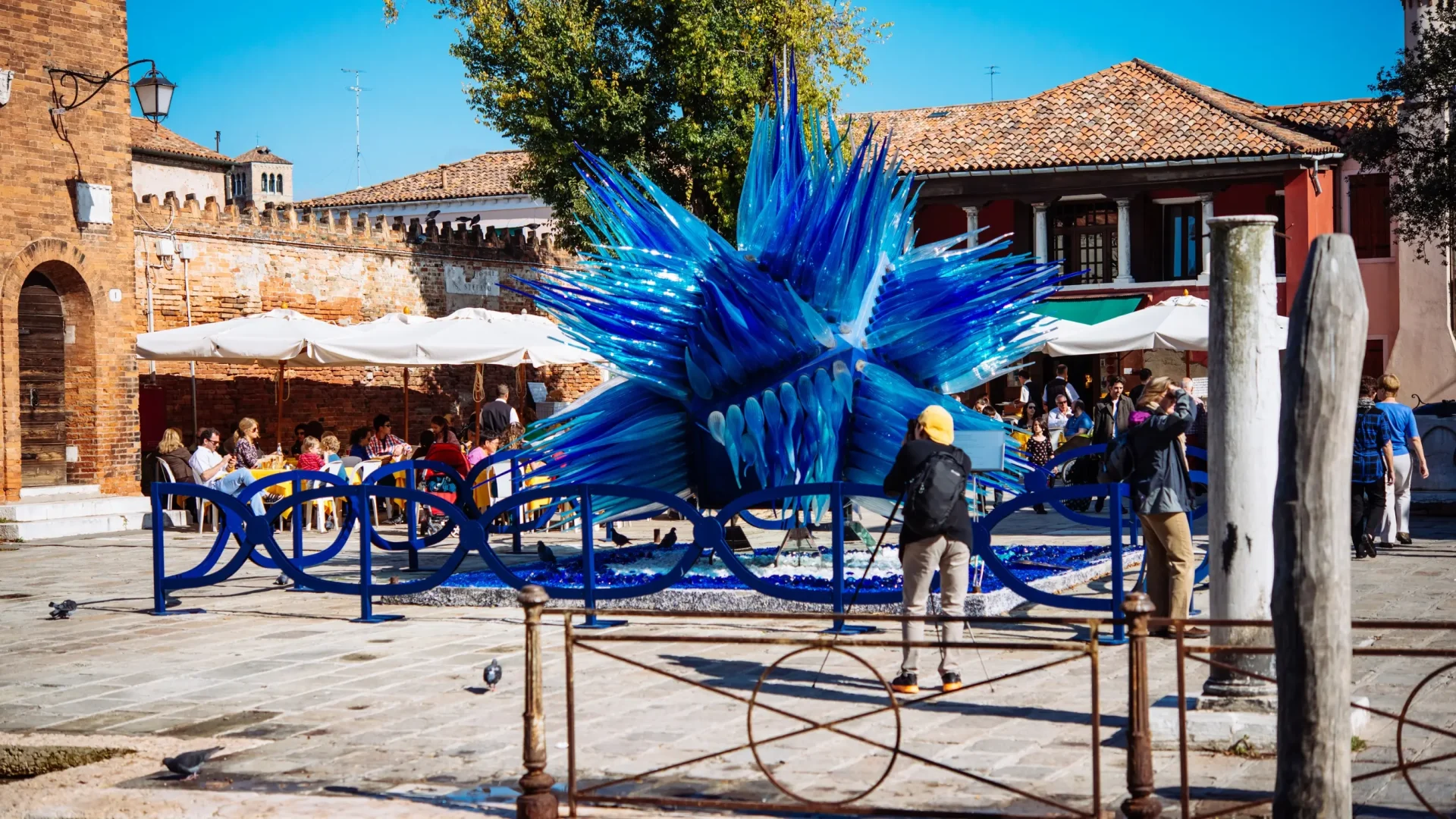
Anyone who wants to know about the Campo Santo Stefano stroll through one of the central and busiest squares on Murano, you will come across a work of art that perfectly bridges the gap between centuries-old tradition and avant-garde design: the Comet Glass Star. Right next to the historic church San Pietro Martire this sculpture with its countless tapered glass arms attracts everyone's attention. In a deep, luminous Cobalt blue the work looks like an explosion of stars frozen in time or a stylized supernova. It radically breaks with the classic forms of Venetian vases or chandeliers and impressively proves that the island's glass art has lost none of its dynamism and innovative power.
The official name of the plant is Cometa di Vetro and comes from the pen of the renowned glass artist Simone Cenedese. As the scion of one of Murano's most influential glassblowing dynasties, Cenedese is a master at translating the artisanal heritage of his ancestors into a modern design language. The blue star was originally created in 2007 as part of the „Natale di Vetro“ (Glass Christmas) was erected as a temporary installation. However, the response from locals and international visitors was so overwhelming that the sculpture became a permanent landmark of the square. It consists of over 500 handmade glass elements, which radiate like crystalline lances in all directions and give the place an almost extraterrestrial aura.
Particularly fascinating is the changing play with light that the Venetian lagoon makes it so unique. Depending on the position of the sun and the weather, the Comet Glass Star changes its appearance: while it appears almost ethereal and transparent in the cool morning light, the blue tips catch the warm light of the Adriatic Sea at sunset and begin to glow intensely. In the evening hours, the sculpture is also artfully illuminated from within, making it a must-have photo motif for anyone who wants to take a photo. Venice vacationers makes. For the people of Murano, however, this star is far more than just a decorative object; it is a powerful symbol of the island's optimism and creative potential. It stands for the vision that the UNESCO World Heritage Site of glassblowing does not just remain in the past, but also shapes the identity of the region in the 21st century as a lively, courageous art form.
The echo of the dragons: The mysterious basilica of Murano
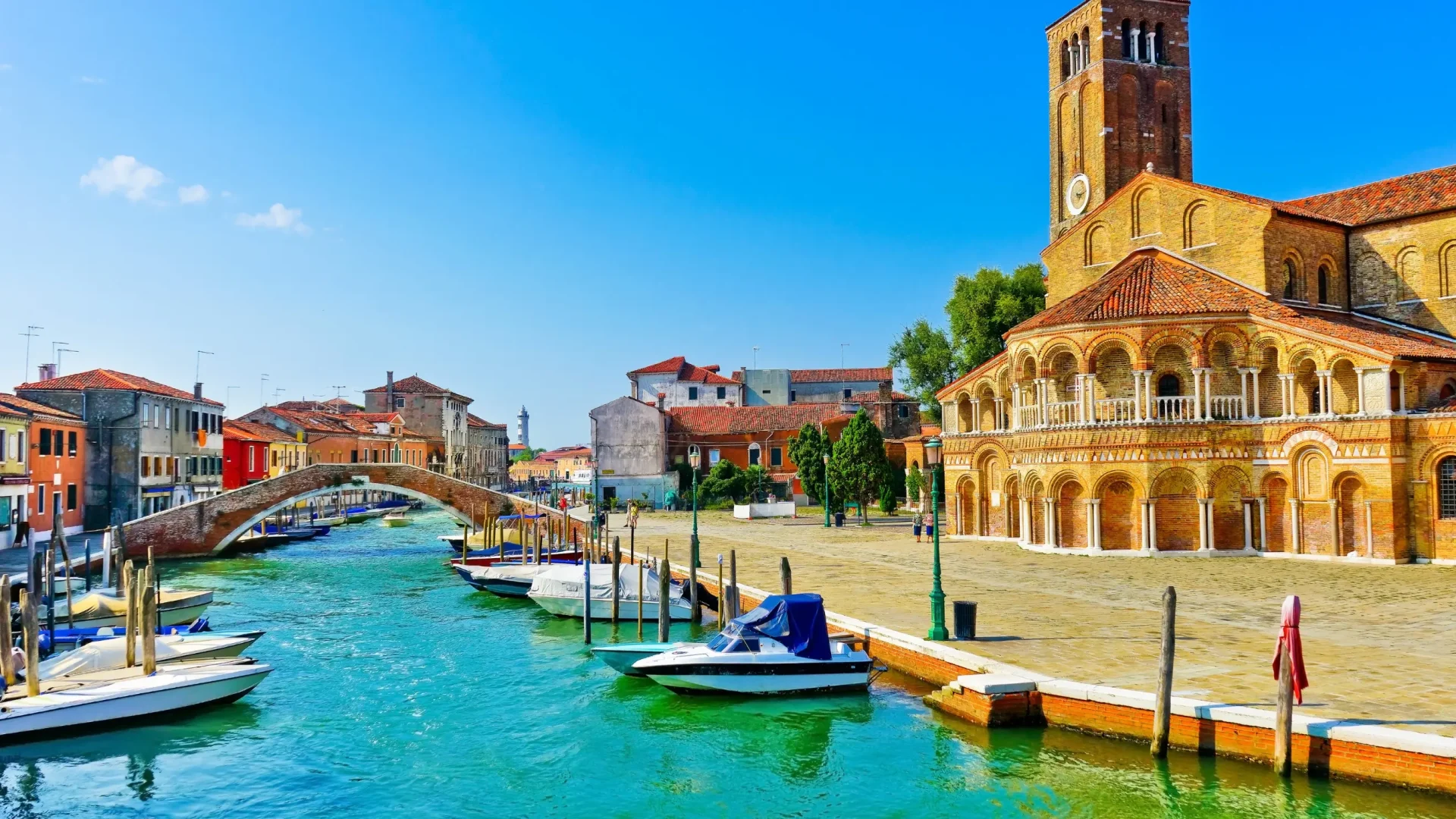
Murano is much more than the center of the fiery glassworks; it is a place where the cultural and spiritual DNA of the Venice lagoon in its purest form. This manifests itself particularly impressively in the Basilica di Santa Maria e San Donato, an architectural jewel that is one of the most important examples of the Veneto-Byzantine architecture counts. While its humble beginnings date back to the 7th century, the church owes its current majestic appearance mainly to the 12th century. The magnificent, two-storey outer apse in particular, with its delicate arcades and reddish brick, attracts the attention of visitors who dock at the Murano Canal by vaporetto.
Anyone entering the nave is greeted by a silence that immediately contrasts with the hissing of the glass ovens. The gaze inevitably wanders downwards, because the Mosaic floor of the basilica dating back to 1141 is one of the most spectacular art treasures in Italy. A carpet of thousands of tiny marble and glass stones spreads across a huge surface, forming elaborate peacocks, eagles and complex geometric patterns. These representations are far more than decoration; they are a stone testimony to Venice's former wealth and its deep trade links with the Orient. The aesthetics are strongly reminiscent of the splendor of San Marco, but here on Murano they appear more intimate and almost more original.
However, the spiritual and mythological heart of the basilica is hidden behind the high altar. Here hang four enormous bones, over three meters long, which have fired the imagination of the faithful for centuries. According to legend, these are the remains of a fearsome dragon that the Saint Donatus of Arezzo in Greece before his relics were transferred to Murano together with the „dragon bones“ in 1125. While modern researchers today see the exhibits more as the skeletal remains of Pleistocene megafauna - presumably an extinct whale - this in no way detracts from the mystical aura of the place. It is this fascinating fusion of historical reality, deep faith and local folklore that makes a visit to the church an almost meditative experience.
In the Basilica di Santa Maria e San Donato, it becomes clear that there are two sides to Murano's beauty: the worldly, glittering splendor of glass and the sacred, timeless depth of a place that has offered shelter and contemplation for over a millennium. It is an invitation to slow down and realize that the true art of the island lies not only in the flames of the furnaces, but also in the gentle fall of light on Byzantine mosaic is to be found.


Burano: 7 highlights of the colorful lagoon island
More than just colorful facades: Tradition, cutting-edge art and island flair on Burano At first glance, Burano looks like a canvas come to life that goes far beyond the image of a mere fairytale backdrop. Only...
The white light at the edge of the world: the Faro di Murano as a gateway to the lagoon
On the extreme south-eastern shore of the archipelago, where the busy canals flow into the wide, glittering expanse of the Venetian lagoon an imposing sentinel towers into the sky: the Faro di Murano. Anyone arriving by vaporetto from Venice at the „Faro“ stop of the same name stands directly in front of this elegant landmark, which is far more than just a technical aid to navigation. Today's lighthouse, a magnificent cylindrical structure made of gleaming white Istrian limestone, was completed in its current form in 1912. It replaced an older, less durable wooden predecessor in order to meet the growing demands of modern shipping and the increasing traffic between the Lido and the historic center of Venice.
The choice of material - the famous Pietra d'Istria - is no coincidence, as this stone has shaped the architecture of the Serenissima for centuries and defies the aggressive salt water and humid sea breeze like no other. Technically speaking, the Murano lighthouse a masterpiece of functional aesthetics. It has two beacons, one above the other, which fulfill different tasks: While the upper light serves as a signal visible from afar for long-distance navigation, the lower one guides captains safely through the treacherous shallows and narrow channels of the lagoon. Although the tower is unfortunately not open to the public, the promenade at its foot offers one of the most beautiful views in the entire region.
A walk to the southern tip of Murano is particularly worthwhile in the late afternoon hours. When the sun slowly sinks behind the silhouette of Venice and the sky turns shades of purple and gold, the white limestone of the tower literally begins to glow. For the locals Master glassblower, whose workshops are often just a few streets away, the faro is a symbol of stability in a constantly changing world. It is the silent observer that reflects the centuries-old tradition of Glass art and shows the ships carrying the precious cargo from Murano all over the world the safe way out of the lagoon. In the midst of the tourist hustle and bustle, it remains a place of stability, reminding us that safety and beauty have always gone hand in hand in the seafaring city of Venice.

The crossing to the glass island: when water slows down time
Those who make the journey to Murano are not simply leaving the historic center of Venice; they are embarking on a pilgrimage to a place where time, tradition and the elemental power of fire can be felt in every breath. Even the journey there is a conscious deceleration that prepares the mind for what is to come. As soon as the Vaporetto on line 4.1 or 12 at the bus stop Fondamente Nove and glide out into the wide, glittering lagoon, the hectic backdrop around St. Mark's Square fades away. On the way, you pass the cemetery island enclosed by high walls San Michele, The cypress trees rise majestically into the sky before the characteristic silhouette of Murano finally emerges on the horizon. The atmosphere changes noticeably with every meter you approach the archipelago: the air becomes saltier, the soundscape more subdued and the light seems to refract in the water in a way that is only possible here.
The panorama that greets the visitor is characterized by a fascinating contrast of rustic charm and industrial history. Red tiled roofs, the patina of old palazzi and the striking, often still smoking Factory chimneys of the historic glassworks form a cityscape that is much more honest and less staged than the tourist heart of Venice. At first glance, Murano appears almost modest, but behind the inconspicuous brick facades along the Rio dei Vetrai beats the pulsating heart of a centuries-old Arts and crafts. Here, glass art is not a preserved relic from days gone by that can only be admired in sterile museum showcases. It is a living, breathing reality.
As you stroll through the alleyways, you can hear the rhythmic clinking of glass and feel the radiant heat from the open ovens seeping through open workshop doors onto the street. In these Manufactories the heritage lives on in the skillful hands of the masters, who still tame the liquid, glowing material with a precision that amazes the observer. Murano is a place that invites contemplation - a refuge for aesthetes that proves that true mastery is not characterized by volume, but by consistency and attention to detail. A visit here is an encounter with the soul of the Venetian lagoon, unadulterated and deeply rooted in a world where glass dictates life.

Murano for connoisseurs: insider culinary tips and quiet corners
To round off your day on Murano perfectly, you should explore the island especially when the large tour groups set off again towards St. Mark's Square in the late afternoon. At this time, the island has an almost magical tranquillity. A culinary must for every visitor is the traditional Venetian aperitivo culture. Instead of settling directly on the main tourist canals, it's worth taking a detour into the smaller alleyways around the Rio dei Vetrai. There you will find authentic Bacari, small wine bars where you can taste the famous Cicchetti you can try. These hearty snacks - from baccalà mantecato (creamy stockfish) to sardines marinated in saor - are best enjoyed with an „ombra“, a small glass of local wine, right by the water.
If you are looking for the culinary soul of the lagoon, keep an eye out for the restaurants that serve fresh fish from the northern lagoon of Venice serve. Away from the classic routes, for example in the area of the bus stop Murano Navagero, The area is home to restaurants that are popular with locals for their homemade pasta dishes with seafood. The atmosphere here is relaxed and honest, far removed from the hustle and bustle of the souvenir stores. It is the ideal moment to soak up the impressions of the glowing glass ovens with a glass of cool wine. Prosecco from the nearby Veneto region.
A real insider tip for explorers is also a walk to the Sacca San Mattia. This area in the north of the island is largely undeveloped and offers an almost wild, unspoiled nature that you would hardly expect to find so close to the gates of Venice. From here you have an unobstructed view of the open lagoon and on a clear day you can even see the outline of the Dolomites on the horizon. It's the perfect place to explore the spiritual and artisanal depths of Murano before taking the Vaporetto the return journey on line 12 or 3. If you then make sure to buy your handmade souvenir directly in one of the small studios Instead of buying in the big showrooms, you don't just take a piece of glass home with you, but a real story.

Murano's legacy: why the glass island remains the heart of the lagoon
If you look at the journey as a whole, one thing becomes unmistakably clear: Murano is far more than just a production site for exquisite handicrafts. It is a vibrant way of life, a deeply rooted culture and the centuries-old pursuit of a perfection that transcends short-lived trends. The island and its Master glassblower symbolize impressively what happens when a tradition is not only preserved over generations, but is further developed with burning passion and tireless curiosity. Here, patience and respect for the material merge into one Venetian identity, that is unrivaled anywhere in the world.
Every single object that leaves the heat of the furnaces in the manufactories carries a deeper narrative within it. It is not just the physical history of the glass, but that of the people who shaped it with their breath and their strength. In the vases, sculptures and the filigree Murano jewelry you do not recognize anonymous mass-produced products, but the unmistakable expression of character and soul. These works do not arise from a calculated desire for mass production, but from the primal human drive to create something true and lasting in an often superficial world. A Original from Murano is therefore always also a piece of the artist's lived biography.
At the same time, the island functions as a precious cultural memory of the Serenissima. The knowledge preserved in the workshops is a distillation of Byzantine influences, oriental ornamentation and the aesthetic sensibilities of bygone eras. Here, glass is the medium that literally preserves time - the fleetingness of the glowing moment is captured and preserved for centuries in crystalline form. In an era that seems increasingly digital and fleeting, the glass art of the lagoon stands for permanence and genuine craftsmanship. It is a conscious decision for quality and against the throwaway mentality of our time.
A visit to this special group of islands in the north of Venice is therefore much more than a classic tourist stopover. It is a profound encounter with a living art form and with people who dedicate their entire existence to the creation of beauty. If you enter Murano with open eyes and a wide heart, you will witness an archaic miracle: the transformation of simple elements such as sand, fire and air into something sensual and timeless. The flowing movements of the glassblowers, the play of light in the canals and the palpable heat of the workshops merge into a state of inspiration. Murano is ultimately not just a geographical location, but an idea - the reminder that man is capable of shaping eternity from the ephemeral.

Map: Murano, Venice
Tickets: Burano, Venice
FAQ: Murano near Venice
What is the best way to reach the island of Murano from Venice?
Getting to Murano from Venice is very straightforward with the public water buses, the so-called vaporetti, which depart regularly from stations such as Fondamente Nove or St. Mark's Square. Depending on the starting point, the crossing takes around ten to twenty minutes and offers a magnificent view of the lagoon and the passing cemetery island of San Michele.
Is a visit to the Museo del Vetro glass museum worthwhile?
A visit to the Museo del Vetro is highly recommended for travelers interested in culture, as it impressively documents the entire history of glass production from antiquity to the present day. In the magnificent rooms of Palazzo Giustinian, visitors can admire not only rare archaeological finds, but also modern masterpieces that illustrate the world-famous craftsmanship of the islanders.
Where can you watch the glassblowers at work?
Although many large factories offer special demonstrations for tourist groups, smaller, authentic workshops can often be found along the main canals, where you can look over the shoulders of the master craftsmen for a small fee or while buying a souvenir. It is advisable to look specifically for businesses with the „Vetro Artistico Murano“ trademark to distinguish genuine handicrafts from cheap imports.
When is the best time for a trip to Murano?
To avoid the large crowds of tourists and enjoy the island in its relaxed atmosphere, travelers should ideally plan their visit for the early morning hours or late afternoon. Especially in the low season or during the week, Murano shows a quieter side, which makes strolling through the colorful alleyways and visiting the historic basilica much more pleasant.

Cavallino-Treporti: beach, lagoon and Venice
The sunny Cavallino-Treporti peninsula between the Adriatic Sea and the Venice lagoon delights beach lovers, nature enthusiasts and culture vultures alike. Fifteen kilometers of fine sandy beach, picturesque lagoon landscapes and the proximity to the world-famous lagoon city of Venice make this...

Top accommodations in Murano
Video: Murano, Venice
Experiences & sights
Note: Disclaimer - Italien.news is not the owner or organizer of the sights, accommodations and events published here and therefore not responsible for program changes, cancellation of the event and possibly incorrect information. The editorial team of Italien.news always endeavors to provide detailed and accurate information. However, it is possible that events, attractions, etc. may be changed and not updated promptly. Exact details of dates, times and programs can be obtained directly from the owner of the attractions and accommodation.
Please also check the website or social media of the attractions and events for updates before you travel! Our blog articles contain our personal recommendations in the form of affiliate links. If you book or buy something via the links or simply click on them, we receive a small commission. This does not change the price for you at all. Content and texts © Italien.new & KI / Photos © Canva.com / shutterstock.com / Unsplash.com / Pixabay.com / Pexels.com / Others. Please also visit our Italy Shop!