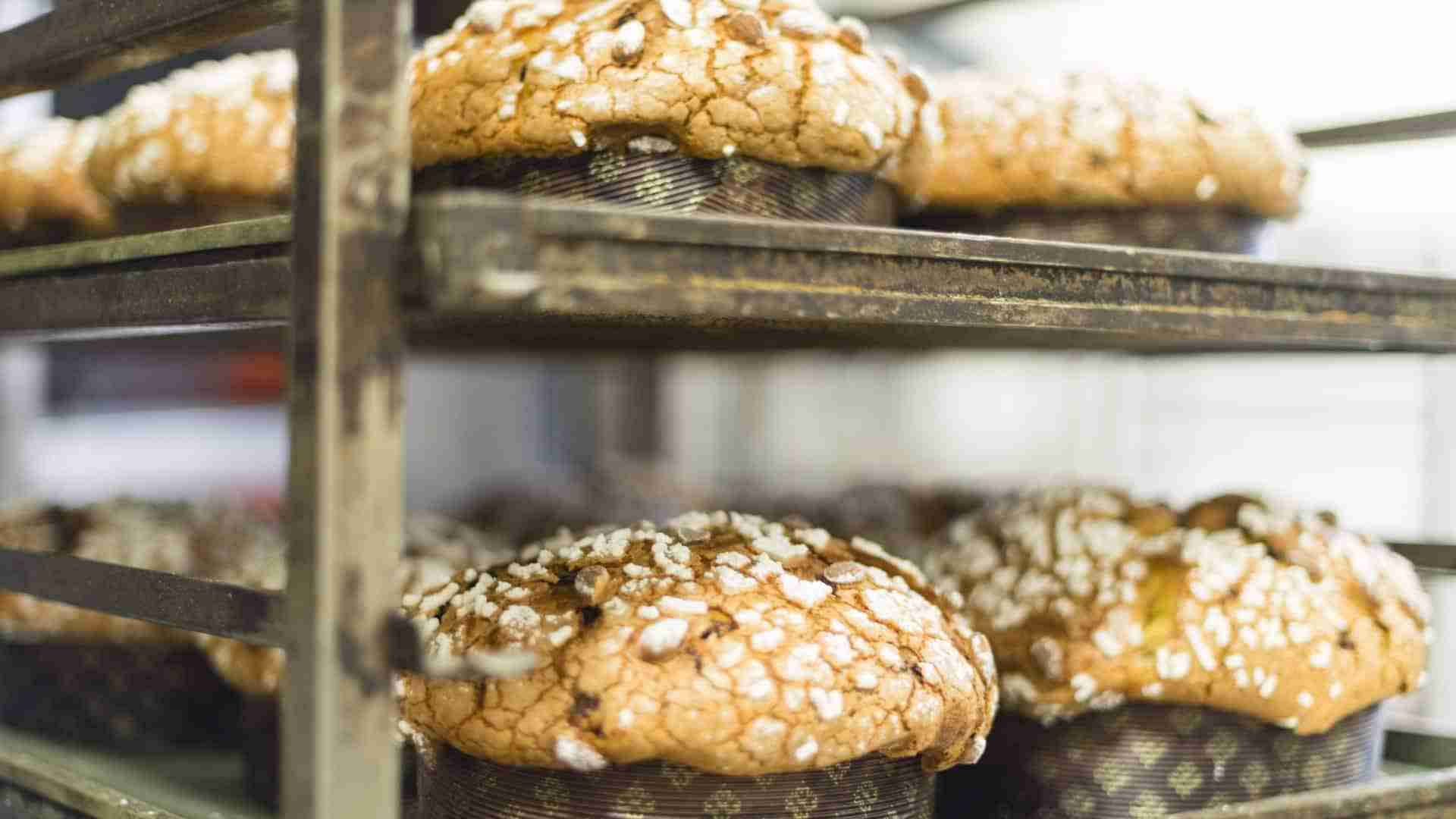
Milan – The Panettone is Italy’s Christmas cake: a tall, dome-shaped yeast cake from Milan, made with butter, egg yolks, raisins, and candied orange and citron peel, which appears on nearly every Italian table between December 8 and January 6. A ministerial decree enacted in 2005 specifies the criteria for what can be called a Panettone. A legend from the Sforza court in Milan tells the story of its origins, and you’ll find step-by-step instructions on how to bake it at home below.
This article explains the history of panettone, the minimum legal requirements, the classic three-stage dough recipe, the main varieties, the best bakeries in northern Italy, and how it differs from the Veronese version. Pandoro. To find out how the cake fits into an Italian family’s holiday celebrations, read our article on Christmas in Italy.

Where does panettone come from, and is there any truth to the legend of Toni?
Panettone comes from Milan, and its best-known origin story takes place at the court of Ludovico Sforza, known as il Moro, Duke of Milan in the late 15th century. During the Christmas banquet, the court chef burned the dessert. A kitchen boy named Toni had made his own dough from leftovers in the pantry—using flour, butter, eggs, raisins, and candied fruit—and offered it as a substitute. The duke was delighted and asked for the name; the cook replied in the Milanese dialect: This is Toni's bread, that's Toni's bread. It's supposed to be panettone have become.
There is no historical evidence of this. What is certain is that as early as the Middle Ages, a wheat bread enriched with fruit—flat and dense—was baked in Milan for Christmas, and that the word panettone simply means „large bread.“ The tall, dome-shaped form we know today is a relatively recent development: Angelo Motta In 1919, he opened his first bakery on Via Chiusa in Milan, where he experimented with sourdough to create a lighter dough and let it rise in a paper sleeve. His bakery grew into an industrial enterprise; today, the Motta and Alemagna brands are part of the Verona-based Bauli Group.

What can be called "panettone" in Italy?
Just a cake that meets the requirements of the Ministerial Decree of July 22, 2005 met. The decree „Disciplina della produzione e della vendita di taluni prodotti dolciari da forno“ stipulates that panettone must contain wheat flour, sugar, fresh Class A eggs, butter, raisins, candied citrus peel, salt, and natural sourdough. Three minimum percentages are crucial: at least 16 percent butterfat, at least 20 percent raisins and candied peel combined, and at least 4 percent egg yolk. Fats other than butter are prohibited. Anyone who omits raisins or candied peel must indicate this in the name, for example senza canditi. Pandoro and Colomba are covered by the same decree, which requires pandoro to contain at least 20 percent butter.
Panettone by the Numbers
The Italian decree specifies minimum percentages, not a recipe: Good pastry chefs use significantly more butter and egg yolks than that.
As of November 2026 · Minimum percentages according to the Decree of July 22, 2005, Art. 1, based on dry matter.

How do you bake panettone at home?
In three dough stages each with a long resting period; plan on a full day. The classic recipe uses a starter dough, a main dough, and a third dough, to which butter, fruit, and flavorings are added. Professionals use lievito madre, a sourdough starter that’s been maintained for years; for home baking, fresh yeast works just fine—the panettone will be slightly less chewy but will rise reliably. You’ll need a paper mold that’s 18 centimeters in diameter and 10 centimeters tall, which you can find at Italian grocery stores or online. These quantities will yield a panettone weighing about one kilogram.
Ingredients for a 1-kilo panettone
- 500 g Wheat flourType 550 or Manitoba, in three sizes: 100 g, 180 g, 220 g
- 12 g fresh yeast10 g for the pre-dough, 2 g for the main dough
- 60 ml Milklukewarm
- 1 tsp Baking Maltor sugar
- 4 Eggsplus 3 egg yolks, at room temperature
- 160 g Sugar60 g and 100 g
- 160 g Buttervery soft, 60 g and 100 g
- 5 g Salt
- 120 g Raisinssoaked and drained
- 40 g candied orange peelrolled
- 40 g Candied Lemon Peelrolled
- 1 1 organic orange and 1 organic lemononly the wear and tear
- 1 Vanilla podthe marrow
The steps build on one another. Each resting period is a minimum amount of time; the dough must have doubled in size each time before you continue.
- Prepare the starter dough
Dissolve the yeast and malt in the lukewarm milk, add 100 g of flour, and knead into a smooth dough. Cover and let rise until the volume has doubled, about 1 to 2 hours. Meanwhile, soak the raisins in lukewarm water.
- Knead the main dough
Add 2 eggs, 2 g yeast, and 180 g flour to the pre-dough and knead until the dough is uniform. Then incorporate 60 g sugar and 60 g softened butter and continue kneading until the dough pulls away smoothly from the sides of the bowl. Cover and let rise for 2 hours.
- Enrich the third batch of dough
Knead in 2 eggs, 3 egg yolks, and 220 g of flour; after about 10 minutes, add 5 g of salt and 100 g of sugar. Then work in 100 g of softened butter in two batches, and finally add the drained raisins, candied orange peel, candied lemon peel, orange and lemon zest, and the vanilla seeds. Cover and let rise for at least 2 hours.
- Shape them and let them go one last time
Shape the dough into a ball on a lightly floured surface and place it in the paper pan. Let it rise until the dough reaches the top edge; depending on the room temperature, this takes 2 to 4 hours. Before baking, score the surface in a cross pattern, the scarpatura, and place a pat of butter in the center.
- Bake in three stages
Preheat the oven to 200 °C (top and bottom heat) and place a bowl of water on the bottom rack. Bake for 10 to 15 minutes at 200 °C, then 10 to 15 minutes at 190 °C, and finally about 30 minutes at 180 °C. If the top gets too dark, cover it with aluminum foil. A wooden skewer should come out clean.
- Let it cool upside down
Insert two long knitting needles or skewers through the paper mold just above the bottom, and hang the panettone upside down between the backs of two chairs or pots for at least 6 hours. This will prevent the dome from collapsing. Only then should you slice it.


What kinds of panettone are there?
The classic Milanese, rich and studded with raisins and candied fruit, and alongside it, a growing family of variations. The glazed basso The version from Piedmont is flatter and has a hazelnut icing with almonds and coarse sugar; Galup from Pinerolo made it famous. Today, stores and pastry shops offer panettone with chocolate chips or ganache, with pistachio cream, with coffee or gianduia, with figs, apples, and walnuts, and with liqueur or passito. Those who don’t like raisins and candied fruit can opt for the senza canditi; according to the decree, the disclaimer must appear on the package.
A branch line is the gourmet panettone, a plain butter dough that is sliced horizontally and filled with cheese, salumi, or salmon to make a layered sandwich; it’s making a comeback as an aperitif pastry in Milanese pastry shops. Lactose-free, whole-grain, and vegan versions are available, but they do not comply with the decree and, strictly speaking, are not allowed to be called panettone; without butter and egg yolks, the dough lacks its characteristic fibrous texture. A related pastry is the Genoese pandolce from Liguria, flatter, denser, and made with pine nuts; it is often confused with the Milanese version.
Read more about theTopic

Where can you find the best panettone in northern Italy?
In the Pastry shops in Milan, Brescia, Vicenza, Padua, and Verona, where sourdough, long fermentation, and high-quality candied fruit make all the difference. In the supermarket, traditional brands dominate the shelves: Motta and Alemagna—now part of Bauli in Verona—along with Melegatti, Tre Marie, Maina, Balocco, and Galup. The family-run businesses Loison and Filippi from the province of Vicenza deliver solid quality at a fair price; they use traditional methods but produce in quantities sufficient to supply even German delicatessens.
If you want to know just how fragrant and fluffy a panettone can be, buy one at a pasticceria. An artisanal panettone weighing one kilo costs between 35 and 50 euros there, while a supermarket panettone of the same size starts at around 5 euros; the difference lies in the butter content, the aging time, and the quality of the candied fruit.
Eight Places to Find Artisanal Panettone
| Pasticceria | Here's what you can expect |
|---|---|
| Pasticceria Martesana Milan | A multi-award-winning classic panettone made with sourdough and house-made candied fruit peel; the company has several locations throughout the city. |
| Pavé Milan | A small bakery near Porta Venezia; panettone with a long aging process and a rich buttery flavor—it sells out early. |
| Pasticceria Marchesi 1824 Milan | A historic pastry shop on Via Santa Maria alla Porta, now part of the Prada Group, offering classic panettone in elegant packaging. |
| Pasticceria Cova Milan | Located on Via Monte Napoleone since 1817; traditional panettone in the fashion district, high price, guaranteed quality. |
| Iginio Massari Brescia, Boutique in Milan | Italy's most famous pastry chef; his tall, glazed panettone is considered by many to be the gold standard. |
| Olivieri 1882 Arzignano, Province of Vicenza | A fifth-generation family-run business that makes panettone using a long fermentation process and consistently ranks at the top of Italian rankings. |
| Pasticceria Biasetto Padua | From the pastry shop of world champion Luigi Biasetto: a fine-textured panettone with elaborately candied fruit. |
| Infermentum Grezzana near Verona | Founded by three young bakers; made exclusively with sourdough; a crisp, clean flavor; also available with figs, apples, and walnuts. |
As of November 2026 · Selected by the editorial staff, in no particular order. Panettone is available in most stores from early November through January 6.

Panettone or Pandoro: What's the Difference?
The Panettone comes from Milan, has fruit in the dough, and is domed; the Pandoro It comes from Verona, is fruitless, and star-shaped. Domenico Melegatti patented the pandoro on October 14, 1894—a tall, eight-pointed star made of butter dough with egg yolks and vanilla, dusted with vanilla powdered sugar and served sliced crosswise. The crumb is finer and more brioche-like than that of panettone, and the overall impression is sweeter and butterier.
In panettone, the three-stage dough fermentation process using sourdough creates large air pockets and long fibers; the candied fruit adds acidity and aroma, while the crust offers a subtle caramel note. It is sliced into wedges like a cake, often served with mascarpone cream or zabaglione. Both cakes are mentioned in the 2005 decree; both are available in artisanal and industrial versions; and in most Italian families, both are served on December 25, because the question Panettone or pandoro? has been unable to decide for generations.
Never serve panettone cold
Take the panettone out of its packaging half an hour before serving and place it—still in the bag—on top of a turned-off, lukewarm oven or next to the heater. The butter flavors only come out with a little warmth; cold from the pantry, even a 45-euro panettone tastes lackluster. When buying it, the ingredient list gives it away: just a few lines, with butter listed near the top, egg yolks instead of „egg,“ vanilla bean instead of „flavoring,“ and a cross-section revealing long, elastic fibers.
Once cut, it will keep for a good week when sealed in a bag. The last few slices are toasted in a pan with a little butter and served with mascarpone or zabaione; in Milan, this is called Panettone Grilled on a Griddle.

Our Take on Panettone
Panettone is more than just a Christmas cake: it’s a Milanese classic steeped in legend, governed by law, and made with a dough-rising process that requires patience. If you bake it at home, you’ll need a day and a paper pan; if you buy it, head to the pasticceria and check the ingredient list. And if you’re in Milan during Advent, combine your shopping trip with a stroll through the city—see our post on the Sights in Milan and to the Christmas Time in Milan.
Map: Milan, Italy
FAQ - Frequently Asked Questions About Panettone
Experiences & sights
Prices and product selections at the pastry shops listed may change; please check their websites for opening hours and availability before visiting. This post contains affiliate links: If you make a purchase through these links, we receive a small commission, but the price remains the same for you.
Sources and Further Information
- Decree of July 22, 2005: Regulations Governing the Production and Sale of Certain Baked Confectionery Products (Official Gazette No. 177) (accessed November 2026)
- Gambero Rosso: How Panettone Came to Be (accessed November 2026)
- Il Post: "It's a great time for panettone," featuring the 1956 interview with Motta (accessed November 2026)
- Altroconsumo: Panettone Test (accessed November 2026)