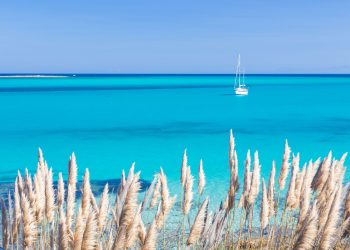

Arzachena – Between Portisco and Liscia di Vacca lies a 55-kilometer stretch of coastline that didn’t even exist as a tourist destination before 1962. The Costa Smeralda is not a time-honored landscape with an ancient name, but rather a construction project: On March 14, 1962, six men founded the Costa Smeralda Consortium, the association of landowners, and established the rules governing construction on approximately 3,500 hectares of macchia. To this day, the area spans the two municipalities of Arzachena and Olbia in northeastern Sardinia.
You’ve seen what it looks like in photos: white sand, granite in every shade of red, and water that shifts from dark blue to emerald green. What you don’t see in the photos are the barriers in front of it. Almost every large beach has a paid parking lot; during peak season, you’ll be stuck in traffic there starting in the late morning, and the bus only runs from mid-June through mid-September.
This guide tells you which eight beaches are really worth the trip, how much parking, bus fare, admission, and boat tickets will cost in 2026, how to get there without a rental car, and when it’s best not to go.
The hard facts about the Costa Smeralda are surprisingly rarely compiled in one place. The Consorzio itself cites 55 kilometers of coastline and approximately 3,500 hectares of land; the municipality of Arzachena publishes its parking and bus fares anew every spring; and the archaeological park in the hinterland has its own price list. This map summarizes what you need to know before booking.
The Costa Smeralda by the Numbers
The Costa Smeralda is not an administrative region, but a registered trademark: Costa Smeralda® It is part of Servizi Consortili, the operational arm of the Consorzio. Those looking for the coast should explore the area between the Gulf of Cugnana in the south and the Bay of Liscia di Vacca in the north.
As of August 2026 · Data provided by Consorzio Costa Smeralda, Comune di Arzachena, Ge.Se.Co. Arzachena, Pevero Golf Club, and ISTAT.
- Beachgoers who want to be close to excellent beaches
- Sailors and anyone who enjoys watching regattas
- Families with young children—many coves slope gently
- Golfer
- Photographers who like granite and maquis
- Travelers without a car outside the period from mid-June to mid-September
- Dog owners—pets are not allowed on almost all beaches
- City travelers looking for historic districts
- Anyone who wants to park on the spur of the moment in August
- Bargain Hunters During Peak Season
Where exactly is the Costa Smeralda?
The Costa Smeralda is located in northeastern Sardinia, in the Gallura region—the granite-dominated landscape between Olbia and the Strait of Bonifacio. The Consorzio defines the boundaries itself: Portisco on the Gulf of Cugnana to the south, and the Bay of Liscia di Vacca to the north. In between lies about 55 kilometers of rugged coastline with dozens of coves.
From an administrative standpoint, this is not a separate entity. The larger, eastern part with Porto Cervo, Baja Sardinia, and the well-known beaches are part of the municipality Arzachena, which has a population of 13,456 and covers an area of 230.97 square kilometers. The western part, with Porto Rotondo and Portisco belongs to Olbia. Arzachena itself isn't located by the sea, but a few kilometers inland—that's where you'll find the town hall, the weekly market, and the supermarkets, which aren't available on the coast.
Incidentally, the name of the place is misleading in two ways. The Costa Smeralda is neither a municipality nor an officially surveyed coastline: it is a private association of landowners with a registered trademark, and the Consorzio also takes action against other coastal areas that wish to use the name. For you as a guest, this means above all that a hotel „on the Costa Smeralda“ could very well be located 20 kilometers away. Before booking, check the address on the map—not just the name in the brochure.

Why the Coast Looks the Way It Does
The rock in Gallura is granite, and granite weathers in its own unique way. Wind and salt erode it into rounded boulders that look as if they were placed there; in between, light-colored sand made of ground quartz and crushed shells accumulates. That’s exactly where the color of the water comes from: over light-colored sand at shallow depths, the sea appears turquoise to emerald green; over seaweed and rock, it’s blue to almost black. Within just a few hundred meters, you have both right next to each other.
The second key topic is the Mediterranean scrub, the evergreen, hard-leaved vegetation of juniper, rockrose, mastic, and strawberry tree. In June, it exudes an intense scent of resin and honey, and it is the reason why the development here does not seem as intrusive as on other Mediterranean coasts: The Consorzio’s building regulations require low-rise houses in earth tones, designed to blend into the macchia.
The downside of that same vegetation cover: it catches fire. When the forest fire alert level is orange, the municipality of Arzachena regulates access to Liscia Ruja Beach separately, and in the height of summer, a road may be closed on short notice. Checking the municipality’s website in the morning takes two minutes and, if in doubt, can save you an hour-long detour.

How 3,500 hectares of scrubland Became a Luxury Destination
Until the late 1950s, this coastline was pastureland. There were sheep, a few stazzi, that is, the isolated granite farmsteads of Gallura, with no roads and no electricity. The fact that this changed is due to a handful of names mentioned by the Consorzio itself: On March 14, 1962, in Olbia, Karim Aga Khan, Patrick Guinness, Felix Bigio, John Duncan Miller, André Ardoin and René Podbielski the consortium's articles of incorporation.
Its purpose was not to build, but to prevent construction. The Consorzio set itself a Building Code, a binding set of building regulations, and an architectural committee that reviewed every design. The committee consisted of Luigi Vietti, Jacques Couëlle, Michele Busiri Vici and Antonio Simon Mossa. They pioneered the style you see today in Porto Cervo Take a look: no straight edges, no high-rises, stucco in shades of sand and terracotta, roofs made of fired bricks, staircases winding around the rocks.
The plan worked—and it also backfired. It worked because the coastline still has no row of concrete buildings, and the development is barely noticeable from a distance. It backfired because the success has driven up prices that no longer reflect Sardinia: the district around Arzachena is one of the most expensive areas in Italy, and hotel staff commute from the hinterland.
One thing that older guidebooks still get wrong: Prince Karim Aga Khan IV died in Lisbon on February 4, 2025, at the age of 88. Since then, his son Rahim Al-Hussaini has served as the Aga Khan V, leading the Nizari Ismaili community. Any texts that refer to the Aga Khan in the present tense as the owner of the Costa Smeralda are therefore outdated.

Palau in Sardinia: Your guide to the gateway to La Maddalena
Why travel to Palau in Sardinia? Eight o'clock in the morning on the quay in Palau: the ropes of the large traghetti (ferries) clap heavily in the harbor basin, while the muffled diesel engine of the first morning connection to...
How much does a day on the Costa Smeralda cost?
A day at the beach by car will realistically cost you between 12.50 and 15 euros at the managed beaches if you just park and don’t rent anything. Parking costs 2.50 euros per hour, capped at 12.50 euros for the entire day; the municipality of Arzachena operates these areas from June through October, daily from 9 a.m. to 8 p.m. Sun loungers and umbrellas are charged separately by private operators and are not officially regulated.
| Offer | Price |
|---|---|
| Parking at the Beach, Car | €2.50 per hour · maximum of €12.50 per day |
| Parking at the beach: motorcycle or scooter | 1.00 € per hour · up to 5.00 € per day |
| Parking at the Beach: RVs or Buses | 10.00 € per hour |
| „Lu Pustali“ Bus, Arzachena–Porto Cervo | €2.50 per ride · €25.00 for twelve rides |
| „Lu Pustali“ Bus, Arzachena–Cannigione | €1.50 per ride · €15.00 for twelve rides |
| Arzachena Archaeological Park, a Monument | €4.00 · €3.00 for groups of 20 or more |
| Arzachena Archaeological Park, all seven | €20.00 · €17.00 for groups of 20 or more |
| Pevero Golf Club, 18 holes | €120.00 to €180.00, depending on the season |
| Boat Permit for La Maddalena National Park | €2.00 per meter of boat length per day, up to 10 m |
| Diving in La Maddalena National Park | €5.00 per day · €75.00 per year |
| Cala Coticcio on Caprera | €3.00 environmental fee, guided tours only |
| Parking at Olbia Airport, Long-Term Parking Area | €3.00 for the first hour · €20.00 for 24 hours |
You can visit almost all beaches for free: Access to the sea is generally free in Italy; you only pay for parking and anything you rent at the beach. Children under 12 and residents of Arzachena also get free admission to the Archaeological Park, and for school groups, admission costs one euro per child.
There are two things that cannot be estimated in advance because they depend on the date and occupancy: the ferry crossing to the mainland and the boat tours to the Maddalena Archipelago. For the ferries, the price isn’t displayed until you enter your travel date; for the sightseeing boats, each provider sets its own rates. The National Park maintains a list of authorized companies—anyone not on that list isn’t allowed to take you there at all.

Which eight beaches on the Costa Smeralda are must-sees?
The municipality of Arzachena maintains a separate data sheet for each of its beaches, detailing the type of sand, seabed, wind protection, parking, and bus service. These eight are the ones worth the trip—listed not by beauty, but by how easy it is to get there and what you can expect once you arrive.
1. Liscia Ruja – the largest beach on the Costa Smeralda
Liscia Ruja It is located in the southern part of the gulf and, according to the municipality, is the largest beach on the Costa Smeralda. Fine white sand, a sandy seabed, and behind it, dense macchia consisting of strawberry trees, rockroses, and junipers. The beach is so wide that there’s room for both managed sections and free areas side by side—you don’t have to pay to lie down here.
It is sheltered from the west wind, has a ramp for wheelchairs, and is served by a bus; however, it is a very long walk from the bus stop. The parking areas along the shore are not operated by the municipality but by the SKG company. Good to know: When the wildfire alert level is orange, special access rules apply—in that case, the bus will take you farther than your own car.
2. Poltu di li Cogghji – Spiaggia del Principe
The best-known beach name on the coast is a nickname: Poltu di li Cogghji means „Harbor of Hides“ in Gallurean, because local products—especially leather—used to be shipped from here. The Aga Khan later chose the bay as the site for his own villa. It was never built—the name Spiaggia del Principe, "Prince's Beach," stuck in my mind anyway.
Fine white sand, a gently sloping sandy bottom, and colors ranging from green to blue. There are lounge chairs, umbrellas, and a small food stand; the beach is sheltered from north and west winds. Parking is available for a fee, and the summer bus stops here. not Note: If you're coming without a car, get off at Capriccioli and walk quite a distance.
3. Capriccioli – Four Bays on a Headland
Capriccioli Strictly speaking, it’s not a beach, but a low granite headland with four sandy coves: two on the east side and two on the west. This means you’ll always have a sheltered spot no matter which way the wind blows, and you can enjoy both sunrise and sunset light on the same afternoon. The headland is home to old, wind-sculpted juniper trees that are protected.
The beach slopes gently into the water, which is why Capriccioli is one of the best family beaches on the coast. There’s a ramp leading down to the beach, lounge chair and umbrella rentals, a bar, and a few small restaurants. Parking costs money, but the summer bus stops right at the Capriccioli stop—it has the best access of all the major beaches here.

4. Romazzino – the bay with "rosemary" in its name
Romazzino is called, according to the Gallurese romassinu, the rosemary that grows all around the bay. The bay lies between the headlands of Punta Capaccia to the north and Punta Romazzino to the south; it faces southeast, is about 300 meters deep, and 500 meters wide. Near the parking lot, the sand is fine and white; further east, it becomes coarser.
Despite its exposed location, Romazzino is sheltered from the mistral, and its gentle entry makes it suitable for children. One section belongs to the historic hotel of the same name; the rest is open to the public. The bus doesn’t go all the way here—the nearest stop is Capriccioli, and from there it’s a long walk.
5. Grande Pevero – Sand in front of the golf course
The Grande Pevero It is located south of Porto Cervo, below the Pevero Golf Club. Fine sand, a sandy seabed, sheltered from the south wind, plus lounge chairs, umbrellas, a bar, and a small restaurant. The beach is considered one of the most elegant on the coast and is accordingly crowded.
It is accessible only to a limited extent: Behind the barrier at the entrance is an access platform, which you’ll need to ask the concessionaires about. Parking costs money, and the bus stops at the intersection with Piccolo Pevero, from where it’s still quite a walk.

6. Piccolo Pevero – the little one with the bridge
The Piccolo Pevero It is the smaller beach in the same cove and the most accessible beach on the Costa Smeralda for anyone who has difficulty walking: it has a permanent access walkway leading right down to the sand. Fine sand, a sandy seabed, sheltered from westerly and southerly winds—sun loungers, umbrellas, and a bar are all available.
The summer bus stops at the Piccolo Pevero intersection; from there, it's just a short walk. That makes it the best option if you're traveling without a car but still want to see one of the classic beaches.

7. Cala Granu – the family-friendly cove near Porto Cervo
Cala Granu It’s just a few minutes’ drive from the Marina di Porto Cervo. Fine white sand, very shallow water, and rocks behind which the macchia grows thick—this is the beach that families with small children head to. In high season, it’s understandably crowded.
The Cala Granu vacation resort is located on the edge of the bay, which stretches Luigi Vietti is on the decline, one of the original architects. The parking lot is on the main street; the bus stops at the intersection with the marina—after that, it’s a long walk. Good to know: If you arrive after 10 a.m., you'll often find that there are no seats left. Getting there early is more helpful than any reservation.
8. La Celvia – rose quartz in the sand
La Celvia is the most interesting beach on the coast for anyone who looks closely: Its sand is coarse-grained and consists of colorful shell fragments and pink quartz dust from the surrounding rocks. Partly wild, partly managed, sheltered from the mistral and the north wind. Villas line the beach, their gardens extending right down to the sand.
From here, you can reach the small neighboring beach, dell’Elefante, by climbing over the rocks or swimming for about ten minutes. If even La Celvia is too crowded for you, there’s another beach behind Liscia Ruja Cala Petra Ruja: a sandy beach about 340 meters long, which even the local municipality describes as not overcrowded, even during peak season.
What's Prohibited on the Beach—and How Much It Costs
The same regulations apply to all beaches in the municipality of Arzachena, and they are stricter than vacationers might expect. The following are prohibited: single-use plastics, smoking, taking sand, pebbles, stones, or shells, leaving trash behind, fishing for protected species, and entering the dunes. Animals are not allowed on most beaches at all; designated dog beaches are only available in La Sciumara, Lu Postu and Poltu Liccia.
Anyone who takes sand, pebbles, stones, or seashells from a Sardinian beach risks a fine of 500 to 3,000 euros under Article 40 of Regional Law 16/2017. Inspections are conducted at Olbia Airport—and they happen regularly.
In addition, for the past few summers, access restrictions have been in place for beaches that are particularly crowded. The Le Piscine Beach North of Cannigione, the beach is accessible only with a prior online reservation between July 15 and August 31, for both guests and locals. In the northern section, you can spread out your towel; in the southern section, swimming is the only activity permitted.
To visit Le Piscine, you can book your beach spot online through the municipality of Arzachena. Without a reservation, you won’t be able to get onto the sand during the height of summer—keep this in mind if you’re staying in Cannigione.
That sounds like a lot of red tape for a day at the beach. In practice, you hardly notice it: The vast majority of beaches don’t require reservations, and the restrictions are what have kept this coastline in such good shape in the first place. If you take home a photo instead of sand, you’ll get more out of it anyway.
Porto Cervo: the town that made the coast famous
Porto Cervo It is the main town of the Costa Smeralda and a place with no history: It was designed on the drawing board starting in 1962 and built on the slopes overlooking a natural bay. The result is architecturally remarkable, even if you’re not into luxury vacations. There are no straight walls, no urban canyons, and no buildings that extend beyond the edge of the hillside.
The center is the Piazzetta, a collection of arches, stairways, and shady alleys that feels more like a village than a resort. Between the shops, passageways lead to small squares from which you can see the bay. It costs nothing to look around, and outside of store hours, you’ll have the place almost all to yourself.

The second attraction is the Marina di Porto Cervo, the marina below the town. It is home to the Costa Smeralda Yacht Club, which was founded in 1967 and today organizes the most important regatta calendar in the Mediterranean. Anyone interested in boats can spend an hour here at the dock and see more than in any museum.
Good to know: In August, the Piazzetta gets so crowded in the evenings that taking pictures isn't much fun, and parking in town is limited to two hours—the first 15 minutes are free once a day, after which each half-hour costs one euro. Come in the late morning or just outside of vacation weeks, and it's a whole different place.

Porto Rotondo and San Pantaleo: The Other Side
Porto Rotondo It is located at the western end, already within the municipality of Olbia, and, strictly speaking, is not part of the Consorzio. The resort was also established in the early 1960s by the Venetian Donà dalle Rose family on approximately 500 hectares between the Gulf of Cugnana and the Gulf of Marinella. The marina is situated in a natural bay between the headlands of Punta Nuraghe and Punta Volpe and has 652 berths, 25 of which are for very large yachts.

The difference from Porto Cervo is noticeable: Porto Rotondo is smaller, more Italian, and in the summer has a more family-friendly atmosphere than an exclusive one. On the outskirts of town lies the Ira Beach, a flat sandy beach that’s easy to reach without a long drive—it’s perfect for an afternoon spent between a stroll through the harbor and dinner. For those exploring the Costa Smeralda without a rental car, this is the shortest route from town to the beach.

A ten-minute drive inland lies San Pantaleo, a village that has little to do with the coast and therefore belongs there. It lies 18 kilometers from Olbia at the foot of three granite peaks: Sant’Andrea, Pelchia Manna and Pelchia Minori, which from a distance resemble Dolomite peaks. The houses are built of local granite, many of them former stazzi, which have been converted into vacation homes.

Over the past few decades, San Pantaleo has evolved into an artists’ village: galleries, studios, and a weekly market featuring arts and crafts. If you’ve had enough of the beach on a hot afternoon, this is the best alternative the area has to offer—a shady piazza, granite instead of sand, and no one trying to talk you into renting a lounge chair.


Cala Corsara, Sardinia: a white-sand beach on Spargi
Cala Corsara is located on the uninhabited island of Spargi—white sand, pink granite, and water in every shade of turquoise—accessible only by boat.
How do you get to the Costa Smeralda?
The route almost always goes through Olbia. The Olbia Costa Smeralda Airport (OLB), operated by Geasar S.p.A., is located right on the outskirts of the city and, according to its own information, serves approximately 86 destinations; in the summer, airlines such as Ryanair, easyJet, Volotea, Condor, Edelweiss, and Transavia fly there. From the terminal, ASPO city bus lines 2 and 10 run to the city center approximately every 30 minutes; the bus stop is located 50 meters from the arrivals area. The Olbia train station is about four kilometers away and can be reached via the same routes; on trenitalia.com, you can purchase a combined ticket for the city bus and train.
With the Ferry You’ll also arrive in Olbia. Moby and Tirrenia operate year-round from Civitavecchia (7 to 7.5 hours during the day, 7.5 to 8 hours at night) and from Livorno (7 hours 50 minutes to 9 hours). The route from Genoa to Olbia operates seasonally—from May 7 to November 2 in 2026—and takes 10 to 13 hours overnight. Prices depend on the date, cabin type, and vehicle—it would be misleading to give a flat rate here.
In nine out of ten cases, you'll need a Car. The beaches are far apart, the roads are winding, and every major beach has a paid parking lot. Expect to pay 2.50 euros per hour, up to a maximum of 12.50 euros per day; payment can be made via app, at a parking meter, or at the ticket booth. In Porto Cervo and Baja Sardinia, there’s also a two-hour parking limit.

The summer bus that hardly any vacationers know about
From mid-June through mid-September, the municipality of Arzachena operates its own local transit service, the Lu Pustali – Gallurese for „the Postbus.“ In 2026, it will operate from June 15 through September 15 with three routes: The Blu Line connects Arzachena with Cannigione all the way to Barca Bruciata Beach, which Smeralda Line and the Pink Line Take the same long route in the opposite direction, passing through Cannigione, Monti Canaglia, Santa Teresina, Abbiadori, Porto Cervo, Liscia di Vacca, Poltu Quatu, and Baja Sardinia.
In August, the Lu Pustali by Night Collection which runs at night from Cannigione, Tanca Manna, Baja Sardinia, and the Monti di Mola parking lot. A one-way trip from Arzachena to Porto Cervo costs 2.50 euros, and a book of twelve tickets costs 25 euros; to Cannigione, the cost is 1.50 euros and 15 euros, respectively.
Take the bus to Piccolo Pevero instead of paying a 12-euro parking fee
The Smeralda and Rosa lines stop at the intersection leading to Piccolo Pevero, and from there it’s just a few minutes to the beach—via a sturdy boardwalk that’s accessible even with strollers or wheelchairs. Two rides cost five euros; the capped-rate day pass, available at the parking lot, costs twelve euros and fifty cents.
But the real reward isn't the money. Starting in the late morning, the beach parking lots between Porto Cervo and Capriccioli are full, and you end up driving around in circles while the bus passes by the line of cars. Take the one-way route, get off at Piccolo Pevero, and have the bus pick you up again in the opposite direction in the evening.
There's still one catch: Nothing runs at all between September 16 and June 14. If you visit during the off-season, you'll need a car—but you'll have plenty of parking available everywhere.

What are some worthwhile day trips from the Costa Smeralda?
Three destinations stand out, and all three are less than an hour's drive away.
The La Maddalena National Park. To the north lies the archipelago with La Maddalena, Caprera, Spargi, Budelli and other islands—a total of 180 kilometers of coastline, and nearly the entire area is protected as a Site of Community Importance. Anyone sailing in their own or a rented boat needs a permit: in 2026, the daily rate will be 2.00 euros per meter of boat length for boats up to ten meters; a five percent discount is available online. Drones are prohibited throughout the entire park area.
Cala Coticcio on Caprera. You may only enter what is perhaps the most beautiful bay in the area if accompanied by a certified hiking guide. The environmental fee for the park is three euros per person; children 12 and under are free. Payment is made through the government platform pagoPA, and the ticket is valid only for the booked day. The guide’s fee is in addition to this and is arranged directly with the guide.
The Arzachena Archaeological Park. The inland region is home to eight archaeological sites from the Nuragic period, and they are the best reason to skip a day at the beach. The park includes the Albucciu Nuraghethat Malchittu Shrine and the Moru Giants' Tomb in the Malchittu region, the La Prisgiona Nuraghe and the Coddu Ecchju Giant's Tomb at Capichera as well as the Li Muri Necropolis and the Li Lolghi Giant's Tomb in the Li Muri region.
Prices vary depending on the number of monuments visited: 4.00 euros for one, 20.00 euros for all seven, with discounts available for groups of 20 or more. Children under 12 and residents of Arzachena enter for free, and families receive a 10 to 20 percent discount. Hours of operation are from 9 a.m. to 7 p.m. in Malchittu and Capichera, and from 10 a.m. to 6 p.m. in Li Muri; the Michele Ruzittu Civic Museum In Arzachena, it is open from 10 a.m. to 1 p.m. and from 4 p.m. to 7 p.m., and is closed on Mondays.

Golf courses, regattas, and Gallura white wine
The Pevero Golf Club Between the two Pevero bays was Robert Trent Jones designed by the most influential golf course architect of the 20th century, and is ranked among the fifty best courses in the world by Golf Magazine. In 2026, the green fee for 18 holes ranges from 120 euros in the off-season to 180 euros during the peak weeks from July 20 to August 16; nine holes cost between 80 and 110 euros. Juniors pay half price.
The local wine is the Vermentino di Gallura DOCG – a dry white wine made from at least 95 percent Vermentino grapes, produced in a region spanning 23 municipalities that covers approximately 1,150 hectares and yields just under 28,000 hectoliters annually. It pairs well with everything that comes from the sea here and is the only reason to drink white wine at lunchtime in the height of summer.
There are two wineries you can visit right on the Costa Smeralda. Vigne Surrau Located along the road from Arzachena to Porto Cervo, it offers eight options ranging from 45 to 80 euros, starting with the one-hour Gourmet Aperitivo up to three and a half hours Dolce Vita. Capichera, also in Arzachena, is open Monday through Saturday from 10:30 a.m. to 7:00 p.m. and accepts visitors by reservation only —the offerings there range from a two-hour tasting to a four-and-a-half-hour tour through the vineyards to a nuraghe and a giants’ tomb.

When is the best time to visit the Costa Smeralda?
May, June, and September are the best months. The sea is warm enough starting in June, the beach parking lots aren't staffed until June, and the big regattas take place in May and September—so you get a lively atmosphere in the harbor without the beaches being overcrowded.
July and August are the height of the season. Everything is open, everything is expensive, and starting in the late morning, you won’t be able to find a parking spot at the popular beaches. Green fees are also at their highest during these weeks, and the access restrictions for Le Piscine are in effect from July 15 through August 31. If you’re visiting during this time, you should get up early and plan on taking the bus.
October through April is the quiet season. The parking lots are free again starting in November, the summer bus isn’t running, and many hotels and beach bars are closed. For hikes in the hinterland, for the nuraghi, and for photographers, this is still the most beautiful time of year—that’s when the granite, the macchia, and the empty coves are all yours.
The municipality of Arzachena sets new parking and bus fares every spring, and the green fees at the Pevero Golf Club change with the season. Be sure to double-check the information before booking—the rates listed here are for the 2026 season.
What dates should you mark on your calendar for 2026?
The Costa Smeralda calendar of events is a sailing calendar. The Costa Smeralda Yacht Club It hosts regattas in Porto Cervo almost nonstop from April through October, and watching is free—the boats set out from the harbor, and the rocks at the entrance offer the best vantage point.
| Date: 2026 | Event |
|---|---|
| May 26–30 | Giorgio Armani Superyacht Regatta, Porto Cervo |
| May 31 – June 7 | Range Rover Sardinia Cup, Porto Cervo |
| June 15–20 | Rolex TP 52 World Championship, Porto Cervo |
| July 29 – August 1 | YCCS Members Championship, Porto Cervo |
| August 18–23 | Palermo–Porto Cervo–Monte Carlo Regatta, Finishing in Porto Cervo |
| September 6–12 | Maxi Yacht Rolex Cup, Porto Cervo |
| September 13–19 | Rolex Swan Cup, Porto Cervo |
| Sept. 29 – Oct. 4. | J/70 Cup and Italian Championship, Porto Cervo |
Two weeks in particular deserve special attention: During the Maxi Yacht Rolex Cup It's early September, and the Rolex Swan Cup The following week, hotels in Porto Cervo and the surrounding area are practically fully booked, and prices go up. If you're coming for the beaches, either book early or plan your trip for the week before.
What You Should Know About the Costa Smeralda
This coastline is famous for good reason, and it has five unique features that no one ever tells you about beforehand.
1. Almost nothing is within walking distance. The towns are far apart, the beaches are accessible only via side streets, and there are hardly any sidewalks. You won't get very far without a car or the summer bus. The bus, however, follows the exact route where parking is the most expensive.
2. Parking is the actual admission fee. Access to the beach is free, but parking isn't: 2.50 euros per hour, up to 12.50 euros per day, from June through October. If you're traveling as a couple, you can get there by bus for half the price.
3. Dogs must stay outside. Pets are not allowed on the vast majority of beaches. There are exactly three designated dog beaches in the municipality, all three located around Cannigione—if you’re traveling with a dog, it’s best to stay there.
4. Smoking is prohibited on the beach, and taking sand home is definitely not allowed. Both are covered by the same regulation; for sand, the fine ranges from 500 to 3,000 euros. The pocket ashtray costs two euros and solves the first problem.
5. The prices do not apply to the entire island. What costs this much for dinner here costs half as much 40 kilometers away. If you're on a tight budget, stay in the countryside or in Cannigione and drive to the coast to go swimming—the beaches are the same.
Who would enjoy the Costa Smeralda?
For families with young children. Capriccioli, Cala Granu, and Romazzino slope gently into the water, which is calm and warm. Piccolo Pevero and Liscia Ruja have solid paths leading right down to the sand, making them accessible even with a stroller.
For sailors and anyone who enjoys watching. From late May through early October, there’s almost always a regatta in Porto Cervo, and you can see the boats from the shore. You’ll need a permit from the national park to take boat trips to the archipelago.
For connoisseurs. Vermentino di Gallura DOCG, two wineries in the municipality that are open to visitors, and a cuisine that draws its inspiration from the sea. Be sure to book your tastings in advance—very little can be arranged on the spur of the moment there.
For photographers and hikers. Granit, Macchia, and Licht are best in May and October, and then you'll have the coves almost all to yourself. Rent a car; the bus doesn't run outside of the summer months.
Not really for city travelers. There is no historic old town, no art museum, no cathedral. Anyone looking for those things should head to the coast Alghero or Bosa in the western part of the island.
Combine the Costa Smeralda with Palau, Alghero, and Bosa
The Costa Smeralda alone isn't enough for two weeks. There are three great destinations to add to your itinerary, all of which are within day's reach of Arzachena or can be visited as stopovers.
Palau It's located half an hour north and is the ferry port for the Maddalena Archipelago. From there, it's a twenty-minute ferry ride to La Maddalena, and the island of Caprera is connected to it by a causeway. If you only have one day to spend in the archipelago, depart from Palau, not from Porto Cervo.
Alghero In the northwest, the contrast is striking: a Catalan-style old town with city walls, narrow streets, and a harbor that wasn’t designed on a drawing board. A two-hour drive, and you’re in a different part of Sardinia. Further south lies Bosa with its colorful houses along the river.
For the islands off the coast, it's worth checking out Cala Corsara on Spargi. And if you're planning a trip around the entire island, you'll find an overview in the Sardinia Travel Guide; that Weather in Sardinia and the Forecast for Olbia are updated daily on our site.
Sardinia Travel Guide
Sardinia Travel Guide: The Most Beautiful Places, Beaches, Best Time to Visit, and How to Get There—an overview of all Sardinia articles from italien.news.
Our conclusion: an artificial coastline that still delivers on its promises
The Costa Smeralda is a man-made creation, and it shows—but it’s a successful one. No high-rises, no rows of concrete buildings; instead, 55 kilometers of granite and scrubland, against which low-rise houses in earth tones barely stand out. What began in 1962 as a construction ban backed by a consortium agreement is the reason why this coastline looks better today than most Mediterranean coasts that were allowed to develop freely.
It’s still expensive, though—in ways you might not expect: parking, dining, and during the two regatta weeks in September. If you want to keep your budget in check, stay in Cannigione or the hinterland, take the bus from mid-June through mid-September, and plan your trip for May, June, or the first half of September. The beaches are the same, but the cost is different.
The next concrete step: First, choose your accommodations based on the bus route, not the brochure—if you stay along the Smeralda and Rosa lines, you can reach six of the eight beaches in this guide without a car. After that, it’s worth taking a look at the Sardinia Travel Guide for the rest of the island.
Map: Costa Smeralda, Sardinia
FAQ - Frequently Asked Questions About the Costa Smeralda
Sources and Further Information
- Consorzio Costa Smeralda – Our History (accessed August 2026)
- Municipality of Arzachena – Beaches (accessed August 2026)
- Municipality of Arzachena – Lu Pustali, Local Public Transportation (accessed August 2026)
- Ge.Se.Co. Arzachena – Arzachena Archaeological Park, Admission Fees (accessed August 2026)
- La Maddalena Archipelago National Park – 2026 Rates (accessed August 2026)
- Costa Smeralda Yacht Club – Regattas 2026 (accessed August 2026)
- Autonomous Region of Sardinia – Ban on Removing Sand (accessed August 2026)
- Geasar S.p.A. – Olbia Costa Smeralda Airport: How to Get There (accessed August 2026)
Prices, hours of operation, schedules, and dates are subject to change—be sure to check the official websites for the latest information before your trip.