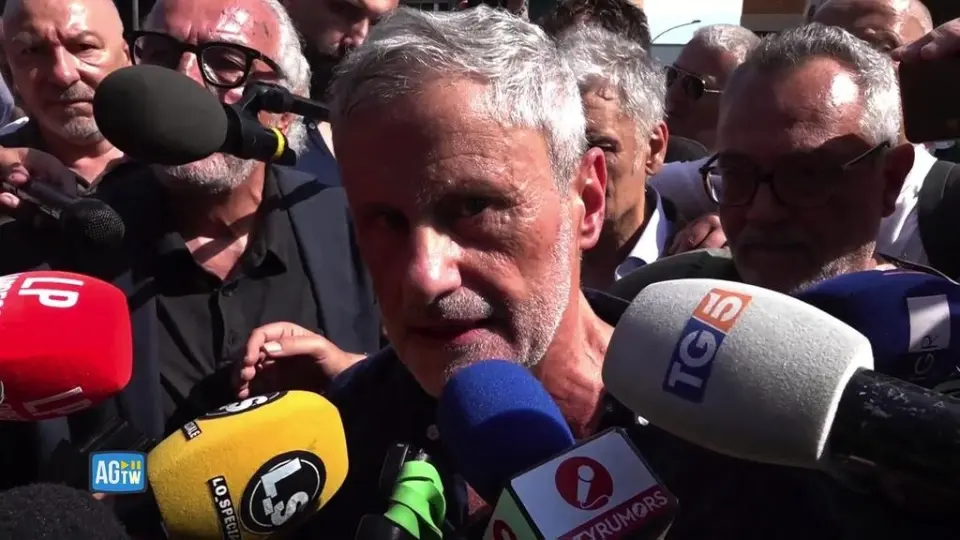
Rome – No sooner had the gates of Rebibbia Prison closed behind him than Gianni Alemanno was back in full political mode. Rome’s former mayor was released on Wednesday after 535 days behind bars—and used his first minutes of freedom to deliver a twofold message: an announced political comeback alongside General Roberto Vannacci and a scathing critique of conditions in Italy’s prisons. „I am leaving as an innocent man,“ Alemanno called out to the waiting crowd.
In front of the main entrance on the Roman Via Majetti waited about a hundred people from – including longtime companions, former fellow inmates, and activists from the far-right camp. That first moment of freedom dedicated the former mayor told his defense attorney, Edoardo Albertario, before facing the microphones of the numerous journalists who had gathered there stated.
Comeback alongside Vannacci
Alemanno clearly sees his political future alongside General Roberto Vannacci. He said his commitment is aimed at bringing about „real and profound“ change. He plans to meet with Vannacci for dinner that very evening. Although they do not agree on every point, Alemanno views Vannacci as the new face and hope of Italian politics. He is not seeking any office or position—he simply wants to contribute his experience to the general’s movement, the former mayor emphasized.
This connection is no coincidence: Alemanno's own movement Indipendenza joined the group founded by Vannacci last March National Future . Among their Roman ranks are numerous acquaintances from Alemanno's time in the capital.
„A disgrace to the republic“
Alemanno sharply criticized the prison system. He said prisons are a disgrace to Italy; there, the Republic loses face in the way it treats people. He particularly denounced overcrowding and the heat in the cells—last night, he said, the humidity had been almost unbearable. Those who deserve a chance at a fresh start do not get it within the system. Alemanno announced that he intended to discuss this with Justice Minister Carlo Nordio; he also said he was seeking a meeting with the DAP prison administration.
He also took aim at the government of Prime Minister Giorgia Meloni—the political family with which he had been associated during his time with Alleanza Nazionale. He criticized the government for doing nothing to address prison overcrowding; not a single additional prison bed had been created, he said. Meloni must allow for a broad debate within the right-wing camp; without genuine dialogue, a sustainable foundation cannot be built.
Controversial Remarks About Detained Migrants
Alemanno’s descriptions of the situation of foreign inmates are likely to spark debate. In his own cell block, he said, there were only a few migrant prisoners, and the situation was calm; in other blocks, however, he claimed that „ethnic clans“ had formed and that „racism by immigrants against Italians“ prevailed. In some cases, he claimed, Italian inmates paid a kind of protection money just to be allowed to shower. He described the conditions as intolerable in terms of the numbers involved. He did not provide any evidence to support this account.
The Background: The „Mondo di Mezzo“ Case“
Alemanno’s imprisonment stems from the „Mondo di Mezzo“ investigation into the Roman corruption scandal. He had originally been charged, among other things, with external involvement in a mafia-like organization; these charges were later downgraded. In the end, the conviction for improper influence stood. In 2022, Alemanno was sentenced to one year and ten months for this offense; according to court records, he actually served one year, five months, and 24 days.
He was taken into custody on the evening of December 31, 2024, after violating the terms of his community service; he had previously been allowed to serve his sentence through social service work with the So.Spe. association. Even from his cell, the politician remained active: with the help of staff, he updated his Facebook profile almost daily and described the abuses within the prison system. In his last post, just a few hours before his release, he wrote that he felt as if he were leaving a trench—a piece of his heart would remain in the cells, „where you die of the heat.“.