



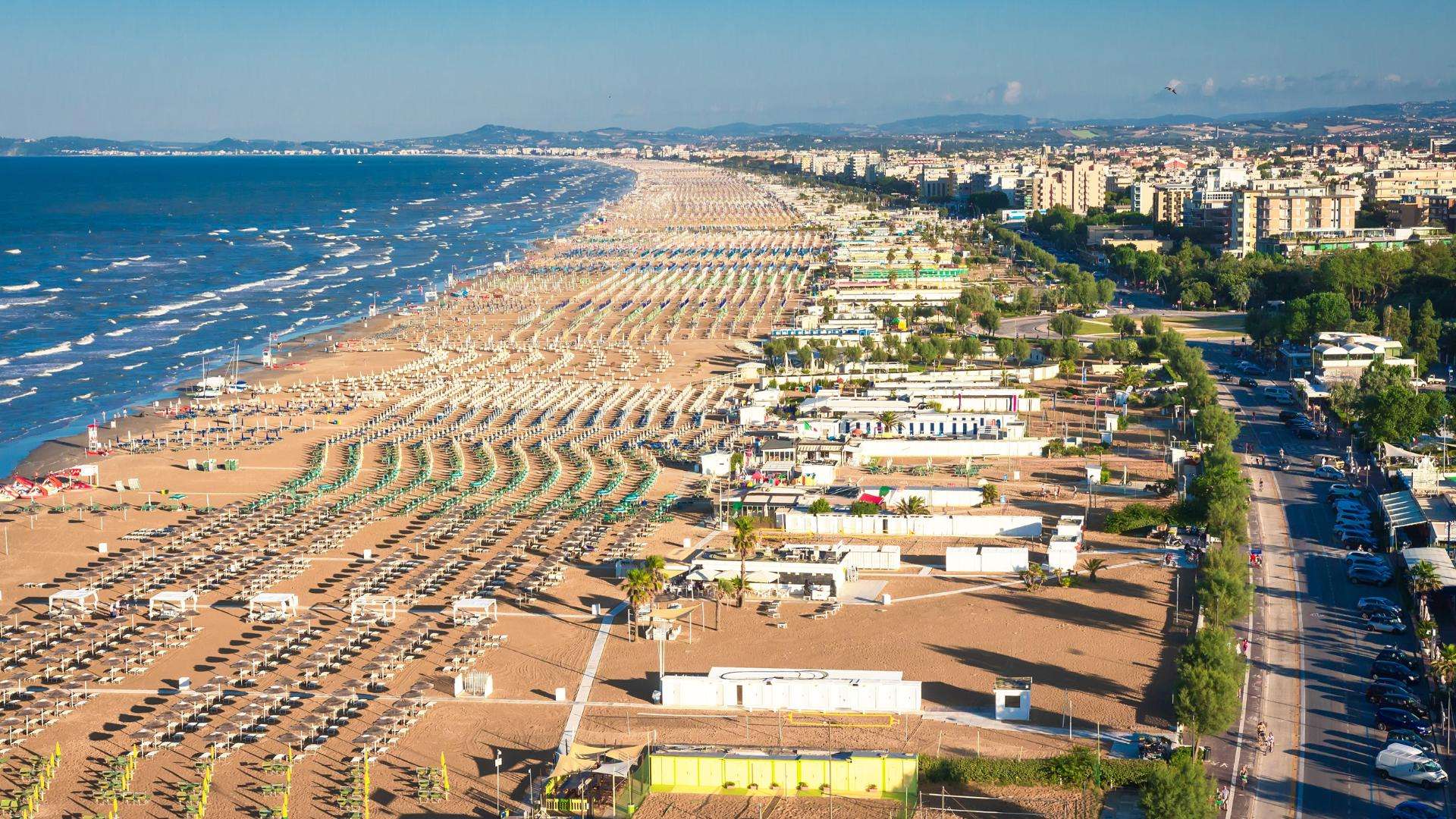
Rimini – Anyone traveling along the Tiberius Bridge As you cross the Roman bridge over the Marecchia River, you walk on cobblestones that have stood for two thousand years. Two kilometers further on, the other Rimini begins: fifteen kilometers of beach, 250 beach resorts, row after row of umbrellas. Rimini’s sights are spread across these two parts of the city—the Roman one and the seaside one—and anyone who wants to see both should plan on spending two to three days and buy a ticket for €1.50.
This guide lists the ten highlights, including prices and opening hours, tells you where you can swim for free, how to get there without a car, and why a visit to a museum costs you nothing if you're under thirty.
Rimini by the Numbers
Rimini is the largest city on the Romagna Riviera and was also a Roman colony founded in 268 B.C. The key facts you’ll need for planning are listed here; details are provided in the sections below.
As of September 2026 · Information provided by the Comune di Rimini, Musei Comunali Rimini, the Fellini Museum, and Rimini Turismo.
- Families with children
- Roma fans and movie lovers
- Travelers under thirty
- Cyclists along the coast
- Everyone traveling without a car
- Search for secluded coves
- People in Need of Rest in August
- Fans of unspoiled coastlines
- Short visits lasting less than a day
- Museum Tours on Mondays
How much do the attractions in Rimini cost?
Admission to the three municipal museums costs between €2.00 and €10.00; admission to the Roman monuments is free. The Fellini Museum, which the director Federico Fellini dedicated to a man who was born in Rimini and is buried here, costs €10.00 and is spread across two buildings: the castle Castel Sismondo and the Palazzo del Fulgor above the old movie theater on Corso d’Augusto. The „Luigi Tonini“ City Museum“, the Rimini City Museum, and the Domus del Chirurgo, the excavation of a Roman physician's house beneath the Piazza Ferrari, share a ticket for €7.00.
The most important information for young travelers is found in the fine print at the city museums: Admission is free to all three museums for visitors under the age of 30, as well as for residents of the province of Rimini. Those who are older and want to visit more than one museum should take the Art Card for €14.00, valid for seven days starting from the first visit.
Anyone who also includes amusement parks and local transit should check the Rimini Pass, the city's digital multi-day pass. It includes the three museums, which Ferris Wheel, that is, the Ferris wheel at the harbor, plus castles in the surrounding countryside and the entire local transit system, including Metromare, the express bus line to Riccione. It pays off after three days if you visit more than two paid destinations.
Admission and Tickets in Rimini
| Offer | Price |
|---|---|
| Museo della Città and Domus del Chirurgo | 7.00 € · reduced rate 5.00 € · free for those 30 and under |
| Fellini Museum, both buildings | €10.00 · reduced price €8.00 · Wednesdays: €8.00 for everyone |
| Fellini Museum, also known as Palazzo del Fulgor | 2,00 € |
| Art Card for all three venues, 7 days | €14.00 · reduced price €10.00 |
| Guided Tour of Castel Sismondo, 45 minutes | €8.00, in Italian only |
| Rimini Pass, 1 Day · 3 Days · 7 Days | €29.90 · €44.90 · €59.90 |
| Ruota Panoramica, one ride | 10.00 € · Children ages 2 to 10: 7.00 € |
| Bus and Metromare, single ride | €1.50 for one zone · €2.50 for two zones · Day pass: €5.00 |
| Italia in Miniatura, One-Day Pass | €22.00 online · €26.00 at the box office |
Admission is free for the Malatesta Temple, Rimini Cathedral, the Arch of Augustus, the Ponte di Tiberio, and the Porta Montanara, the city gate dating from the 1st century B.C. on the southern edge of the Old Town. They are located in a public space, and the cathedral does not accept donations.
As of September 2026 · Information provided by Musei Comunali Rimini, the Fellini Museum, Rimini Pass, Start Romagna, the Rimini Ferris Wheel, and Italia in Miniatura.


Riviera Romagnola: The 8 Most Beautiful Beach Towns on Italy's Adriatic Coast
From the Lidi di Comacchio to Cattolica: the eight most beautiful beach resorts on the Romagna Riviera, featuring beach prices, Blue Flags, and travel tips.
What are the 10 must-see attractions in Rimini?
Almost all ten sights are located within a one-kilometer radius, between the Ponte di Tiberio in the north and the Arco d’Augusto in the south. Two hours are enough for the walking tour, plus half a day for the museums. The order listed below roughly follows the route you would take on foot from the train station.
1. The Ponte di Tiberio, the bridge that has withstood everything
Augustus had construction begin in the year 14, and Tiberius completed it in A.D. 21. This is stated in the inscription on the inner balustrades. Five arches made of Istrian stone rest on massive pillars with wave breakers, and these pillars are positioned at an angle to the bridge’s axis so that they follow the current and break its force. Recent excavations have shown that the entire structure rests on a system of carefully insulated wooden piles.
The bridge has withstood earthquakes, floods, the attack by General Narses in 551 during the war between the Goths and the Byzantines, and, most recently, an attempt by the retreating German troops to blow it up. The traces of 551 can be seen on the last arch on the side facing Borgo San Giuliano. Two consular roads begin here: the Via Emilia, which Consul Aemilius Lepidus built as far as Piacenza in 187 B.C., and the Via Popilia Toward Ravenna and Aquileia. You can reach the bridge from Corso d’Augusto or from Viale Tiberio.

2. The Arco d’Augusto, the oldest surviving arch in northern Italy
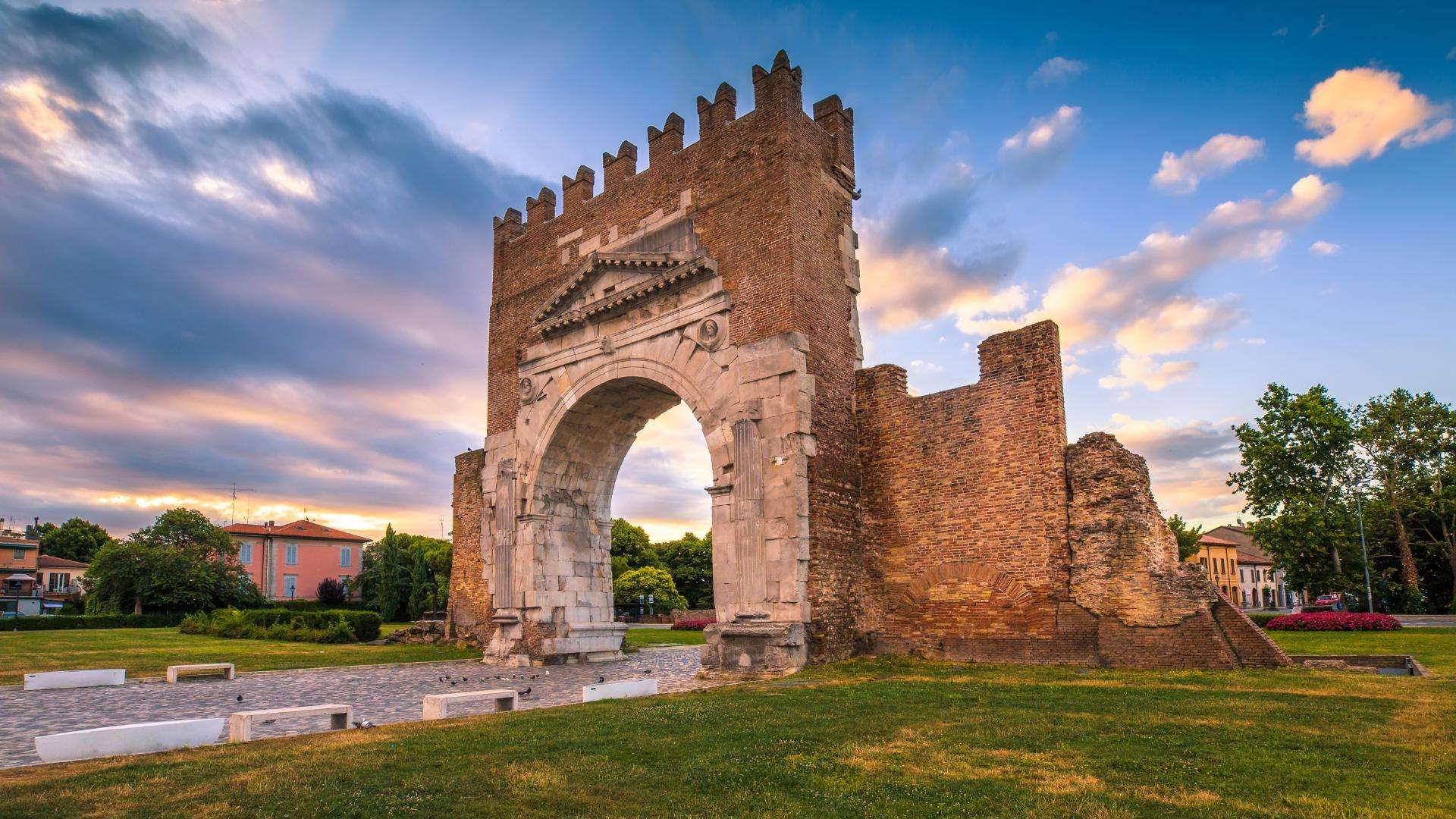
Almost every travel guide gets this wrong: The Arco d’Augusto is not the oldest triumphal arch in Italy, but rather the oldest surviving one in northern Italy. That is how the municipality itself puts it. It was erected in 27 B.C. as a triumphal arch in honor of Octavian Augustus, and it marked the end of the Via Flaminia, which Consul Flaminius had built here from Rome in 220 B.C.
The passageway is so wide that it couldn’t even be closed off by gates. This was both intentional and symbolic: peace after long civil wars. In the circular reliefs, you can see Jupiter and Apollo on the outer side, and Neptune and Roma facing the city. At the top there was once a finial, probably featuring an equestrian statue or a quadriga; the crenellated crown you see today dates from the Middle Ages. Since the demolitions of the 1930s, the arch has stood exposed; on either side lie the remains of the oldest city wall, built of local stone.
3. The Tempio Malatestiano, Alberti's unfinished cathedral
A Romanesque church was converted into Sigismondo Pandolfo Malatesta a Renaissance work from the 15th century. The design was provided by Leon Battista Alberti, the early Renaissance architect and theorist, and inside there is a fresco by Piero della Francesca. The marble cladding on the facade stops halfway up because the client ran out of money and time.
Good to know: The Tempio is not a museum, but the city’s cathedral, so admission is free. It can only be visited outside of Mass times—that is, not on Sundays and holidays at 11:00 a.m. and 5:30 p.m., nor on the evenings before holidays at 5:30 p.m.; the church is closed one hour before each Mass for the Rosary. So plan to visit on a weekday morning—then you’ll have it almost all to yourself. Wheelchair users can enter through the Bishop’s Garden to the left of the main portal; audio guides are available in several languages at the main entrance.

4. Castel Sismondo and the Fellini Museum
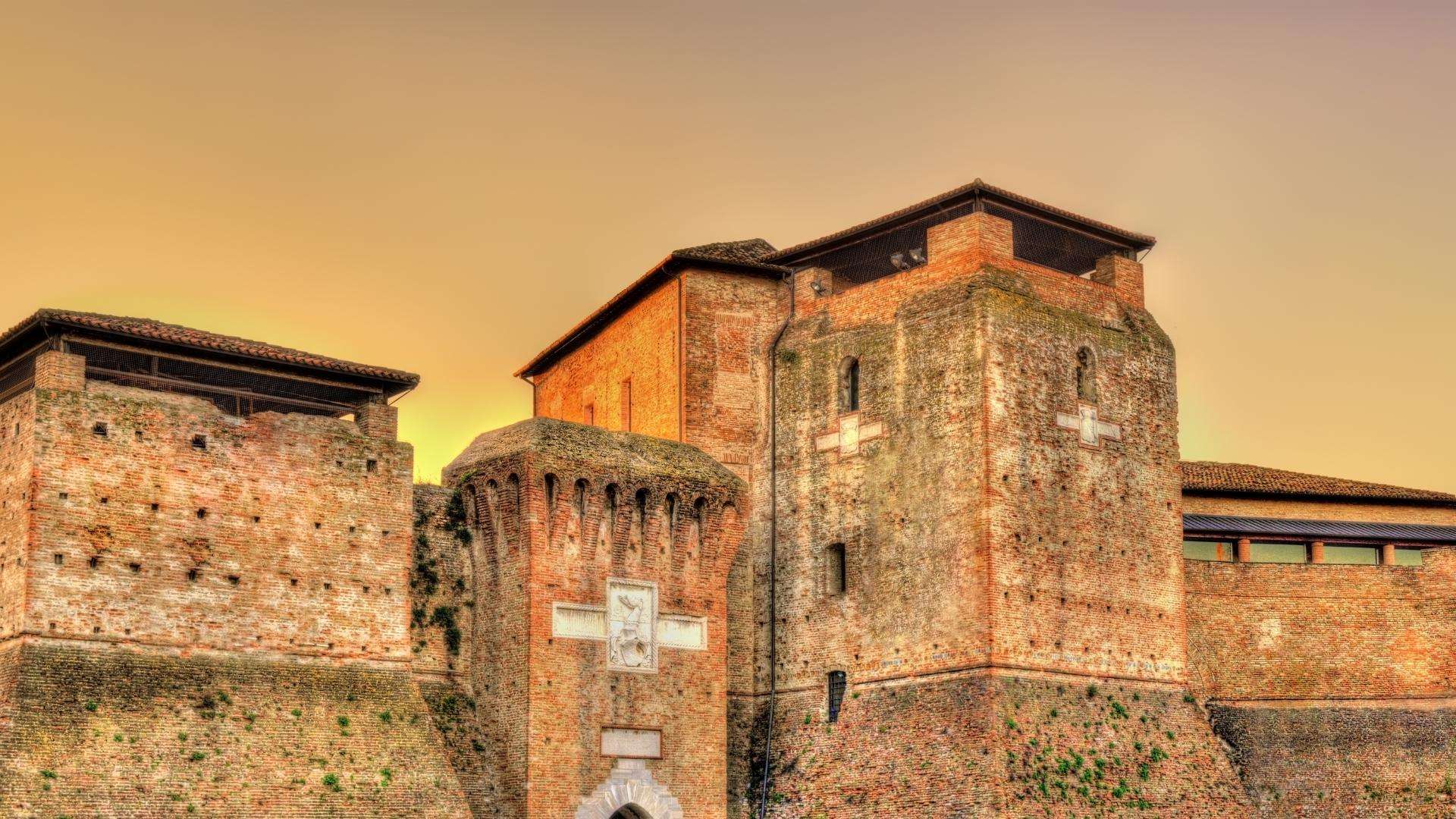
Sigismondo Pandolfo Malatesta was the ruler of Rimini from 1432 to 1468, and his residential fortress was intended to serve both as a defensive structure and a stately residence. Construction began in 1437 and lasted about fifteen years; the building was already inhabited as early as 1446. The defensive structure was built with the advice of Filippo Brunelleschi, the architect of the Florence Cathedral dome. The inscription and the coat of arms featuring an elephant, a rose, and a checkerboard still stand above the entrance portal today.
Starting in the 17th century, the castle served as a papal fortress: the outer walls were demolished, the moat was filled in, and the furnishings were sold off. From the 19th century until 1967, it served as a prison. Today, together with the Palazzo del Fulgor and Piazza Malatesta, it houses the Fellini Museum. Castel Sismondo is open Tuesday through Friday from 10 a.m. to 1 p.m. and from 4 p.m. to 7 p.m., and on Saturdays and Sundays from 10 a.m. to 7 p.m.; the Palazzo del Fulgor is open continuously from 10 a.m. to 7 p.m. Both are closed on Mondays, unless Monday is a holiday. Every first Sunday of the month, there is a guided tour of Castel Sismondo at 11:00 a.m. (45 minutes, €8.00), though it is conducted only in Italian. It is about a thirteen-minute walk from the train station.
5. The Domus del Chirurgo and the Museo della Città
In 1989, a construction crew stumbled upon the remains of a wall in Piazza Ferrari. What was subsequently uncovered was a Roman medical practice whose surgical instruments have become internationally famous: a residential building from the second half of the 2nd century A.D., covering 700 square meters, located near what was then the harbor front of Ariminum. At its heart is the Taberna Medica, the clinic, which was divided into a treatment room and rooms for short stays. There was an extensive collection of surgical instruments and mortars for preparing medicines.
The floors are also worth seeing: in the triclinium, the dining hall, there is a mosaic depicting a large vessel, along with wall paintings and a delicate glass panel depicting fish on the seabed; in another room, there is the Orpheus mosaic. A fire in the second half of the 3rd century preserved everything under the rubble. The ticket is also valid for the Museo della Città, which is housed in the former Jesuit college, built between 1746 and 1755 based on a design by Alfonso Torreggiani Built and used as a hospital from 1797 to 1977. Both are open Tuesday through Sunday and on holidays from 10 a.m. to 1 p.m. and from 4 p.m. to 7 p.m.; in July and August, they are also open on Wednesdays from 9 p.m. to 11 p.m.
6. The Roman Amphitheater on the edge of the Old Town
The amphitheater measured 118 by 88 meters, with an arena inside measuring 73 by 44 meters, making it not far behind the largest structures of its kind. At least 12,000 spectators watched the gladiator games here. It was built in the 2nd century CE, as determined by a coin of Emperor Hadrian found embedded in the masonry. With two stories one above the other and an exterior colonnade featuring 60 arches, it stood directly on what was then the coastline: anyone coming from the sea would see this structure first.
When the city was refortified in the 3rd century to defend against incursions from the north, the outer ring of the amphitheater was incorporated into the city wall. After that, it faded from memory: first it became gardens, then a plague hospital around 1600, until Luigi Tonini uncovered parts of it again in the 19th century. The southwestern section still lies beneath a school grounds today. You’ll find the remains at Via Roma 86, across from the Settebello movie theater; from the train station, walk along Viale Dante to the roundabout, then turn left and continue for about 300 meters.
7. Piazza Cavour, featuring the Fontana della Pigna and the Teatro Galli
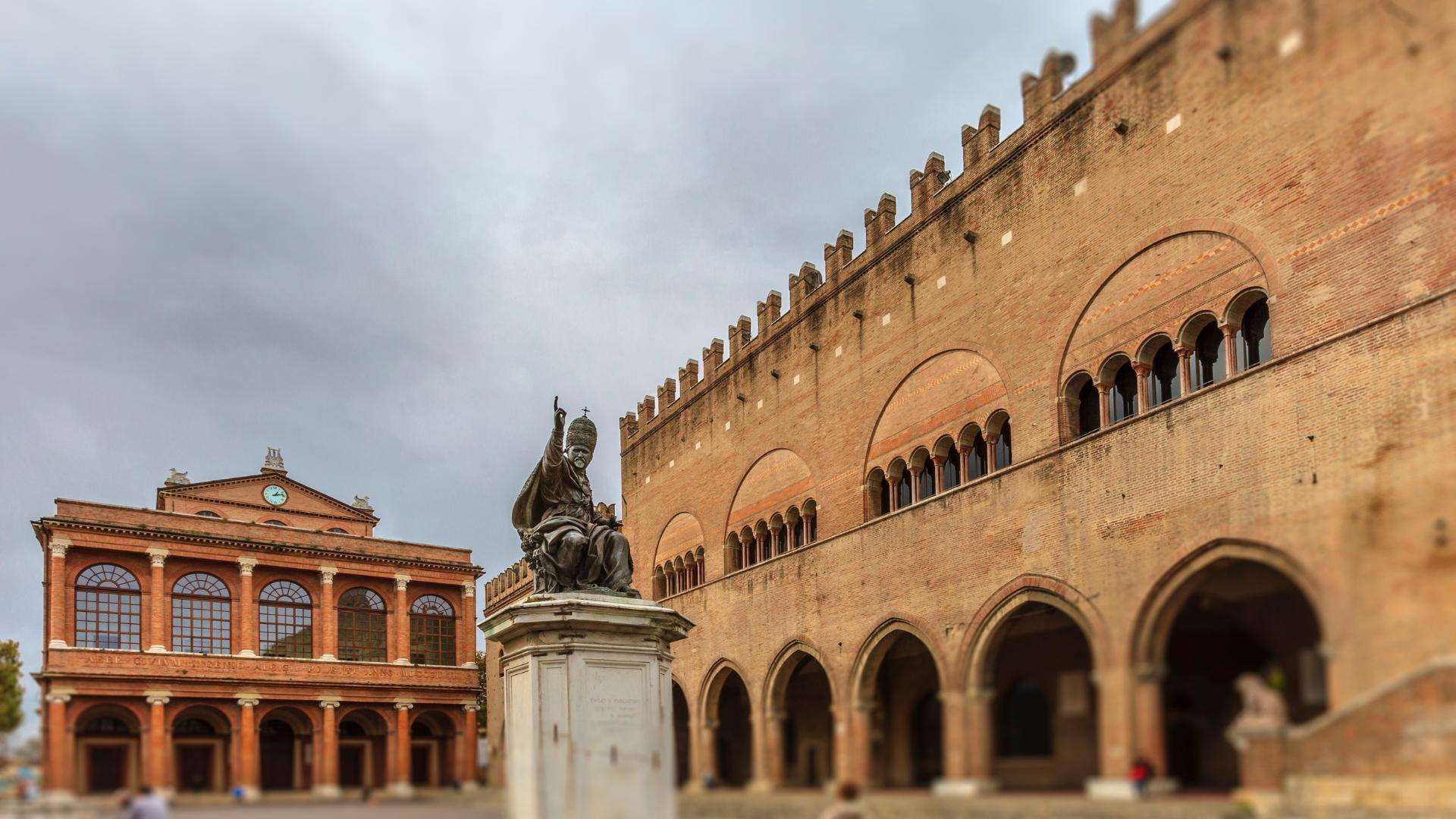
Since the Middle Ages, Piazza Cavour has been the heart of the city. In 1204, the Palazzo dell’Arengo, the town hall: Justice was administered under the wide portico, while the town council met in the large hall above it. In the 14th century, the Podestà’s residence was built next to it, and the emblems of the new rulers, the Malatesta, are displayed above its entrance arch.
In the center is the Fontana della Pigna, the Pine Cone Fountain. Giovanni da Carrara rebuilt it in 1543; the cylindrical shaft beneath it is Roman and covered with reliefs. A statue of St. Paul once stood at the very top, but in the 19th century it was replaced by the pine cone that gives the fountain its name. Leonardo da Vinci He stood there on August 8, 1502, and his words are carved into the stone: „Find harmony in the various waterfalls, as you saw at the spring in Rimini.“
Also located at the site is the Amintore Galli Theater, Rimini City Theater. Luigi Poletti It was designed in 1841 as a Neoclassical temple of the arts; it was funded by the citizens, and that is exactly what is inscribed in bronze letters on the facade: Aere civium. In the summer of 1857, he opened Giuseppe Verdi the theater in person with the world premiere of his Aroldo and was called back to the stage more than thirty times. On December 28, 1943, an aerial bomb struck the roof of the hall; after that, only the front building, with its foyer and Sala Ressi, remained.
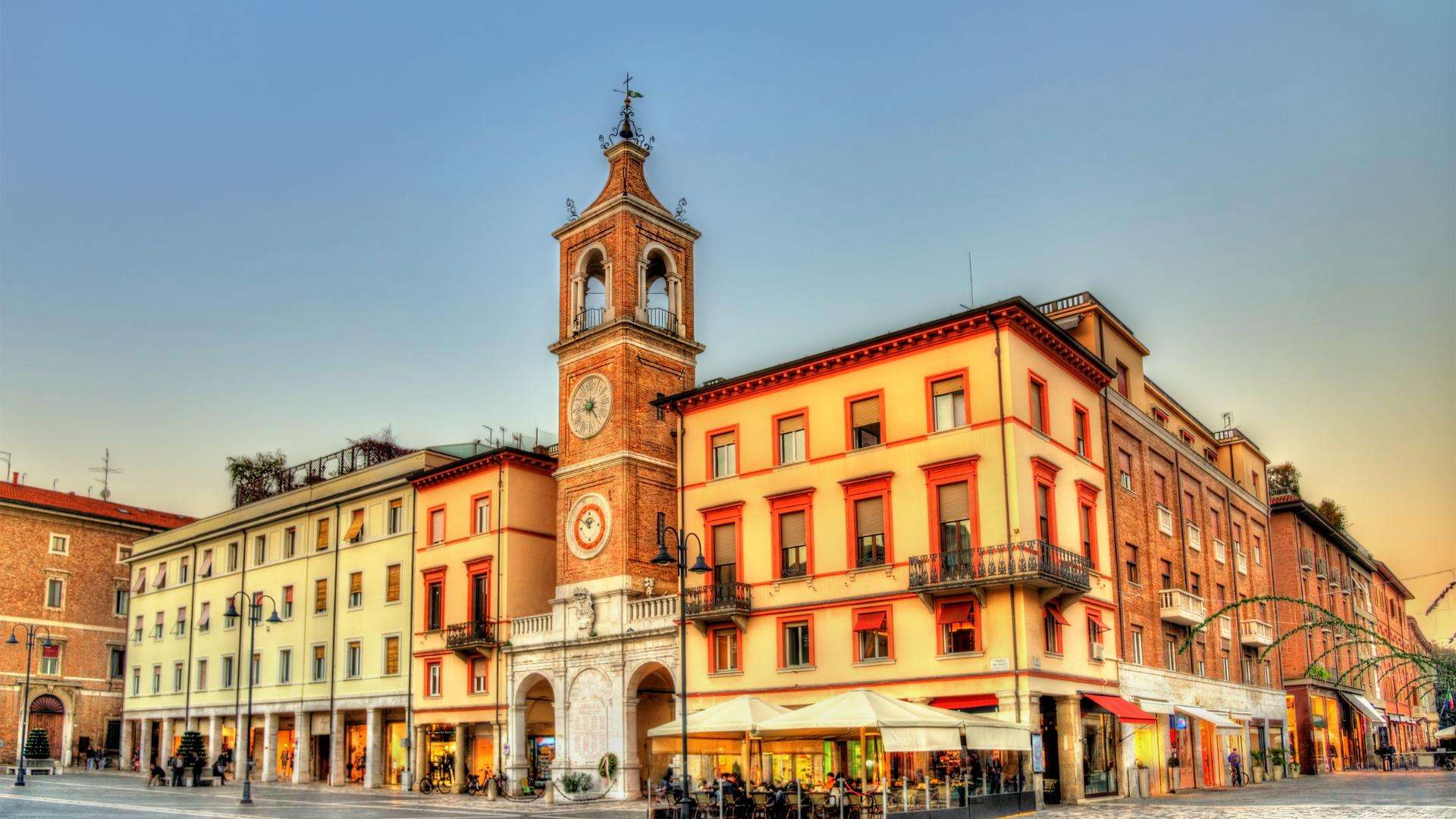
8. Piazza Tre Martiri, the Forum of Ariminum
Where cafés stand today, the forum of the Roman colony once stood Ariminum, founded in 268 B.C. The square is located at the intersection of the two main axes, the Cardo and the Decumanus, and was originally larger: it extended as far as what is now Via San Michelino in foro and was paved with large rectangular stones. Through fenced-off openings in the ground, you can still see parts of this paving.
Honorary statues and elaborate architecture formed the backdrop; a stone foundation likely supported an arch over the eastern entrance. A 16th-century commemorative stone marks the spot where Caesar is said to have addressed his legions after crossing the Rubicon; the bronze statue in the square is a copy of a Roman original. On Wednesday and Saturday mornings, the weekly market is held here, stretching across several streets and squares in the Old Town.
9. Borgo San Giuliano, on the left bank of the Adriatic Sea
Right after the Ponte di Tiberio, the Borgo San Giuliano, the old fishing district, which dates back to around the year 1000. Narrow alleys, low-rise houses, pastel-colored walls, balconies full of flowers, and murals everywhere. Since the district is a pedestrian zone, you walk here in silence, and it’s no wonder that Rimini Turismo calls it the little Rive Gauche of the city—that is, the left bank, modeled after Paris.
In the evening, the Borgo is the best place to go for a aperitivo, a drink before dinner, since the alleys are lined with osterias and small restaurants. Every two years in September—always in even-numbered years—the neighborhood celebrates its Festa de‘ Borg. Two other borghi are worth the detour: Borgo Sant’Andrea in front of Porta Montanara and Borgo San Giovanni beyond the Arco d’Augusto along the old Via Flaminia.

10. Porto Canale, Darsena, and the Ferris wheel
Long before beach tourism took off, Rimini was a port, and you can tell that from the Porto Canale at the canal harbor between Borgo San Giuliano and the sea. The palata, as the locals call the pier, is the city's most popular place for a stroll, especially in the evening when the fishing boats return and flocks of seagulls follow in their wake.
To the left of that is the Darsena Marina di Rimini, the marina: over 600 berths, more than 100,000 square meters of water, restaurants all around, and San Giuliano Mare Beach. Running along the entire length is an elevated walkway more than one kilometer long—a natural balcony overlooking the sea. And towering above it all is the Ruota Panoramica, open daily from 3:00 p.m. to midnight; tickets are €10.00 for adults and €7.00 for children ages two to ten. The wheel stops in wind and rain, but on a clear day, you can see the entire coastline from above.

What makes Rimini's beach so special?
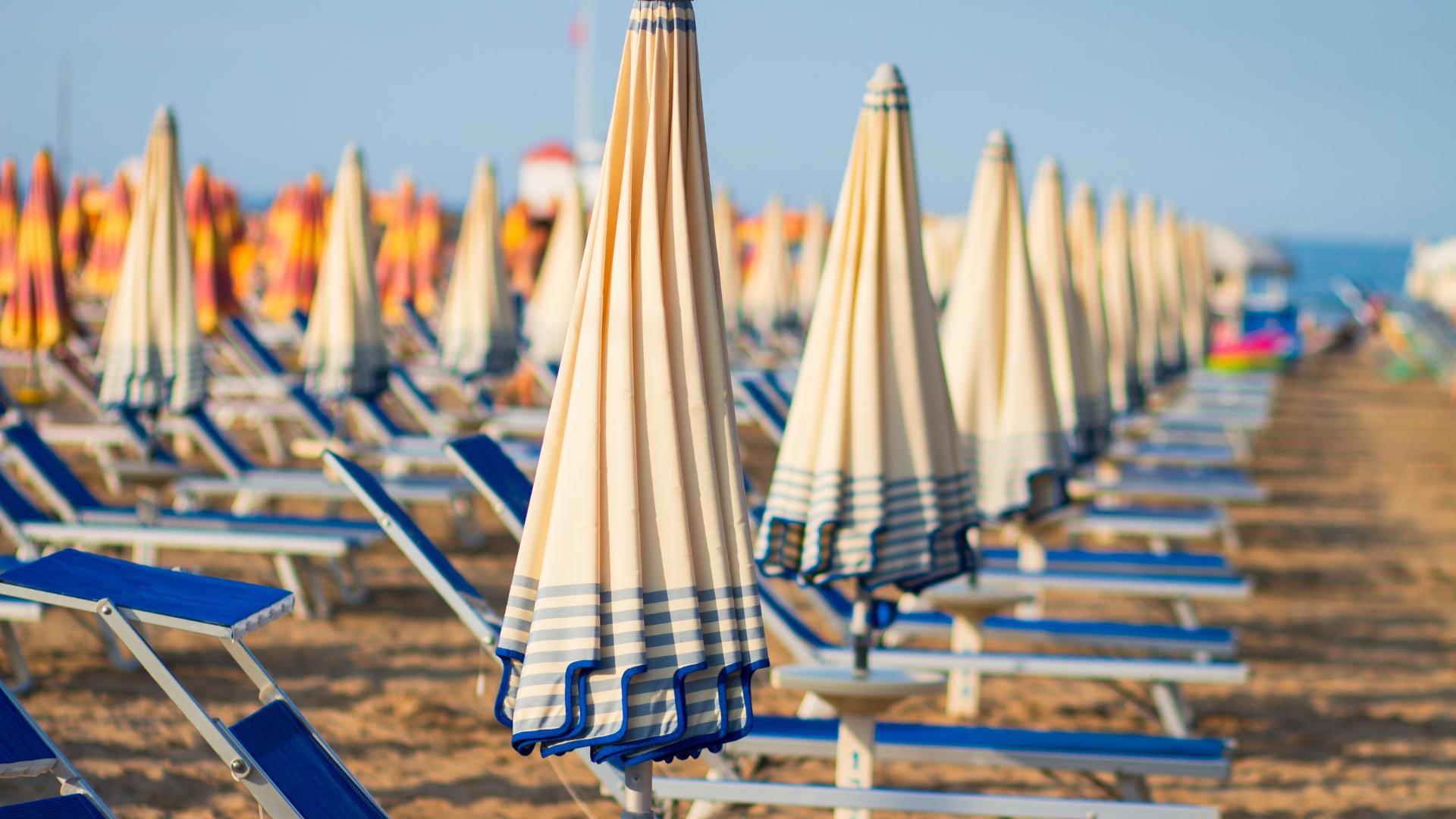
Fifteen kilometers of fine sand stretching from Torre Pedrera in the north to Miramare in the south, dotted with 250 numbered beach resorts: that’s the picture Rimini has presented for nearly two centuries. In 2026, the Blue Flag flew here again for the first time in fifteen years, and the municipality officially raised it on June 21 at Piazzale Kennedy.
The lifeguard service runs from May 16 through September 20, daily from 9:30 a.m. to 6:30 p.m. At the beach resorts, the daily fee for a beach umbrella and lounge chair includes everything the facility has to offer: beach volleyball, a playground, children’s activities, and often fitness equipment as well as a sailing or surfing course at the nautical center. Those who prefer to sunbathe without an umbrella can head to the spiagge libere, the public beach sections: San Giuliano between the pier and Bagno 10, as well as Rivabella, Viserbella, and Torre Pedrera to the north, and Marebello, Rivazzurra, and Miramare to the south. The city’s accessible beach section is located at Piazzale Boscovich.
For several years now, the entire riverbank has been both a construction site and a source of profit: Under the name Parco del Mare The city is transforming its beach promenade into a continuous green corridor featuring bike paths, sidewalks, sports areas, and Mediterranean vegetation. It all began a few hundred meters further on, in Marina Centro: That is where Italy's first seaside resort opened in 1843; that is where Piazzale Fellini stands today, with its four-horse fountain; and that is where the Grand Hotel stands, a national historic landmark since 1994 and the setting for Fellini's childhood memories.
The public beach sections are closed at night between 1 a.m. and 5 a.m. During the day, the same rules apply to all sections as at the public swimming areas: lifeguards are on duty only during the season and within their scheduled hours.

What amusement parks are located around Rimini?
There are five large parks within a half-hour drive, which is why the Riviera Romagnola is such a hit with families. The closest one is Italia in Miniatura in the Viserba neighborhood, where Italian and European buildings are featured as models; a one-day ticket costs €22.00 online and €26.00 at the ticket office.
Fiabilandia On the southern outskirts of town is the park for younger children: You pay full price if you're 130 centimeters or taller; the reduced rate applies to those between 90 and 130 centimeters. If you're looking for roller coasters, head to Mirabilandia near Savio, close to Ravenna, Italy's largest amusement park; a one-day ticket costs €27.90 online, and admission is free for children under 100 centimeters tall. The Cattolica Aquarium It's located a good twenty kilometers to the south and costs €19.50 online and €23.00 at the ticket window; children between 100 and 140 centimeters in height pay €18.00 or €19.00, respectively.
Staying at the Water Park Aquafan and the nature park Oltremare, both in Riccione. Their daily prices vary by calendar day, so it’s worth checking the park’s website the night before. And if you’re planning to visit multiple parks: The Rimini Pass offers a 30 percent discount on Mirabilandia and up to 10 percent on the others; the seven-day pass even includes admission to Mirabilandia.


Vacations in Riccione: experience beaches, shopping & dolce vita on the Adriatic Sea
More Than Just a Beach: Discover the Vacation Paradise of Riccione Riccione, affectionately known as the „Green Pearl of the Adriatic,“ is a true gem on the sun-drenched Riviera Romagnola in the Italian region of Emilia-Romagna. Its...
How do you get to Rimini?
By train, with no transfers: During the 2026 season, there will be two direct connections from German-speaking countries to the Riviera. The Railjet from Munich departs daily at 9:23 a.m., stops in Bologna, Cesena, Rimini, and Riccione, and arrives in Cattolica at 6:16 p.m.; on weekends, it arrives as early as 5:37 p.m. The return trip departs from Cattolica at 12:16 p.m., arriving in Innsbruck at 6:32 p.m. and in Munich at 8:37 p.m. This service runs from April 2 to October 3, 2026. The Eurocity from Zurich runs daily from May 30 to October 5, 2026: departing Zurich at 10:33 a.m., arriving in Rimini at 6:23 p.m.; the return trip departs Rimini at 9:52 a.m. and arrives in Zurich at 5:27 p.m., taking about seven and a half hours each way. Outside of these months, you’ll transfer in Bologna, from where the line to Ancona runs hourly.
The airport Federico Fellini (RMI) is located in the Miramare neighborhood, about eight kilometers from the city center. Bus line 9 connects it to the train station, which is about 6.5 kilometers away, in roughly half an hour. The 2026 summer flight schedule includes direct flights from Cologne, Vienna, and Basel; otherwise, Bologna and Ancona are the nearest alternatives. By car, take the A14 highway and exit at Rimini Nord or Rimini Sud.
You won't need a car once you're there. A single ride on the city bus costs €1.50 for one zone and 60 minutes, €2.50 for two zones and 75 minutes, and a day pass costs €5.00. The Metromare runs on its own track from the Rimini station to Riccione, 15 stops in about 23 minutes. You can park at the station in the Metropark, which has 309 spaces, or in the Italo Flori parking garage on Via Fracassi, which has 370 spaces for €0.50 per hour between 8 a.m. and 10 p.m. and €2.00 for overnight parking, as well as at the Parcheggio Tiberio in Borgo San Giuliano and on the former Sartini site along the western bypass.
Rimini has three restricted-traffic zones: the Old Town, Borgo San Giuliano, and Parco del Mare Nord. The zone by the sea is in effect daily from June 1 through September 10, and as of July 1, 2026, entries into the zone are automatically recorded and fines are issued. Park your car outside the zone and walk the last few meters.

What should you definitely try in Rimini?
The Rimini-style piada, specifically at one of the chioschetti, the small flatbread stands, of which there are dozens in the city. The Rimini version is thinner than those found elsewhere in Romagna, and this is even specified in the trademark: The Piadina Romagnola IGP It comes in two approved forms. The classic variety measures 15 to 25 centimeters in diameter and 4 to 8 millimeters thick, and features small, uniform brown spots. The alla riminese It measures 23 to 30 centimeters, is no more than 3 millimeters thick, remains soft and flexible, and forms large, irregular bubbles.
You can fill it however you like: the classic way, with raw ham and squacquerone, the creamy fresh cheese from Romagna, or with wild herbs and vegetables au gratin. The second star of the show comes from the sea: bluefish, the bluefish of the Adriatic—that is, mackerel, red mullet, mantis shrimp, sardines, and above all the sardoncino, the small Adriatic anchovy. To go with it, the people of Romagna drink Sangiovese, the region's red wine, and the olive oil from the hills behind Rimini is among the best in the country.
A side note for connoisseurs with time to spare: The Via Emilia begins at the Ponte di Tiberio, and if you follow it, you’ll travel straight through Italy’s most famous “Food Valley,” passing by Parma ham, balsamic vinegar from Modena, and Parmigiano Reggiano.

Where's the best place to eat in Rimini?
In the Old Town—and best of all, with a museum ticket in hand. The Fellini Museum maintains a list of participating restaurants, and the deal works both ways: If you show a receipt from one of these establishments, you pay only €5.00 for museum admission on that day and the following two days. Conversely, if you present your museum ticket at the restaurant, you’ll receive a 10 percent discount on your bill. Five of the locations are situated so that you’ll pass them anyway on your walking tour.
Five partner restaurants of the Fellini Museum
| Restaurant | Here's what you can expect |
|---|---|
| Osteria delle Poveracce Rimini, Old Town | Around the old Pescheria, the historic fish market, just a few steps from Piazza Cavour and its pine cone fountain. |
| La Esse Romagnola Rimini, Borgo San Giuliano | Across the Ponte di Tiberio in the old fishermen's quarter, amid murals and pedestrian alleys. The quietest spot for a late dinner. |
| Giulietta Rimini, Piazza Malatesta | Right in front of Castel Sismondo—and thus the shortest route between lunch and the museum entrance. |
| Berberè Rimini, Via Gambalunga | A pizzeria in the Old Town, on the way between the train station and Corso d’Augusto. |
| Liberty Rimini, Porta Montanara | On the southern edge of the Old Town in Borgo Sant’Andrea, where the Roman city wall once had its gate. |
As of September 2026 · List of partner restaurants according to the Fellini Museum. Closing days and hours vary by season; calling the day before will save you a detour.
Where's the best place to stay in Rimini?
The decision depends less on the house than on the neighborhood. Marina Centro It is the quintessential hotel strip, right on the beach and about two kilometers from the Old Town—just a few minutes away by bus or bike. San Giuliano a Mare The marina area is quieter and closer to the Ponte di Tiberio. If you're looking for the Roman city, stay in the historic center and take a trip to the beach. Four places that cover this range:
Four Houses in Rimini
| Accommodations | Here's what you can expect |
|---|---|
| Grand Hotel Rimini Marina Centro, Federico Fellini Park | A five-star Art Nouveau hotel, opened in 1908 and designated a national historic landmark in 1994. It features its own private beach, a spa, and the house where Fellini Amarcord has immortalized. |
| Hotel Continental Rimini Marina Centro, 40 Via Amerigo Vespucci | A four-star hotel for families, with its own beach right across the street, a pool, and a kids' club open seven days a week, plus cribs and a children's menu. |
| Atlas Family Hotel Marina Centro, 74 Viale Regina Elena | Family hotel with an all-inclusive package, a pool with slides and a hot tub. The room includes a beach umbrella and two lounge chairs on the beach across the way. |
| Hotel Maria Serena San Giuliano a Mare, at the marina | A three-star hotel with breakfast, about 200 meters from the new harbor and just a few steps from the beach. Free bike rental, dogs welcome, no set check-in times. |
As of September 2026 · Information provided by the establishments. Many businesses on the Riviera are open only during the season, so be sure to check their hours before booking.
When is the best time to visit Rimini?
May, June, and September—if you want to go swimming without having to wait in line. Lifeguard service runs from May 16 through September 20, the water in September is still as warm as it is in June, and the beach resorts are open without every lounge chair being taken. There’s also a practical reason: Direct trains from Munich and Zurich run until early October.
July and August are peak season in the literal sense. Everything is open, every festival takes place, and in return, you share the beach with half of Central Europe. Families with school-age children have no choice anyway; those who can choose freely opt for June.
Between October and April, the Old Town belongs to the people of Rimini once again. The museums are open as usual, the weekly market takes place on Wednesdays and Saturdays, and the beach resorts are closed. This is the time of year covered by the Rimini section of this guide. To see what the current weather is like, check out our Weather Forecast for Rimini.
What holidays and celebrations should you plan for?
The largest one is the Notte Rosa, the "Pink Night" of the entire Romagna Riviera: In 2026, it took place from June 19 to 21, and during that weekend, the entire coastline is bathed in pink light, with concerts lasting until morning. On June 21, the city also raised the Blue Flag at Piazzale Kennedy—the first one in fifteen years. If you’re looking for a room during this time, book early or consider staying in neighboring towns.
A classic for music lovers is the Malatestian Music Festival, the Rimini Concert Festival, which will run from May 16 to December 9, 2026, for its 77th edition; the symphonic series at the Teatro Galli began on August 30. In addition, there are the Borghi festivals: the Festa de‘ Borg In Borgo San Giuliano every two years in September (always in even-numbered years), the Festa del Borgo Sant’Andrea in odd-numbered years to celebrate the feast day of San Gaudenzo, and the Festa del Borgo San Giovanni in July. And with no set schedule: The weekly market runs on Wednesday and Saturday mornings through Piazza Tre Martiri, Piazza Gramsci, Corso d’Augusto, and several side streets.
What You Should Know About Rimini
Five things that aren't mentioned in any brochure but still make or break your day.
1. The beach is almost completely full. There are 250 beach resorts spread out over fifteen kilometers, with only short stretches of open beach in between. They’re still worth a visit, though: San Giuliano, Rivabella, Viserbella, Torre Pedrera, Marebello, Rivazzurra, and Miramare are free, and if you arrive early, you’ll find more space there than at some of the paid beaches.
2. The Old Town and the Sea are two cities. It’s about two kilometers from Piazza Cavour to Marina Centro, and if you only book a beachfront stay, you’ll never see the Roman part of Rimini. The solution costs €1.50: a bus ticket—or better yet, a rental bike—since the route is flat and lined with bike paths the whole way.
3. The ZTL has three effects. The Old Town, Borgo San Giuliano, and Parco del Mare Nord are closed to through traffic along the waterfront daily from June through September, and since July 2026, automatic license plate recognition has been in place. Park your car at the Italo Flori parking garage or at the train station; everything is within walking distance from there.
4. Museums are closed on Mondays. The Museo della Città, Domus del Chirurgo, and Fellini Museum are closed on Mondays, unless Monday is a holiday. Spend your Monday at the beach, an amusement park, or on a trip to the countryside, so you don't waste half your trip.
5. The Tempio Malatestiano is a church. There is no admission fee, but your visit will depend on the church service schedule rather than the museum’s regular hours. A weekday morning is the best time to go, and the audio guide at the entrance will turn a twenty-minute visit into a good half hour.
Who should visit Rimini?
Families. Shallow water, lifeguards on duty through the end of September, beach resorts with entertainment included in the daily rate, and five amusement parks within a half-hour drive. No other Italian coastline offers more amenities for children.
Travelers under thirty. All three city museums are free, including the Fellini Museum. Anyone traveling through Italy at this age will find that Rimini offers the most affordable cultural outing in the country.
People interested in antiquity. Two Augustan-era structures, a forum, an amphitheater, and a Roman doctor's office—all within walking distance, and most of them free. For a single day, that's more than some provincial capitals offer in a week.
Cyclists and pedestrians. The waterfront area is currently being transformed into a continuous green corridor, featuring an elevated path over the Darsena and flat bike paths all the way to Riccione. Anyone who wants to walk or ride can go a long way here without any hills.
Visitors arriving without a car. Two direct trains from German-speaking countries, an airport just eight kilometers away, and a day pass for €5.00: Rimini is one of the few Italian beach resorts where a car-free lifestyle really works.
Combine a trip to Rimini with visits to San Marino, Ravenna, and Santarcangelo
Rimini is conveniently located, and that was already the case in ancient times. The most rewarding day trip takes you to San Marino, the small republic on Monte Titano, whose three towers you can see from the beach on a clear day. To the north lies Ravenna, where the early Christian mosaics are part of the World Heritage Site.
In the hinterland, there are three smaller destinations worth visiting that are included in the Rimini Pass: the Monumental Grotto near Santarcangelo di Romagna, a cave system carved into the sandstone beneath the town center, the Rocca Malatestiana including the Archaeological Museum in Verucchio and the fortress of San Leo on its rocky outcrop in Montefeltro. Those who prefer to stay on the coast can take the Metromare to Riccione or the regional train to Bellaria-Igea Marina.


San Marino Attractions: 7 Highlights on Monte Titano
Three towers on a limestone ridge, the world's oldest surviving state, and a trail across bare rock: We'll show you the 7 highlights of Monte Titano, which is...
The balcony overlooking the Darsena
Almost all the guests go out in the evening on the palata To the lighthouse and back. The more scenic route begins a hundred meters further to the left: An elevated walkway more than a kilometer long runs above the Darsena Marina di Rimini, winding up and down, with views of over 600 boats on one side and San Giuliano Mare Beach on the other.
And while you're there, look for the "Muschelhaus" on Via Fante: a small fisherman's cottage whose facade is completely covered with seashells. It's not listed in any guidebook, it's free, and it's the quirkiest photo spot in town.
Our conclusion: two cities for the price of one
Rimini is underrated, and that’s because of its own success. Anyone who knows only the row of hotels along the sea thinks of the city as nothing more than a beach destination. Two kilometers inland, however, lies one of the best-preserved Roman cities in northern Italy, featuring a bridge dating from A.D. 21, an arch from 27 B.C., a forum beneath the market square, and a doctor’s office from the 2nd century.
The price argument is easy to explain: Four of the five main historical attractions are free, the three museums together cost €14.00, and admission is free for visitors under thirty. A day of cultural sightseeing in Rimini thus costs less than a single admission ticket in Florence or Venice—and the beach is right next door.
The next step depends on how long you're staying. If you're staying for two days, a tour of the Old Town and a day at the beach are enough. If you're staying for a week, it's worth checking out the neighboring towns: Our overview of the Riviera Romagnola shows which eight beach resorts along this coast are suitable for what.
Map: Rimini, Emilia-Romagna
Experiences & sights
Prices, hours of operation, schedules, and seasonal dates are subject to change. Check the information on the official websites of the Municipality of Rimini and the operators before your trip.
Sources and Further Information
- Municipality of Rimini, Places (accessed in September 2026)
- Rimini Municipal Museums, Individual Ticket (accessed in September 2026)
- Fellini Museum, Information and Tickets (accessed in September 2026)
- Rimini Tourism (accessed in September 2026)
- Rimini Riviera, Public Beaches (accessed in September 2026)
- Start Romagna, Metromare, and Fares (accessed in September 2026)


