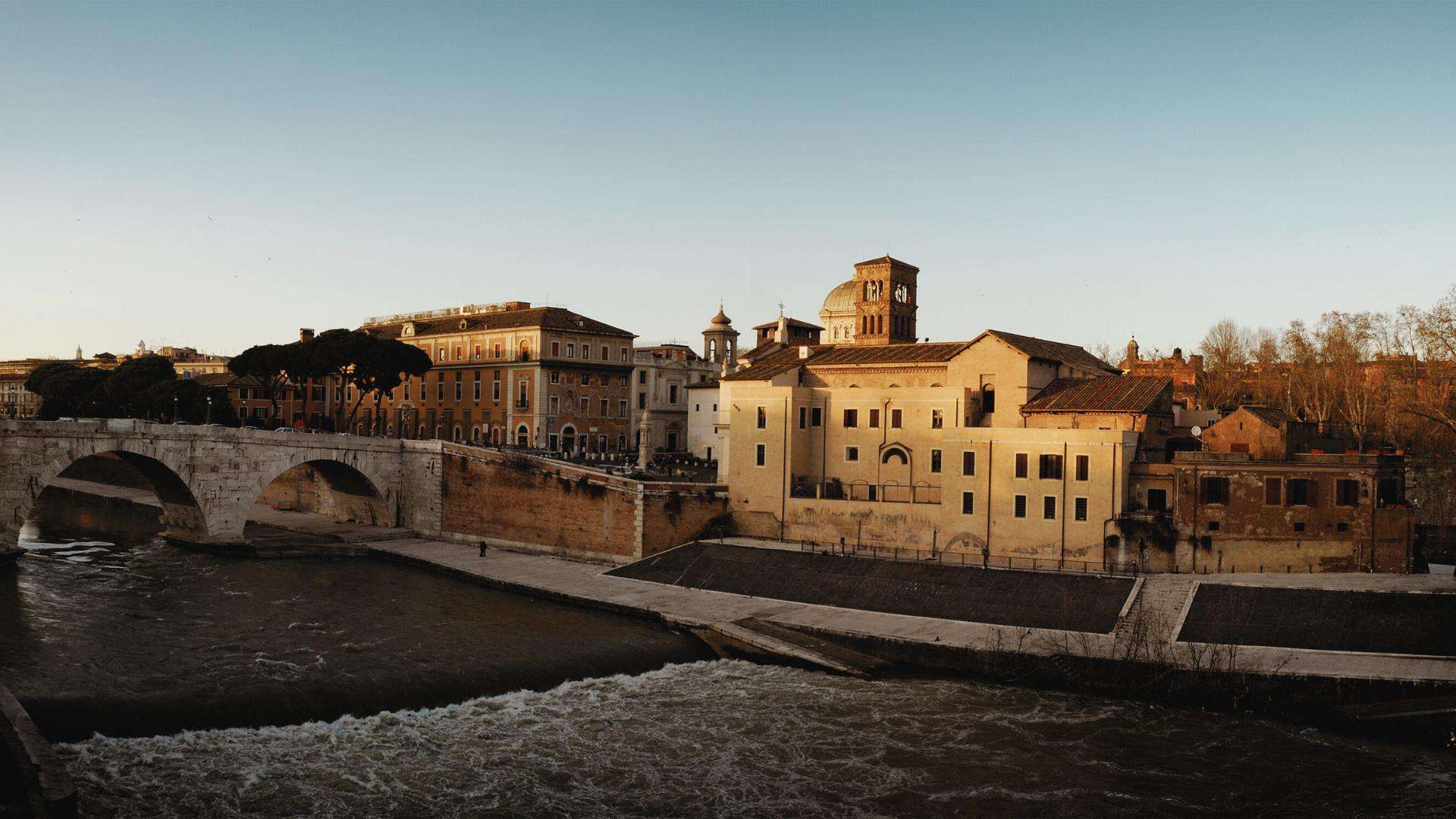

Rome – In the heart of this metropolis lies an island where the sick have been treated for more than two thousand years. The Isola Tiberina, Rome’s only island in the Tiber, has no admission fee and is about 300 meters long and about 90 meters wide. You can reach it on foot via two ancient bridges: the Ponte Fabricio, built in 62 B.C., and the Ponte Cestio, which dates back to 46 B.C.
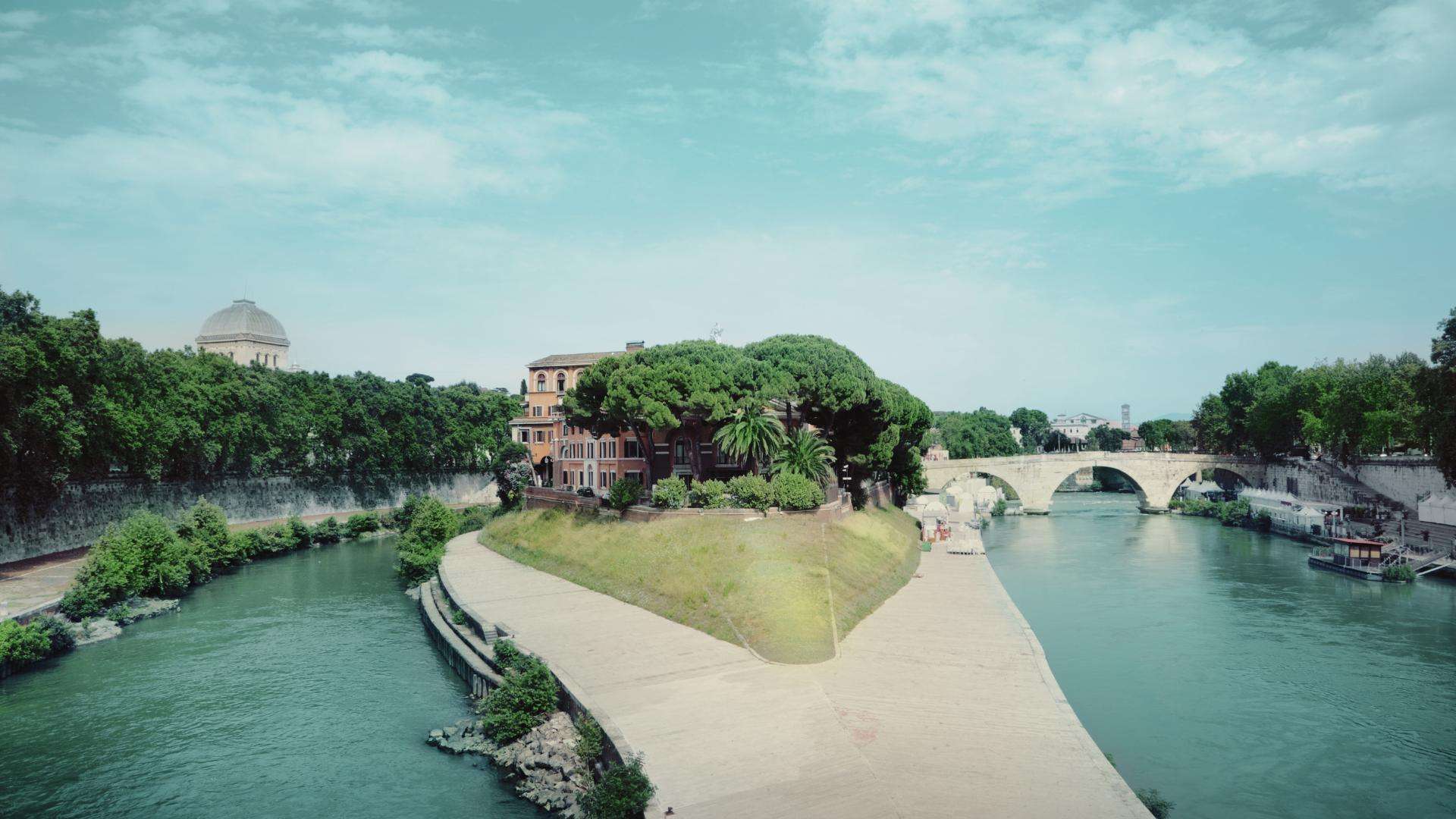
Within these few hundred meters, you’ll find a basilica dating back to 998, a hospital that has been in operation since 1584, and a medieval defensive tower. And the embankments are built in such a way that, when viewed from above, the island looks like a ship. This post tells you what you’ll see there, when the basilica is open, how to get there, and what time of day is best for the walk.
Tiber Island in Rome by the Numbers
The island is part of two rioni: Its western end faces Trastevere, with the eastern part bordering the former Jewish ghetto. Everything you need is within a five-minute walk.
As of September 2026 · Information provided by Basilica San Bartolomeo all’Isola, Turismo Roma, and ATAC.
- Everyone who explores Rome on foot
- Antiquity enthusiasts: two Roman bridges in their original condition
- Photographers in the late afternoon
- a quiet stopover between the Ghetto and Trastevere
- If you're looking for a museum with a guided tour
- For those who want to reach the water without steps: stairs lead down to the waterfront
- Summer evenings, when you want some peace and quiet

How much does it cost to visit Tiber Island?
Nothing. The island is public urban space, both bridges are pedestrian walkways, and admission to the Basilica of San Bartolomeo all’Isola is free. The most you’ll spend here is on an espresso in the piazza or on the public transit ticket you used to get here.
That's exactly what makes the island one of the few places in the heart of Rome where you can show up without a time slot, without waiting in line, and without a reservation. Anyone who otherwise spends their days in Rome with Tickets for the major attractions Anyone who's used to a fast pace will appreciate that.
Admission and Tickets for Attractions Around the Tiber Island
| Offer | Price |
|---|---|
| Access to the island and both bridges | free |
| Basilica of St. Bartholomew on the Island | free |
| Memorial to the New Martyrs | available on Saturdays |
| Guided Tour of the Basilica | upon request |
| Along the Tiber: Rome on the Riverbank | free |
| ATAC Single-Ride Ticket (BIT), 100 minutes | 1,50 € |
| ATAC Rome 24H | 8,50 € |
| ATAC Roma 48H | 15,00 € |
| ATAC Roma 72H | 22,00 € |
| ATAC CIS, seven days | 29,00 € |
As of September 2026 · Information provided by Basilica San Bartolomeo all’Isola, Turismo Roma, and ATAC.

Trastevere in Rome: 7 Highlights & Honest Tips
Trastevere in Rome: 7 highlights from Santa Maria in Trastevere to Villa Farnesina, plus prices, how to get there, dining, accommodations, and honest tips from the editorial team.
When is the Basilica of San Bartolomeo open?
The basilica is open daily from 9:30 a.m. to 1:30 p.m. and again from 3:30 p.m. to 5:30 p.m.; on Sundays, the morning session ends at 1:00 p.m. There is no day off. The lunch break is the only reliable hurdle of the day, and it falls, of all times, during the hours when most visitors to Rome are on the move between two appointments.
The island itself and both bridges are always open. In the evening, the bridges are lit up, and the Comunità di Sant’Egidio, the Catholic lay community that cares for the basilica, holds its evening prayer there from Monday through Friday at 8:00 p.m. On the first and third Mondays of the month, however, it takes place at Santa Maria in Trastevere instead.
Hours of Operation and Church Services on the Tiber Island
| What | When |
|---|---|
| Island, Ponte Fabricio, Ponte Cestio | around the clock |
| Basilica, Monday through Saturday | 9:30 a.m. to 1:30 p.m. and 3:30 p.m. to 5:30 p.m. |
| Basilica, Sunday | 9:30 a.m. to 1:00 p.m. and 3:30 p.m. to 5:30 p.m. |
| Memorial to the New Martyrs | Saturdays from 9:30 a.m. to 1:30 p.m. and from 3:30 p.m. to 5:30 p.m. |
| Sunday Mass | 11:30 a.m. and 7:00 p.m. |
| Evening Prayer of the Community of Sant’Egidio | Monday through Friday at 8:00 p.m. |
As of September 2026 · Information provided by Basilica San Bartolomeo all’Isola, Turismo Roma, and ATAC.

These are the six places you should see on Tiber Island
You can walk around the island in twenty minutes. If you take an hour, you’ll see much more: a basilica built over an ancient sanctuary, a fountain basin carved from a hollowed-out column, a defensive tower with a girl’s head embedded in the wall, and two bridges that are among the oldest structures in Rome still in use.
1. The Basilica of San Bartolomeo all’Isola
In 998, Emperor Otto III had the church built over the ancient sanctuary, expanding an older structure known as San Salvatore de Insula. It was initially dedicated to Saint Adalbert, the Bishop of Prague who was murdered in 997, whose remains also rest here. Beneath the high altar, the Apostle Bartholomew rests in a sarcophagus made of red porphyry.
In 1557, a flood of the Tiber River damaged the church so severely that it was rebuilt in the 17th century by Orazio Torriani. The bell tower remained; it dates from the 12th century and is the oldest visible part of the complex.
2. The marble fountain in the crossing
In front of the altar steps stands a puteal, a circular well rim carved from a hollowed-out ancient column. It follows the tradition of the healing spring that was part of the Temple of Asclepius and is the only place in the church where the connection between ancient worship and Christian architecture is palpable. Excavations in 2006 and 2007 uncovered foundations in the area of the sanctuary.
3. The Memorial to the New Martyrs
The basilica also serves as a memorial to the martyrs of the 20th and 21st centuries. Six side chapels are organized by world region and display personal belongings of people who were killed because of their faith. The memorial is open on Saturdays during the church’s regular hours; at other times, visits are by appointment only.

4. The Torre dei Caetani
The brick tower at the eastern end of the island once guarded the Ponte Fabricio. It was likely built by the Pierleoni family in the 12th century; it later passed to the Savelli family and, from the 14th century onward, to the Caetani family, from whom it takes its name. Its second name is Torre della Pulzella, or “Tower of the Maiden,” after a small female marble head embedded in the masonry. The head is Roman, while the story of the imprisoned noble maiden is much more recent.
5. The Ponte Fabricio
It is the best-preserved Roman bridge in the city and was built in 62 B.C. by Lucius Fabricius, who was then the curator viarum—that is, the official in charge of road construction. Four inscriptions in giant letters on the arch spandrels still bear his name today. Two flat arches rest on a central pier, which contains a small relief arch to allow floodwaters to pass through.
The common name Ponte dei Quattro Capi, or "Bridge of the Four Heads," comes from two marble herms, each with four faces, on the balustrade. According to popular legend, these represent four architects whom Pope Sixtus V had beheaded after the work was completed because they had fallen out with one another. The name has been documented since the early 16th century.
6. The Ponte Cestio
The bridge to Trastevere is attributed to Lucius Cestius, who took over the administration of Rome in 46 B.C. In 365 A.D., the emperors Valentinian, Valens, and Gratian rebuilt it as a single large arch flanked by two narrower ones. At the end of the 19th century, it had to make way for the construction of the Tiber embankments: it was completely dismantled and reassembled in 1892 using the original travertine, this time with three large arch openings.

The mysteries of antiquity: the Bocca della Verità in Rome
The Bocca della Verità, also known as the „Mouth of Truth,“ is a fascinating and mysterious relic deeply rooted in Rome’s rich history. The ancient marble slab, which today is located in...
Why the island looks like a ship
In 291 B.C., a plague raged in Rome. The priests consulted the Sibylline Books and sent a delegation to Epidaurus, the main sanctuary of the god of healing, Asclepius. The ship returned with a snake on board—the god’s sacred animal. When the ship reached the island, the snake leaped into the water, swam ashore, and that is exactly where the temple was built.
This story became architecture. The Romans clad the banks with travertine and shaped the island into a ship with a bow and stern; in the center stood an obelisk serving as the mast. From the railing of the Ponte Cestio, you can still see the ship tapering toward the south today.
The second legend is older and more political: After the overthrow of the last king, Lucius Tarquinius Superbus, in 509 B.C., the people threw their grain into the Tiber, and the island is said to have emerged from the resulting mound of sediment. Geologically, the explanation is more prosaic: Beneath the island lies a solid tuff bed, similar to that of the Capitoline Hill, upon which the river’s sand has settled.
The steps at the southern tip
Almost everyone stays up on the square in front of the basilica. Yet at both ends of the bridge, stairs lead down to the riverbank, and from the southern tip, you can see what the island is famous for: the travertine-clad bow, the current splitting as it flows past it, and downstream, the single arch of the Ponte Rotto, the last remnant of the ancient Ponte Emilio.
Late afternoon is the best time to visit. That’s when the sun is setting downstream and the travertine takes on a warm hue. After heavy rain, the paths along the banks are closed, so the only view available is from the railing of the Ponte Cestio.
A hospital that has been in operation since 1584
The ancient sanctuary never became anything else. In 1584, the Brothers of Mercy founded a hospital on the island, which Romans still call Fatebenefratelli today, after the monks’ plea for alms: “Fate bene, fratelli”—“Do good, brothers.” It is fully operational, with an emergency room and a maternity ward. Next door is the Ospedale Israelitico, Rome’s Jewish hospital.
On October 16, 1943, German units combed through the ghetto on the other side of the river. On the island, Jewish men and women were hidden in the hospital. In recognition of this, Roma Capitale honors Brother Maurizio Bialek—who was the house bursar at the time—in the Giardino dei Giusti dell’Umanità, the city’s Garden of the Righteous: He helped during and after the raid and had a radio transmitter installed in the basement for the Resistance.
You wouldn't notice them unless you were looking for them. That's exactly why it's worth taking a detour across the Ponte Fabricio into the Ghetto, where the Stolpersteine are embedded in the pavement and the Bocca della Verità just a few minutes downstream.

What Happens on the Shore When It Gets Warm
From June through August, the riverside paths on both sides of the island are transformed into a street fair. In 2026, “Lungo il Tevere Roma” ran from June 6 to August 30 between Ponte Sublicio and Ponte Sisto, featuring stalls, concerts, and readings along the Lungotevere Ripa, degli Anguillara, and Raffaello Sanzio. Admission is free.
In addition, there’s the Isola del Cinema summer movie theater, which has been a fixture on the island since the 1990s and sets up an open-air venue in the piazza in front of the basilica. The showtimes change every year; they’re posted on isoladelcinema.com starting in early summer. If you’re visiting in the evenings in July or August, be prepared for the fact that the island is anything but quiet at that time.

How do you get to Tiber Island?
On foot, in almost all cases. The island is located between the Rione Trastevere and the former Ghetto; you can reach both from the historic center with a short walk. From Campo de’ Fiori, it’s about a ten-minute walk along Via Arenula; from Santa Maria in Trastevere, it takes about the same amount of time.
On public transit, Line 8 will take you closest to the bridge. It runs from Casaletto along Viale Trastevere and Via Arenula to Piazza Venezia, and from either direction it’s just a few minutes’ walk to the bridge. Important for 2026: Line 8 is normally a tram, but since August 3, it has been operated by buses throughout the entire network due to track renovations. The buses stop at the same stops as the tram.
A single-ride BIT ticket costs €1.50 and is valid for 100 minutes; the Roma 24H day pass costs €8.50. You can’t drive onto the island: both bridges are pedestrian-only, and there are access restrictions in the surrounding area. The ZTL Centro Storico, the restricted traffic zone in the historic center, is in effect Monday through Friday from 6:30 a.m. to 6:00 p.m. and Saturday from 2:00 p.m. to 6:00 p.m., and the ZTL Trastevere is in effect Monday through Saturday from 6:30 a.m. to 10:00 a.m. and Wednesday through Saturday nights from 9:30 p.m. to 3:00 a.m.
Address and Contact Information on the Tiber Island
If you'd like a guided tour of the basilica, please register in advance by email. There is no ticket office on the island.
| Information | Value |
|---|---|
| Address | Piazza di San Bartolomeo all’Isola 22, 00186 Rome |
| Phone | +39 06 6877973 |
| Guided tours | [email protected] (by appointment only) |
| Website | sanbartolomeo.org |
| Location | between the Rione Trastevere and the Rione Sant’Angelo |
As of September 2026 · Information provided by Basilica San Bartolomeo all’Isola, Turismo Roma, and ATAC.
When is the best time to visit?
In the late afternoon. That’s when the light falls downstream onto the ochre-colored facades, the bridges cast long shadows on the water, and the tour groups are already on their way back toward Trastevere. Early morning is the second-best option, because the basilica is open and almost empty then.
Spring and fall are the most pleasant times of the year: the plane trees along the banks are in full leaf, and the heat doesn’t build up between the walls. In midsummer, the island comes alive with the riverside festival in the evenings; in winter, the Tiber can rise.

What You Should Plan Before Your Visit
1. The island is small. If you plan on spending half a day here, you'll get bored. An hour is enough to see both bridges, the basilica, and the riverbank, and after that, you can be in Trastevere or the Ghetto in five minutes, where you can spend the rest of the afternoon.
2. The basilica has a long lunch break. Between 1:30 p.m. and 3:30 p.m., you'll find yourself standing in front of a locked door; on Sundays, this starts as early as 1:00 p.m. Plan your church visit for the morning and your tour of the grounds for the afternoon.
3. The only way down to the riverbank is by stairs. This means that not everyone can enjoy the best view of the ship’s shape. From the railing of the Ponte Cestio, you can also see the taper—smoothly and without any detours.
4. During a flood, everything downstairs remains closed. Roma Capitale regularly closes the riverside paths along the Tiber when the water level rises, most recently in January 2026. This happens mainly in the winter, but can occur during any rainy period.
After heavy rain, the paths along the riverbank below the island are closed. You can see from both bridges in ten seconds whether they're open or not: If the stairs are blocked off, you'll have to settle for the view from above.


The 10 Most Beautiful Sights in Rome, the Eternal City
The Colosseum, the Pantheon, the Trevi Fountain, and the Vatican: the 10 most beautiful sights in Rome, with verified prices and opening hours for 2026.
Our Thoughts on Tiber Island in Rome
The Tiber Island isn’t a sight worth setting aside a whole day for, but rather a place where two thousand years of the city’s history are condensed into a thirty-meter-wide strip: a sanctuary that became a hospital and has remained one ever since, two bridges that have been crossed since the time of the Republic, and a riverbank that the Romans built into the shape of a ship.
Plan this as a connecting route: from the Ghetto across the Ponte Fabricio, an hour on the island, then across the Ponte Cestio to Trastevere for dinner. If you're still planning your trip to Rome, our overview of the the most beautiful sights in Rome when sorting, and the Campo de’ Fiori is on the same path.
FAQ - Frequently Asked Questions About Tiber Island in Rome
Prices, hours of operation, and schedules are subject to change. Check the official websites for the latest information before your trip.
Sources and Further Information
- Turismo Roma, Tiber Island (accessed in September 2026)
- Turismo Roma, Ponte Fabricio (accessed in September 2026)
- Turismo Roma, Ponte Cestio (accessed in September 2026)
- Turismo Roma, Church of San Bartolomeo all’Isola (accessed in September 2026)
- Turismo Roma: Stories and Legends of the Tower on the Island (accessed in September 2026)
- Capitoline Superintendency, Ponte Fabricio (accessed in September 2026)
- Capitoline Superintendency, Ponte Cestio (accessed in September 2026)
- Basilica of St. Bartholomew on the Island, Hours and Information (accessed in September 2026)
- Basilica of St. Bartholomew on the Island, Archaeological Information (accessed in September 2026)
- Turismo Roma, Along the Tiber, Rome 2026 (accessed in September 2026)
- ATAC, Tickets and Passes (accessed in September 2026)
- ATAC, Tram Network: Service Status (accessed in September 2026)
- Rome Public Transportation, ZTL Schedules (accessed in September 2026)
- Roma Capitale, Garden of the Righteous Among the Nations (accessed in September 2026)